@ai-sdk/voyage 2.0.60 Released: Dependency Update and Versioning Strategy Explained

Vercel's @ai-sdk/voyage releases 2.0.60 patch, syncing only the shared utility layer dependency—a zero-risk maintenance update.
@ai-sdk/voyage releases patch version 2.0.60, with the sole change being a sync of upstream dependency @ai-sdk/provider-utils to 5.0.60, auto-published by github-actions with a GPG signature and no feature or bug fixes. The article notes that provider-utils, as the shared utility layer handling request wrapping, streaming, and error mapping for all provider packages, may indirectly benefit all dependents through patch-level adjustments. This reflects Vercel AI SDK's strategy of managing the monorepo with changesets and versioning each provider independently. Developers can upgrade directly to ^2.0.60 within what the lockfile allows—a zero-risk operation—but must distinguish the npm package from Voyage AI's remote model services, as dependency updates don't affect model capabilities or billing.
The AI SDK ecosystem has another minor version iteration. Vercel's @ai-sdk/voyage package has released version 2.0.60, a typical patch update whose core change is an upgrade to its @ai-sdk/provider-utils dependency.
What Actually Changed in This Update
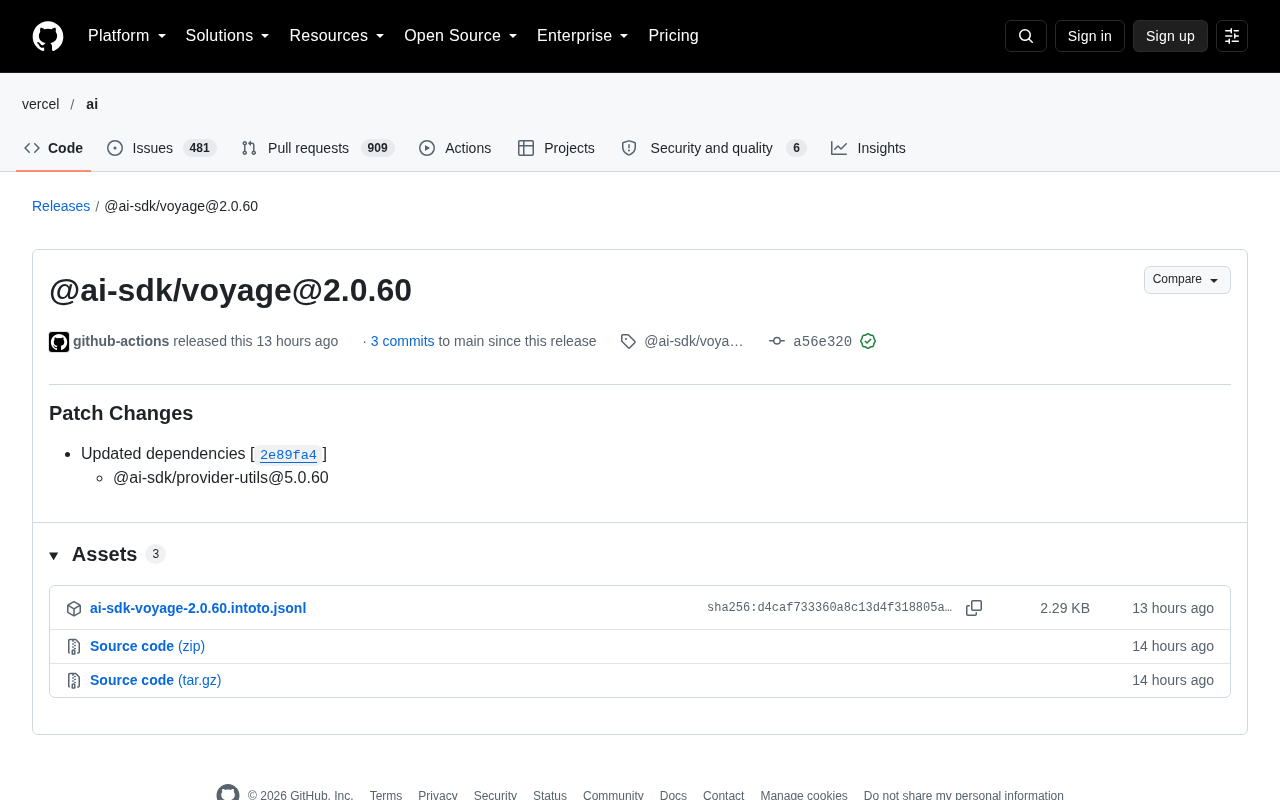
Looking at the GitHub Releases record, the changelog for 2.0.60 is quite concise—just one line:
Patch Changes: Updated dependencies [2e89fa4] — @ai-sdk/provider-utils@5.0.60
In other words, this version introduces no new features and fixes no bugs within @ai-sdk/voyage itself; the change comes entirely from the upstream dependency @ai-sdk/provider-utils being synced to 5.0.60. The commit was automatically published by the github-actions bot on October 15 and carries a GitHub verified signature (GPG key ID: B5690EEEBB952194), indicating this follows the standard CI auto-release process rather than a manual hand-edit.
For developers using Voyage AI embedding models through the AI SDK, this kind of update typically means subtle improvements to underlying request construction, error handling, or type definitions—but it won't affect existing usage patterns.
About changesets and automated releases
Changesets is a version management tool used by Vercel AI SDK and many other large monorepos. It requires developers to submit a metadata file (a changeset) alongside their PR, describing the change, marking it as patch, minor, or major, and providing a summary. After merging to the main branch, CI uses these changesets to automatically calculate the version number each package should release, generate CHANGELOG entries, and publish to npm. The "Patch Changes: Updated dependencies" text in this article is exactly this kind of auto-generated standard copy. Combined with GPG-signed git commits, this whole process can be independently verified by the community, preventing version content from being tampered with, and giving traceability even to releases like 2.0.60 that contain only a single dependency note.
Why Even a Minor Version Is Worth Noticing
On its own, a single dependency update may seem trivial. But placed within the AI SDK architecture, the significance is different.
@ai-sdk/provider-utils is the shared utility layer for all provider packages, handling request wrapping, streaming responses, error mapping, and other cross-cutting logic. Once this layer has behavioral adjustments, all providers that depend on it (including voyage, openai, anthropic, etc.) benefit or are affected in sync. Therefore, even if @ai-sdk/voyage itself has zero code changes, as long as provider-utils has a patch, it may semantically deliver more stable request retries or more accurate type hints.
This kind of "passive upgrade" also reflects the Vercel AI SDK versioning strategy: managing the monorepo with changesets, letting each provider package version independently, while ensuring ecosystem consistency through dependency locking. For users, upgrading to 2.0.60 is essentially zero-risk and recommended within what the lockfile allows.
What does @ai-sdk/provider-utils actually do?
@ai-sdk/provider-utils is the infrastructure package in the AI SDK ecosystem. It provides a set of common capabilities to all providers: constructing HTTP requests that comply with provider specifications, parsing streaming (SSE) response data chunks, mapping vendor-specific error codes into standardized error types, and sharing Zod validation schemas and TypeScript type definitions. It contains no vendor-specific logic itself; provider packages like openai, anthropic, and voyage all include it as a dependency. Precisely because of this, each of its patches can silently alter request retry strategies, streaming parsing boundaries, or type signatures without changing any provider package code. This is why, even with zero changes to @ai-sdk/voyage itself, syncing up provider-utils still has real significance—understanding this dependency relationship is what lets you grasp the true meaning behind the version numbers of AI SDK packages.
How Developers Should Handle It
If you've pinned the @ai-sdk/voyage version in your project, you can loosen it to ^2.0.60 in package.json or run your package manager's upgrade command. Since this is a patch-level change, it won't break API compatibility.
It's worth noting that Voyage AI's own model services (such as the voyage-3 series) are separate from this npm package—the former is a remote API, while the latter is just the SDK adapter layer that calls it. Dependency updates won't change model capabilities or billing; what truly affects output quality is still the model parameter and input content you specify in your requests.
Why patch version numbers are usually safe
Under Semantic Versioning (SemVer), a version number takes the form MAJOR.MINOR.PATCH. An increment in the PATCH position promises only backward-compatible bug fixes and internal implementation adjustments, without introducing breaking API changes. So the caret (^) in ^2.0.60 allows automatically fetching versions within the 2.x.x range that are no lower than 2.0.60, without jumping to 3.0.0. This explains the basis for the "zero-risk" judgment in this article. However, note that behavioral changes from dependency upgrades (such as retry counts or error classification) don't break the API, but can still affect runtime behavior in edge cases. For production environments, it's recommended to run your existing test suite after upgrading rather than relying entirely on version number promises.
Summary
@ai-sdk/voyage@2.0.60 is a quiet maintenance release with no fanfare, but it reflects the ongoing rhythm of infrastructure refinement in the AI SDK ecosystem. For production projects that prioritize stability, these small, rapid updates deserve a place in your regular dependency maintenance workflow.
One-line Summary
Vercel @ai-sdk/voyage releases 2.0.60 patch, syncing only the shared utility layer dependency—a zero-risk maintenance update.
Paragraph Summary
@ai-sdk/voyage releases patch version 2.0.60, with the sole change being a sync of the upstream dependency @ai-sdk/provider-utils to 5.0.60, auto-published by github-actions with a GPG signature and no feature or bug fixes. The article notes that provider-utils, as the shared utility layer for all provider packages handling request wrapping, streaming responses, and error mapping, may indirectly benefit all dependents through its patch-level adjustments. This reflects Vercel AI SDK's strategy of managing the monorepo with changesets and versioning each provider independently. Developers can upgrade directly to ^2.0.60 within what the lockfile allows—a zero-risk operation—but must distinguish the npm package from Voyage AI's remote model services; dependency updates don't affect model capabilities or billing.
Related articles

Chain of Thought Isn't Just for AI: How Humans Can Use CoT to Improve Thinking Quality
Chain of Thought isn't just a prompt trick for large models. Starting from a Hacker News discussion, this article analyzes why CoT works for human thinking too, breaks down actionable ways to transfer it, and highlights the key differences between human CoT and machine CoT.
Cloudflare Teams Up with OpenAI: Closi…
Cloudflare Teams Up with OpenAI: Closing the Loop from Vulnerability Discovery to Defense with AI
Cloudflare uses OpenAI Daybreak to investigate security vulnerabilities and generate reviewable remediation plans, while developers use Codex to boost coding efficiency and quality.

Orca Multi-Agent Orchestration in Practice: A Guide to Parallel Collaboration with Claude and Codex
Orca is Stable AI's free open-source agent workbench supporting 34 agents like Claude Code and Codex in parallel. Learn its Git worktree isolation, multi-model orchestration, and mobile management.