AI SDK Voyage 2.0.68 Released: Documentation Improvements and Dependency Updates

@ai-sdk/voyage releases patch 2.0.68, only unifying docs and syncing foundation dependencies, with no functional changes.
The `@ai-sdk/voyage` package in Vercel's AI SDK ecosystem has released version 2.0.68, a patch-level update with no functional changes. The changes focus on unifying README.md documentation format and eliminating duplicate content, and synchronizing foundation dependencies `@ai-sdk/provider` to 4.0.34 and `@ai-sdk/provider-utils` to 5.0.68 within the monorepo. With no API breaking changes or new configuration options, existing code is compatible without modification, and upgrade risk is very low. The article recommends that projects pinning dependency versions upgrade at their usual pace; projects using range declarations may have already included it automatically, and running embedding-related tests after upgrading is sufficient. Overall, this is routine maintenance under the AI SDK provider packages' high-frequency, small-step release strategy.
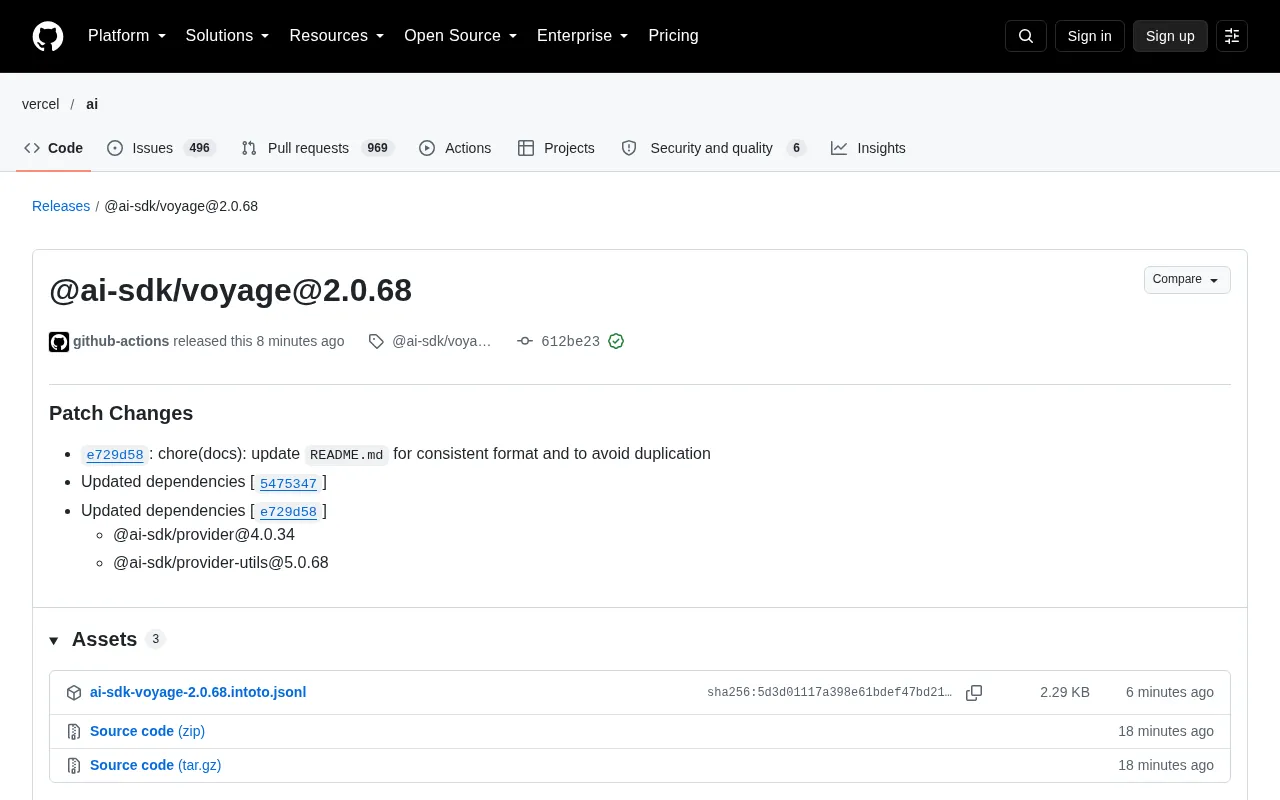
The AI SDK ecosystem under Vercel has received a minor version iteration. @ai-sdk/voyage has released version 2.0.68, which focuses on documentation maintenance and dependency synchronization without introducing any functional changes. For developers using Voyage AI embedding models with the AI SDK, this is a routine patch upgrade.
Version Update Overview
According to the GitHub release record, 2.0.68 is a patch-level update, with core changes concentrated in two areas.
Documentation Format Unification and Deduplication
Commit e729d58 adjusts README.md to unify the documentation format and eliminate duplicate content. While such maintenance changes do not directly affect runtime behavior, they play a practical role in reducing the learning curve for new users and keeping documentation style consistent across multiple packages. The AI SDK uses a monorepo structure to manage a large number of provider packages, and documentation consistency directly impacts the experience of developers switching between different model providers.
Dependency Version Synchronization
This release synchronizes two internal dependencies: @ai-sdk/provider is bumped to 4.0.34, and @ai-sdk/provider-utils is bumped to 5.0.68. These two packages form the shared foundation of the AI SDK provider system—the former defines the provider interface specification, while the latter provides common utility functions. Dependency updates typically mean that minor upstream fixes or type definition adjustments are passed down.
Voyage AI and Embedding Models: Voyage AI is a model provider focused on retrieval and embedding scenarios, and its voyage series of embedding models are widely used in tasks such as semantic search, RAG, and clustering. @ai-sdk/voyage is the official adapter package provided by the AI SDK for this provider. Its role is to wrap Voyage's HTTP API into a provider that conforms to the AI SDK's unified interface, allowing developers to invoke it using standard methods such as embed without having to handle request formats and authentication details directly. Understanding this helps clarify the nature of this update: the adapter package's responsibility is protocol translation and parameter mapping, so maintenance changes at the documentation and dependency level do not change the model's actual encoding capability. What truly affects retrieval performance is the model version, vector dimensions, and whether invocation parameters such as inputType (e.g., document/query) are used.
Division of Labor Between provider and provider-utils: In the AI SDK architecture, @ai-sdk/provider is the source of interface specifications, defining abstract contracts such as LanguageModelV1 and EmbeddingModelV1, as well as shared types for errors and usage; @ai-sdk/provider-utils is the toolbox reused when implementing these contracts, including postJson request wrapping, response parsing, and streaming assistance. Vendor adapter packages depend on both, so minor version advances in the foundation layer are passively propagated to all provider packages. This dependency topology of "centralized interface layer, distributed implementation layer" means that patch upgrades of foundation packages usually involve only type fixes or internal implementation details, but type incompatibilities causing build errors can still occur—which is why type checks and tests need to be rerun after upgrading.
Practical Impact on Developers
Judging from the nature of the changes, the risk of upgrading to 2.0.68 is very low. There are no API breaking changes and no new configuration options, so existing code is compatible without modification.
For projects that pin dependency versions, you can upgrade at your usual pace; for projects using ^ or ~ range declarations, this update may already have been included automatically. It is recommended to run your existing embedding-related tests after upgrading to confirm that the Voyage model invocation chain works properly, especially in scenarios involving custom provider configurations.
Ecosystem Perspective: A Fast, Small-Step Release Cadence
The AI SDK's provider packages adopt a high-frequency, small-version release strategy. Individual changes are often small, but accumulated they keep documentation and dependencies healthy. The long-term value of this model for the ecosystem is that foundation-layer fixes permeate continuously rather than being held back for a single major release, reducing troubleshooting costs during upgrades.
For developers following the AI SDK, rather than tracking changelogs version by version, it is more worthwhile to focus on the stability of the provider interface layer and capability updates of the Voyage models themselves—those are the key variables affecting application performance.
This article is based on information from the GitHub Releases page; update details are subject to the official release records.
Monorepo and Semantic Versioning: The AI SDK repository is organized as a monorepo, where all provider packages share the same build scripts, test configurations, and documentation standards—this is precisely the precondition for changes like README format unification to deliver value across packages. Releases follow semantic versioning conventions: the patch position (e.g., 2.0.68) indicates backward-compatible fixes and maintenance, the minor position represents new capabilities, and only the major position allows breaking changes. Therefore, a preliminary judgment of upgrade risk can be made simply from the version number. It is worth noting that under a high-frequency release cadence, dependency range declarations (^, ~, or exact pinning) significantly affect the version a project actually receives; projects that pin versions need to upgrade proactively, while projects using range declarations should watch lockfile changes to avoid unintentionally introducing unverified foundation-layer updates.
One-line Summary
@ai-sdk/voyage releases patch 2.0.68, only unifying documentation and synchronizing foundation dependencies, with no functional changes.
Paragraph Summary
The @ai-sdk/voyage package in Vercel's AI SDK ecosystem has released version 2.0.68, a patch-level update that introduces no functional changes. The changes focus on two points: first, unifying the README.md documentation format and eliminating duplicate content; second, synchronizing the foundation dependencies within the monorepo—@ai-sdk/provider to 4.0.34 and @ai-sdk/provider-utils to 5.0.68. With no API breaking changes or new configuration options, existing code is compatible without modification, and upgrade risk is very low. The article recommends that projects pinning dependency versions upgrade at their usual pace; projects using range declarations may have already included it automatically, and running embedding-related tests after upgrading is sufficient. Overall, this is a routine maintenance release under the AI SDK provider packages' high-frequency, small-step release strategy.
Related articles

Fifty Years Studying Power: Robert Caro's Writing and Insights on Power
Robert Caro reflects on 50 years studying power: Lyndon Johnson's persuasion and leverage, Robert Moses's transformation from idealist to ruthless builder, the dilemmas of large-scale construction, and his methods of compressing themes and solitary focus in biography writing.

Can a $20,000 Robot Do Your Chores? The Test Results Are Surprising
A YouTube test video shows how a $20,000 robot responds to commands like washing dishes, turning off lights, taking out trash, and feeding the dog. This article analyzes its real capability boundaries, the state of voice interaction technology, and how far household robots are from mainstream adoption.
The Complete Guide to Running AI Models Locally: Inference Engines and Tool Stack Explained
A systematic breakdown of the complete local LLM tool stack: from PyTorch and GGML compute libraries to llama.cpp, vLLM, SGLang inference engines and Ollama, LM Studio wrapper layers, with benchmark data on performance differences and selection logic.