AI SDK Voyage 2.0.72 Update: Async Credential Support and Auth Refactor
@ai-sdk/voyage 2.0.72 patch enables async credential resolution evaluated per request, maintaining backward compatibility.
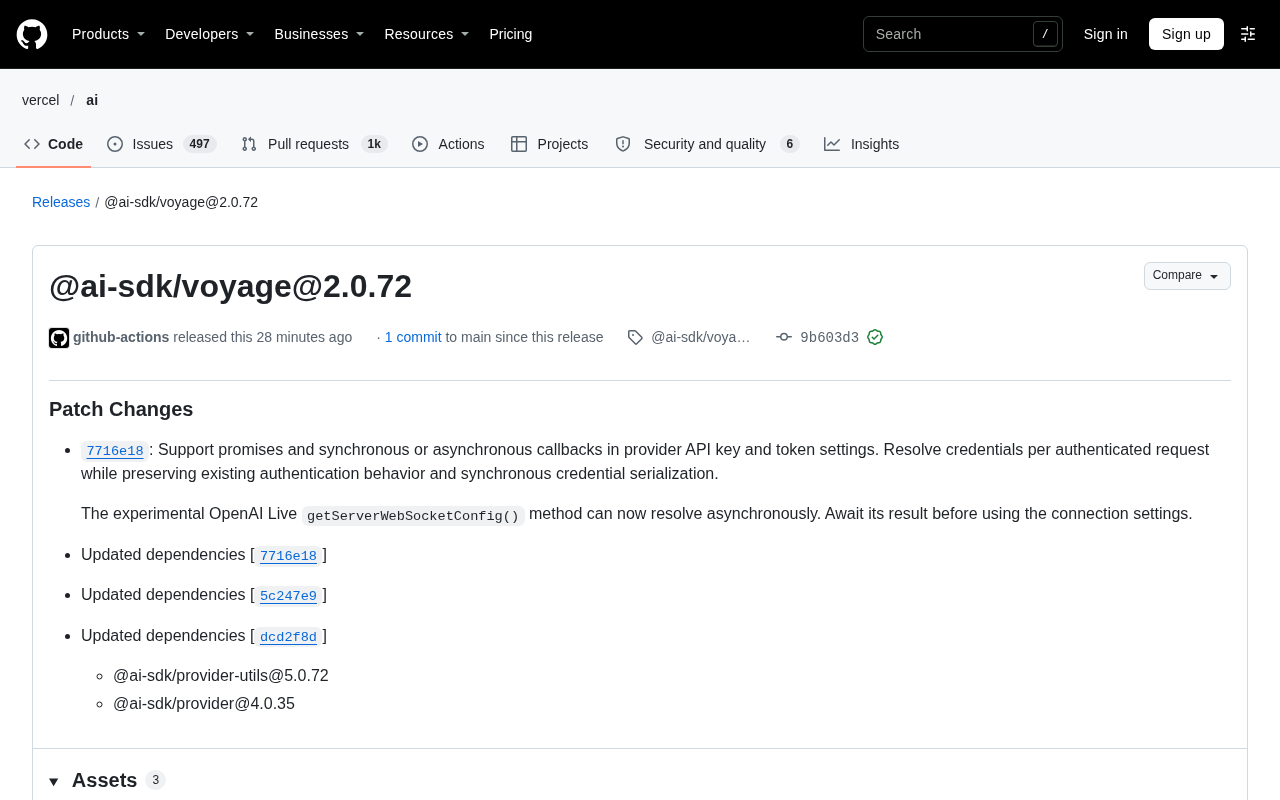
`@ai-sdk/voyage@2.0.72` is a patch update focused on authentication mechanisms. Provider API key and token settings now support Promises and sync/async callbacks, with credentials resolved on each authenticated request rather than at initialization, while preserving existing behavior and sync credential serialization. The same commit enables async returns for experimental OpenAI Live `getServerWebSocketConfig()`, requiring await before use. Dependencies `@ai-sdk/provider-utils@5.0.72` and `@ai-sdk/provider@4.0.35` are also upgraded. Projects using static keys are largely unaffected, but multi-tenant, key-rotation, and Live WebSocket projects should carefully check async logic.
Version iterations in the AI SDK ecosystem often advance quietly as "Patch Changes," but the authentication mechanism adjustments involved can directly affect how developers integrate in production environments. The core changes in this patch release of @ai-sdk/voyage@2.0.72 center on credential resolution and async support.
Credential Settings Now Support Promises and Async Callbacks
According to the GitHub release notes, this update (commit 7716e18) adds support for Promises as well as sync or async callback functions in the provider's API key and token settings. This means developers are no longer limited to passing in static strings—they can wrap credential retrieval logic in functions that are evaluated dynamically on each authenticated request.
The real value of this change lies in making credentials dynamic. In multi-tenant applications or scenarios requiring key rotation, writing credentials as async functions that pull from a secret management service is both safer and more flexible than hardcoding. The release notes also emphasize that the change "resolves credentials on each authenticated request" and "preserves existing authentication behavior and synchronous credential serialization," indicating this is a compatibility-first extension rather than a breaking refactor.
The Role of Provider and Credential Configuration
In the AI SDK's abstraction layer, a provider refers to the adapter wrapping a specific model service (such as Voyage or OpenAI). It translates the unified calling interface into that service's HTTP requests and handles transport-layer details like authentication. Credential configuration is typically exposed as API key, token, and similar fields in the provider's constructor arguments or factory function, injected into request headers by the SDK when making requests. Understanding this helps define the scope of the change: the modification occurs within the provider's internal credential resolution step, not in the caller's business code interface, so the impact is concentrated on the authentication path rather than inference calls themselves.
Per-Request Credential Resolution Instead of One-Time Loading at Initialization
It's worth noting the phrase "per authenticated request." Credentials are no longer fixed at client initialization but resolved on each request that requires authentication. For applications using short-lived tokens or needing per-user key separation, this behavioral change provides finer-grained control. Combined with the note about "preserving synchronous credential serialization," it's reasonable to infer that the sync path remains available—async is merely a new option—and existing code should theoretically continue to work without modification.
Common Patterns for Short-Lived Tokens and Key Rotation
Cloud providers and internal secret management services commonly issue temporary credentials with expiration times—for example, short-lived tokens obtained through STS, or access tokens from OAuth flows, which often have validity periods of only tens of minutes. If the client caches a static key at initialization, long-running services will fail en masse after the token expires; resolving credentials per request allows checking validity and refreshing as needed before each call. Note that async resolution means each request may incur additional credential-fetching overhead. In practice, caching and expiration checks within the function are usually needed to avoid high-frequency calls to the secret management service.
Experimental OpenAI Live WebSocket Config Can Resolve Asynchronously
The same commit also touches the experimental OpenAI Live feature: the getServerWebSocketConfig() method can now return results asynchronously. The release notes explicitly remind users to await its result before using connection settings. Since this feature is itself marked experimental, the API shape may still be changing. Developers using real-time connection capabilities in their projects should verify that call chains properly handle the Promise return value—otherwise they may receive an unresolved object when fetching connection config.
Why WebSocket Connection Config Needs Async
WebSocket handshakes depend on connection parameters such as the URL, request headers (often containing auth info), and subprotocols. These parameters may need to be fetched dynamically in real-time voice or streaming sessions—for example, access addresses with time-limited signatures or per-session endpoints. Designing config retrieval to support async returns lets callers complete a remote query or token exchange before establishing a connection. The trade-off is an additional async boundary in the call chain that must be awaited: any code that directly reads config fields before the handshake will receive an unresolved Promise object, manifesting as missing parameters or auth failures during connection.
Synchronized Dependency Upgrades
This release also updates several dependencies, including @ai-sdk/provider-utils@5.0.72 and @ai-sdk/provider@4.0.35 (corresponding to commits 5c247e9 and dcd2f8d respectively). For projects managing AI SDK-related packages in a monorepo, it's advisable to verify the actually installed versions of these packages to avoid type or runtime issues caused by mismatched provider interface versions.
Responsibilities of @ai-sdk/provider-utils and @ai-sdk/provider
These two packages form the AI SDK's provider foundation layer: @ai-sdk/provider defines the types and interface contracts shared by all providers, while @ai-sdk/provider-utils provides utility functions reused when implementing providers—such as request construction, streaming response parsing, and credential handling helpers. Since upper-layer provider packages depend on specific versions of these, if different sub-packages in a monorepo lock inconsistent versions of the foundation layer, a project may load multiple copies of type definitions or utility implementations. Typical symptoms include compilation errors from mismatched interface types or runtime behavior that doesn't match documentation.
Who Should Pay Attention to This Update
If your project only uses static API keys to call Voyage capabilities, this patch is essentially invisible to you. The scenarios that truly warrant attention are two: first, multi-tenant or key-rotation architectures that need dynamic or async credential retrieval; second, projects using the experimental Live WebSocket capability. The former can take this opportunity to migrate credential management from hardcoding to functional configuration, while the latter must verify their await logic. Though the patch version is small, changes to the authentication path often have wide-reaching effects—running authentication-related integration tests after upgrading is a sound practice.
One-line Summary
@ai-sdk/voyage 2.0.72 patch enables async credential resolution evaluated per request, maintaining backward compatibility.
Paragraph Summary
@ai-sdk/voyage@2.0.72 is a patch update centered on authentication mechanisms. The main change is that the provider's API key and token settings now support Promises and sync/async callback functions, with credentials resolved on each authenticated request rather than loaded once at initialization, while preserving existing authentication behavior and synchronous credential serialization—a compatibility-first extension. The same commit also enables async returns for the experimental OpenAI Live getServerWebSocketConfig(), which must be awaited before use. The release also upgrades @ai-sdk/provider-utils@5.0.72 and @ai-sdk/provider@4.0.35. Projects using static keys will see almost no impact, but multi-tenant, key-rotation, and Live WebSocket projects should carefully verify async logic.
Related articles

Anthropic IPO Explained: Fuel for the AI Boom or the Spark for a Bubble?
Anthropic files for an IPO under ticker ANT. Breaking down the prospectus: 80% of revenue from usage-based pricing, $72B of an $80.7B net loss being non-cash charges, 900% net revenue retention, and how past IPOs like SpaceX performed on day one and over three years — answering the AI bubble question.

Will AI Kill the Research Paper? Mathematicians Offer a New Answer
Mathematicians on the Lex Fridman podcast discuss whether AI will kill research papers—from journal review pressure to Lean formal verification, GitHub open source fatigue to Mathlib's crowdsourcing model, exploring the evolution of academic contributions and the future of mathematical knowledge verification.

Enterprise LLM Development: From RAG to Multi-Agent in Practice
A course breakdown of enterprise LLM application development: from prompt engineering and RAG to multi-agent engineering practice and FDE project delivery, helping developers understand why Agent technology is a key focus for enterprise deployment and learn systematically to avoid detours.