Anthropic IPO Explained: Fuel for the AI Boom or the Spark for a Bubble?

Anthropic files for IPO, with revenue driven by APIs rather than subscriptions and massive losses mostly accounting charges
Anthropic has officially filed for an IPO under the ticker ANT, with the news lifting the S&P 500 and the Philadelphia Semiconductor Index. Based on analysis by investment advisor Robert Reese, this article breaks down the prospectus across four dimensions: IPO mechanics, revenue structure, the truth about costs, and historical references. It notes that retail investors participate at secondary-market prices rather than institutional offer prices; about 80% of the company's revenue comes from usage-based pricing, with roughly 48% completed through competitors' cloud marketplaces; of the $80.7 billion net loss in the first half, about $72 billion is an accounting charge from rising convertible note valuations, with actual operating losses of $693 million. Historical data shows IPOs gain an average of 19% on the first day but trail the broader market by about 21 percentage points over three years — lock-up supply and rigid compute spending are the variables more worth watching.
IPO: You Can't Just Buy In — Process and the Retail Investor Disconnect
Many people's understanding of an IPO stops at the FOMO mentality of "buying a new listing is a guaranteed win," but the actual process is far more sober. The first step is filing the S-1, essentially the company's complete medical chart: revenue, losses, risk factors, and equity structure, all laid bare. The second step is the roadshow, where the company and its underwriting banks pitch to large institutional investors to gauge demand. The third step is pricing, which is typically finalized the night before trading begins.
The key detail: the vast majority of shares sold at the IPO offer price go to large institutions. What ordinary investors buy through their brokerage accounts is the secondary-market price after the stock lists on an exchange. Anthropic hasn't even disclosed its offer price or share count yet — those figures will only be revealed close to listing.
In other words, the "IPO" retail investors participate in and the "IPO" institutions get are essentially two different points in time at two different prices. Understanding this is the only way to stay clear-headed about first-day gains.
The S-1, roadshow, and pricing mechanics
The S-1 is the IPO registration statement required by the U.S. Securities and Exchange Commission (SEC), in which a company must disclose audited financial statements, its business model, risk factors, executive compensation, and equity structure — essentially a full physical examination of the company. After filing, the SEC issues comments, the company goes through multiple rounds of amendments, and only the final effective version can be used for the offering.
The roadshow is where underwriting banks lead management in pitching to large institutional investors. Its core purpose is "bookbuilding" — collecting indicative orders on price and quantity from institutions to gauge the strength of market demand, and then negotiating the final offer price and offering size with the underwriters. Pricing is usually finalized the night before listing, so retail investors often can't see the exact price during the subscription phase.
As for the impression that "buying a new listing is a guaranteed win," it stems from the impressive first-day gains of some hot IPOs in history — but that sample suffers from survivorship bias. There are just as many cases of broken offers or flat opens, and first-day gains are the result of a momentary imbalance between supply and demand in the secondary market, not an indication of long-term returns.
Where Revenue Comes From: API Calls Are the Bulk, Subscriptions Just a Sliver

Anthropic's revenue curve is astonishingly steep. Revenue was $41 million in 2023, $386 million in 2024, and $4.6 billion the following year. In the first six months of this year alone, it hit $16.3 billion, up 1,300% year-over-year.
But the revenue mix may overturn many people's intuitions. About 80% comes from usage-based pricing — enterprises settle based on actual call volume, much like an electricity bill, with the typical scenario being developers integrating Claude into their own applications. Subscription revenue accounts for only about 20%. Additionally, about 48% of revenue is completed through cloud marketplaces operated by Amazon, Google, and Microsoft. That means a large portion of the sales pipeline runs through channels built by competitors.
On customer quality: more than 11,900 customers spend over $100,000 annually, up from 950 a year earlier. Net revenue retention is around 900% — put simply, a customer who spent $1 a year ago now spends about $9. For reference, CNBC cites a median of 108% for public cloud software companies.
Two risk points to watch: the top five customers contribute about a quarter of revenue, so losing one would be a serious blow; and the prospectus doesn't disclose individual subscriber counts, so any numbers circulating in the market need their sources questioned.
The Truth About the Losses: Of an $80.7 Billion Net Loss, $72 Billion Cost No Cash at All
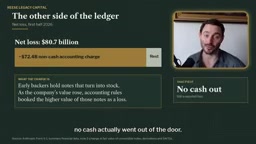
The headline number is easy to scare people with: a net loss of $80.7 billion in the first half. But about $72 billion of that is a non-cash accounting charge — convertible notes held by early investors are marked as losses under accounting rules as the company's valuation rises, with no cash flowing out.
What truly reflects the operating situation is the operating loss: $693 million. Even more telling, in the second quarter the company reported about $1 billion in operating profit.
But the sustainability of that profit is questionable. AI is compute-driven, and Anthropic has already signed long-term compute procurement agreements: roughly $110 billion with Amazon, about $114.5 billion with Google, about $45 billion with Microsoft, and up to about $120 billion with SpaceX. That money must be paid whether the capacity is used or not. The company itself acknowledges that growth rates are expected to slow — and possibly slow significantly.
On equity structure, public shareholders have limited say: the founding team controls 50.1% of voting power, and a special trust is responsible for electing most board members.
Why rising convertible note valuations are recorded as losses
Convertible notes (convertible bonds) are a common tool in early-stage financing: investors put in money as debt first, with an agreement to convert to equity at a later date (or at the next funding round or IPO) at a discount or valuation cap. In accounting, such instruments, if they contain conversion features, typically must be measured at fair value, with changes in fair value recognized in current profit and loss.
When a company's valuation rises rapidly, the conversion value of convertible notes rises accordingly, and the increase in fair value shows up on the books as an "expense" or "loss" — but this portion involves no cash outflow. The company didn't actually pay out that money; it's just the result of accounting measurement. So when analyzing such companies, net profit should be broken down: the operating loss after excluding non-cash items like fair value changes is closer to the true operating burn.
It's worth noting that this accounting treatment can swing dramatically with valuation changes. If valuations pull back around an IPO, book losses could also narrow in the opposite direction.
Historical Reference: After the First-Day Surge, the Truth Often Emerges
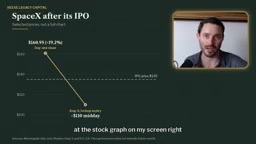
Reese uses SpaceX as a technical reference (not a business comparison). SpaceX listed at $135 per share, raising about $75 billion — the largest IPO in history — at a valuation of roughly $1.77 trillion, about 95 times its 2025 revenue, closing up over 19% on its first day. But by early August, Reuters data showed the stock had fallen to $110, below its offer price. It later recovered to around $150.
Other cases are just as mixed: Figma priced at $33 and closed its first day at $115.5; CoreWeave priced at $40 and closed at $40, barely moving.
Zooming out, University of Florida professor Jay Ritter has tracked more than 9,000 U.S. IPOs since 1980: the average first-day gain is about 19%, but measured from the first-day close, the average three-year gain is also about 19%, while the broader market gained about 40% over the same period. Companies with revenue over $1 billion perform closer to the broader market.
The first day is just a slice of supply. When SpaceX listed, less than 5% of shares were in circulation, with lock-ups keeping early investors out. Anthropic uses a staggered unlock, with some shares sellable on day one and more unlock waves arriving over the coming year. Each unlock could bring new sellers.
Lock-up periods and staggered unlocks
The lock-up period is a selling restriction agreed between underwriters and company insiders (founders, employees, early investment institutions) in an IPO, usually 180 days, during which these shares cannot be sold on the public market. The purpose is to prevent a sudden surge in supply from suppressing the stock price in the early days of trading.
After the lock-up expires, insider holdings unlock in a concentrated wave, increasing market supply and often accompanied by higher trading volume and stock price volatility — a phenomenon known as the "lock-up effect." Some companies adopt staggered unlocks or release a small number of shares early, gradually expanding the float.
For investors, the unlock schedule is an important variable for judging the pace of supply: a small float on day one makes it easy for a modest amount of capital to push prices up; as unlock waves arrive, valuations will be tested more by fundamentals. That's why "first-day gains" and "performance three months or six months after listing" often present completely different pictures.
The Bubble Question: The Listing Is Fuel, but Fuel Isn't Direction
Reese notes that Reuters reported investors discussing a $1.5 trillion valuation and a fundraising size of up to about $100 billion. An IPO of this magnitude would inject enormous capital and attention into the AI sector — in that sense, it is indeed fuel.
But fuel solves "where the money comes from," not "whether the money is well spent." Anthropic's revenue growth is staggering and its customer retention far exceeds the industry, but the rigid spending on compute commitments, customer concentration, and the growth slowdown the company itself forecasts are all variables explicitly stated in the prospectus.
For ordinary investors, a more practical question than "should I buy the new listing" is: beware of fake pre-IPO shares. Both the SEC and FINRA have warned about fraudulent pre-IPO investment opportunities. FINRA explicitly states that legitimate pre-IPO opportunities don't fall out of strangers' emails. Check the seller's credentials — verify on BrokerCheck or investor.gov first.
No one can give a definitive answer on whether the AI bubble will burst. But understanding the revenue structure and cost constraints in the prospectus brings you closer to the answer than chasing first-day gains.
One-line Summary
Anthropic files for IPO, with revenue driven by APIs rather than subscriptions and massive losses mostly accounting charges
Paragraph Summary
Anthropic has officially filed for an IPO under the ticker ANT, with the news lifting the S&P 500 and the Philadelphia Semiconductor Index. Based on analysis by investment advisor Robert Reese, this article breaks down the prospectus across four dimensions: IPO mechanics, revenue structure, the truth about costs, and historical references. It notes that retail investors participate at secondary-market prices rather than institutional offer prices; about 80% of the company's revenue comes from usage-based pricing, with roughly 48% completed through competitors' cloud marketplaces; of the $80.7 billion net loss in the first half, about $72 billion is an accounting charge from rising convertible note valuations, with actual operating losses of $693 million. Historical data shows IPOs gain an average of 19% on the first day but trail the broader market by about 21 percentage points over three years — lock-up supply and rigid compute spending are the variables more worth watching.
Related articles

AI Can Read Neural Network Weights Directly: Do Models Already Exceed Expectations?
A Reddit developer experiment shows language models can directly read neural network weights and infer their function. Astra, Opus 5.5, and Muse Spark 1.3 all passed the test, sparking discussion on model generalization and training sources.

India's Microdrama Market Explodes: EloElo Secures $80M Investment from NBCUniversal
EloElo secures $80M from NBCUniversal to boost StoryTV, its microdrama platform with over 33M monthly active users, as India's microdrama market draws global capital.

Acoustic Detection of Multi-Rotor UAVs: Fusing Handcrafted Features with Pre-Trained Embeddings
Study reveals data leakage from random splits in UAV acoustic detection, proposes source-disjoint protocol with stacked ensemble of handcrafted features and YAMNet embeddings, achieving 95.29% accuracy for low-cost drone detection.