AI SDK Voyage 2.0.75 Patch Release: What the Dependency Chain Update Means

@ai-sdk/voyage@2.0.75 is a pure dependency-sync patch with low upgrade risk, but testing is recommended.
`@ai-sdk/voyage@2.0.75` is a patch release of the official Voyage AI provider package in the Vercel AI SDK ecosystem, containing no new features or breaking changes — it only syncs shared dependencies `@ai-sdk/provider` to 4.0.36 and `@ai-sdk/provider-utils` to 5.0.75. The article explains why this "passive release" matters: separate provider packages share foundational capabilities, so aligning versions ensures consistent behavior across providers. For RAG developers, upgrade risk is low, but integration tests after lockfile changes are recommended.
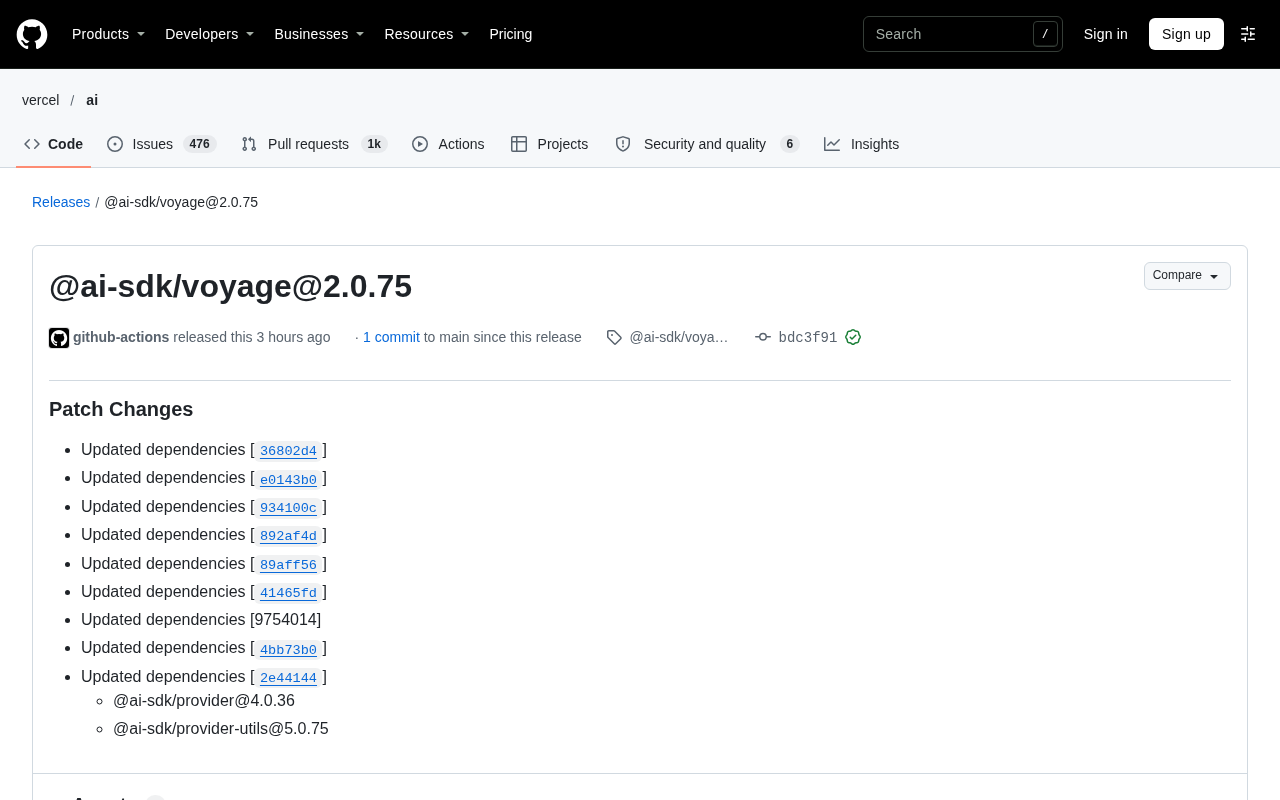
Vercel's AI SDK ecosystem has rolled out another small iteration. @ai-sdk/voyage@2.0.75, the official provider package for Voyage AI models, is a typical patch release — no new features, no breaking changes, just one main thread: dependency updates.
Releases like this happen almost every day in the npm ecosystem, but for developers building applications with the AI SDK, understanding "why a patch version is worth paying attention to" is more valuable than simply bumping the version number.
What this update actually changes
As seen on the GitHub Release page, the change type for @ai-sdk/voyage@2.0.75 is marked as "Patch Changes," and the core content is a string of dependency updates pointing to multiple commits (36802d4, e0143b0, 934100c, 892af4d, 89aff56, 41465fd, 9754014, 4bb73b0, 2e44144). These commits ultimately land on version changes for two packages: @ai-sdk/provider@4.0.36 and @ai-sdk/provider-utils@5.0.75.
In other words, the Voyage Provider itself has no business logic changes — it simply syncs the underlying shared dependencies to their latest versions. This is routine practice under the AI SDK's multi-package monorepo architecture.
Why dependency updates deserve their own release
The AI SDK's design splits integration with different model vendors into separate provider packages, while all providers share the two foundational packages @ai-sdk/provider and @ai-sdk/provider-utils. These foundational packages handle common responsibilities such as request construction, error handling, and streaming response parsing. Once an edge case or type definition is fixed there, all downstream providers need to follow up with synchronization.
According to the release records on GitHub, all nine commits in this update are dependency-level synchronization. This kind of "passive release" may look like noise, but it actually ensures consistent behavior across different providers within the same project — if you use Voyage alongside other model providers, aligning the underlying utility library versions can reduce hard-to-troubleshoot compatibility issues.
Semantic Versioning (SemVer) is the convention in the npm ecosystem that defines what version numbers mean, in the format MAJOR.MINOR.PATCH. A MAJOR change indicates incompatible API modifications, MINOR indicates backward-compatible feature additions, and PATCH indicates backward-compatible bug fixes. Under this convention, @ai-sdk/voyage@2.0.75 going from 2.0.x to 2.0.75 is a patch-level change and should theoretically be a drop-in replacement that doesn't break existing code. However, SemVer only describes compatibility of the "public interface" — it doesn't guarantee that internal implementations or indirect dependencies behave exactly the same. When a PATCH version updates underlying shared dependencies, the dependency packages' own MINOR changes may be "bundled" in, so in practice you still need to consult the changelog to judge the actual impact.
What this means for developers using Voyage
Voyage AI is known for its embedding and reranking models, and is often used in RAG scenarios for vectorization and retrieval result reranking. By integrating through @ai-sdk/voyage, developers can call these capabilities through a unified AI SDK interface without having to write a separate adapter layer for each vendor.
This patch does not involve API signature or parameter changes, so upgrade risk is very low. Per semantic versioning conventions, patch-level updates should be drop-in replacements. That said, in real projects it's still advisable to run integration tests after the lockfile changes, especially for custom wrappers that depend on the internal behavior of provider-utils.
RAG (Retrieval-Augmented Generation) is a technical architecture that combines external knowledge base retrieval with large model generation: documents are first chunked and converted into vectors via an embedding model and stored in a vector database, and when a user asks a question, the most relevant fragments are retrieved as context and handed to the large model for answering. Voyage AI plays two key roles in this pipeline — the embedding model maps text into high-dimensional vectors, and the reranking model refines the initially recalled candidate fragments, improving the accuracy of what goes into the large model's context. The value of @ai-sdk/voyage lies in encapsulating these capabilities into the AI SDK's unified interface, so RAG applications can switch or combine models from different vendors without changing business code.
AI SDK's maintenance strategy as seen from its release cadence
This version was automatically published by a GitHub Actions bot, with signature verification passing (GPG key ID B5690EEEBB952194), and the release process is fully automated. This high-frequency, small-granularity release pattern suggests the team prefers to let dependency updates flow to users quickly rather than accumulating them into large versions released together.
For users, the cost is needing to track version changes more frequently; the benefit is that security fixes and type improvements land faster. If a project has high requirements for dependency stability, you can pin exact versions in package.json and upgrade manually as needed.
lockfile refers to files like package-lock.json, pnpm-lock.yaml, or yarn.lock that record the exact versions of the dependency tree, ensuring that dependencies installed across different environments and at different times are exactly the same. When running npm update or reinstalling within the allowed version range, the lockfile changes, and indirect dependencies may be upgraded as well. Since patch versions update the two shared foundational packages provider and provider-utils, the lockfile diff often reflects the actual changes better than package.json. It's recommended to review lockfile changes before committing to confirm that no unexpected transitive dependency upgrades have been introduced, and to pin Node and package manager versions in CI to ensure reproducible builds.
Quickly judging whether such updates need to be followed up
When facing a patch version with only dependency changes, you can judge in three steps: first check the version span of @ai-sdk/provider and @ai-sdk/provider-utils — crossing minor versions usually comes with behavioral adjustments; then check the changelogs of these two foundational packages to confirm whether there are fixes affecting your current usage; finally run the core paths through in a test environment. For @ai-sdk/voyage@2.0.75, the dependency span is a routine sync, so just follow it at your normal pace.
One-line Summary
@ai-sdk/voyage@2.0.75 is a pure dependency-sync patch with low upgrade risk, but testing is recommended.
Paragraph Summary
@ai-sdk/voyage@2.0.75 is a patch release of the official Voyage AI provider package in the Vercel AI SDK ecosystem. It contains no new features or breaking changes; the core content is simply syncing the underlying shared dependencies @ai-sdk/provider to 4.0.36 and @ai-sdk/provider-utils to 5.0.75. The article explains why this kind of "passive release" deserves attention: the AI SDK splits each model vendor into separate provider packages, but they share foundational capabilities such as request construction, error handling, and streaming parsing. Aligning the foundational package versions ensures consistent behavior when multiple providers coexist and reduces compatibility issues. For RAG developers using Voyage for embedding and reranking, this upgrade risk is very low, but it's advisable to run integration tests after the lockfile changes. The release is automated by GitHub Actions with signature verification, reflecting a high-frequency, small-granularity maintenance strategy.
Related articles

World's First Humanoid Robot Company Agility Lists on Nasdaq: Buy or Not?
Agility becomes the world's first pure-play humanoid robot company to list on Nasdaq. This article analyzes what the landmark event means for the industry and investors, unpacking the commercialization test and investment framework for the pure humanoid robot sector.

Agent-Browser: A Browser Automation CLI for AI Agents
Vercel Labs open-sources agent-browser, a Rust-built browser automation CLI designed for AI agents, with over 45,000 GitHub stars and command-line-first browser control.

LZ4: The Open-Source Benchmark for Blazing-Fast Compression
Explore the LZ4 blazing-fast compression algorithm: its design philosophy, performance advantages, and wide use in the Linux kernel, databases, and more. How a 12k+ star open-source project became the speed benchmark.