@ai-sdk/vue 2.0.264 Released: Dependency Sync Update Explained

@ai-sdk/vue 2.0.264 is a routine patch release syncing dependencies — backward-compatible and low-risk.
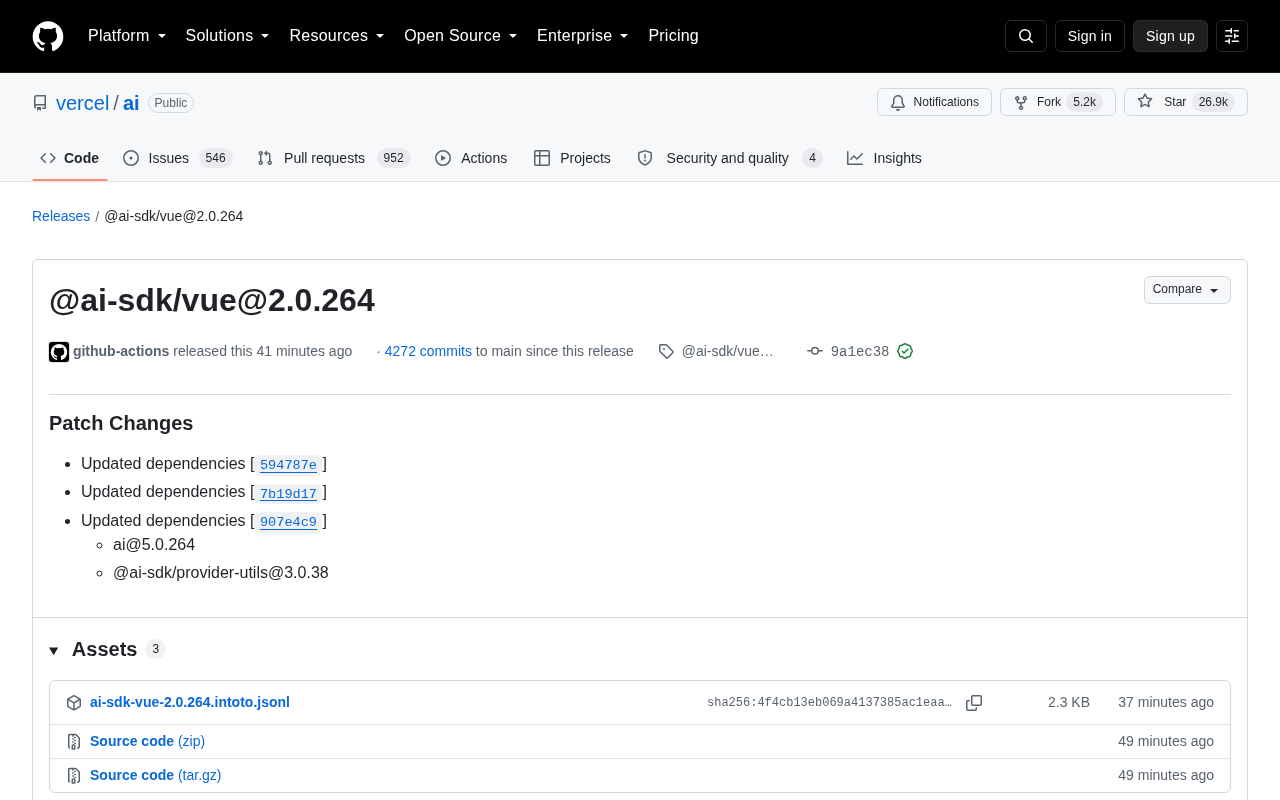
`@ai-sdk/vue@2.0.264` is a routine patch update to Vercel's official AI SDK adapter for Vue.js, auto-published by GitHub Actions on September 23rd. The release focuses on dependency synchronization, coordinating upgrades to `ai@5.0.264` and `@ai-sdk/provider-utils@3.0.38` as part of a monorepo-wide version alignment strategy. The update is backward-compatible, requiring no code changes, though testing before production deployment is still recommended. `@ai-sdk/vue` provides composables like `useChat` and `useCompletion` to help Vue developers integrate LLM streaming and chat features in a Vue-native way.
Vercel AI SDK's ecosystem continues to evolve, with @ai-sdk/vue releasing version 2.0.264. This is a patch-level update focused primarily on dependency synchronization. For developers building AI applications with the Vue framework, staying on top of these updates helps maintain project stability and compatibility.
What's in This Release
@ai-sdk/vue@2.0.264 was published on September 23rd via GitHub Actions as part of Vercel's official vercel/ai repository — a project that has accumulated over 26.9k stars and 5.2k forks, making it one of the most popular AI application development toolkits available.
According to the release notes, the core change in this update is dependency synchronization, involving coordinated upgrades across the following related packages:
ai@5.0.264@ai-sdk/provider-utils@3.0.38
Patch updates like this typically don't introduce breaking changes — they fix issues and update underlying dependencies to keep module versions aligned. For developers, the upgrade cost is low and the risk is well-contained.
What Is @ai-sdk/vue
@ai-sdk/vue is the official adapter package from Vercel AI SDK for the Vue.js framework. The Vercel AI SDK is a TypeScript toolkit for building AI-powered applications, helping developers quickly integrate large language models and implement streaming responses, chat interfaces, and generative UI on the frontend.
The SDK provides framework-specific binding packages for different frontend environments — such as @ai-sdk/react for React and a Svelte version — alongside the Vue-focused package covered here. @ai-sdk/vue enables Vue developers to build interactive AI experiences using composables like useChat and useCompletion in a way that feels natural to the Vue ecosystem.
useChat and useCompletion are the two core composables provided by @ai-sdk/vue. useChat is designed for multi-turn conversation scenarios, with built-in message history management, streaming output rendering, and request state tracking. useCompletion is suited for single-pass text completion tasks such as auto-continuation or summarization. Both are built on Vue 3's Composition API, can be called directly inside <script setup>, and bind to templates via reactive references (ref/computed) — eliminating the need to manually manage low-level streaming protocols like EventSource or ReadableStream, and significantly reducing the complexity of integrating large language models into Vue applications.
What a Patch Update Means for Developers
In Semantic Versioning (SemVer), an increment in the patch number (e.g., 2.0.263 → 2.0.264) indicates a backward-compatible bug fix. This means existing code should continue to work without modification after upgrading.
Also worth noting is the version alignment across packages: @ai-sdk/vue@2.0.264, ai@5.0.264, and @ai-sdk/provider-utils@3.0.38 all follow a synchronized release cadence with matching trailing version numbers. This unified versioning strategy is a hallmark of monorepo projects and effectively reduces the likelihood of cross-package dependency conflicts.
For production projects, it's recommended to review the full Changelog before upgrading and validate in a test environment before deploying. While patch updates carry low risk, changes to the underlying provider-utils dependency could still affect specific model provider integrations.
What is a Monorepo? A monorepo (single repository) is a project structure where multiple related packages are managed together in one Git repository. Vercel AI SDK uses this approach —
ai,@ai-sdk/vue,@ai-sdk/react,@ai-sdk/provider-utils, and other packages all live within thevercel/airepository, built and published collaboratively using tools like Turborepo or pnpm Workspaces. The key advantage is that cross-package changes can be committed atomically in a single PR, and version numbers can be aligned in a unified release cadence — avoiding "dependency hell," where package A depends on one version of package B while package C requires an incompatible version. The matching trailing numbers (like.264in this release) are a visible expression of this coordinated publishing strategy.
How to Upgrade
Upgrading is straightforward — simply run an update command with your package manager:
npm install @ai-sdk/vue@2.0.264
# or
pnpm add @ai-sdk/vue@2.0.264
Since dependencies are declared within the package, your package manager will automatically pull the matching versions of ai and @ai-sdk/provider-utils. It's also a good idea to commit your lock file to ensure a consistent environment across your team.
Summary
@ai-sdk/vue@2.0.264 is a routine maintenance release, with its core value lying in dependency synchronization and stability upkeep. For Vue projects actively using the Vercel AI SDK, keeping dependencies in step with the official release cadence is a healthy practice for long-term application stability. While any individual patch release may seem minor, the project's consistent and frequent iteration is a strong signal of its vitality and active maintenance.
Related articles

Chain of Thought Isn't Just for AI: How Humans Can Use CoT to Improve Thinking Quality
Chain of Thought isn't just a prompt trick for large models. Starting from a Hacker News discussion, this article analyzes why CoT works for human thinking too, breaks down actionable ways to transfer it, and highlights the key differences between human CoT and machine CoT.
Cloudflare Teams Up with OpenAI: Closi…
Cloudflare Teams Up with OpenAI: Closing the Loop from Vulnerability Discovery to Defense with AI
Cloudflare uses OpenAI Daybreak to investigate security vulnerabilities and generate reviewable remediation plans, while developers use Codex to boost coding efficiency and quality.

Orca Multi-Agent Orchestration in Practice: A Guide to Parallel Collaboration with Claude and Codex
Orca is Stable AI's free open-source agent workbench supporting 34 agents like Claude Code and Codex in parallel. Learn its Git worktree isolation, multi-model orchestration, and mobile management.