@ai-sdk/vue 2.0.266 Released: A Patch Update for Vercel AI SDK

Vercel AI SDK's Vue binding releases patch v2.0.266, synced with core package — no breaking changes.
`@ai-sdk/vue` releases patch version 2.0.266, keeping in sync with core package `ai@5.0.266`. The package is Vercel AI SDK's official Vue binding, simplifying AI interactions like streaming, chat state management, and tool calling via composables like `useChat` and `useCompletion`. This patch-level release is backward-compatible, focused on bug fixes and dependency updates, and verified with GPG signing for supply chain security. Developers should ensure version consistency between `@ai-sdk/vue` and the `ai` core package, and validate in a test environment before deploying to production.
Vercel's AI SDK ecosystem continues to evolve, with @ai-sdk/vue receiving a 2.0.266 version update. This is a patch-level release, primarily keeping in sync with the core package ai@5.0.266. For developers building AI applications with the Vue framework, keeping dependency versions in sync is a fundamental practice for ensuring functional compatibility and stability.
What's in This Update
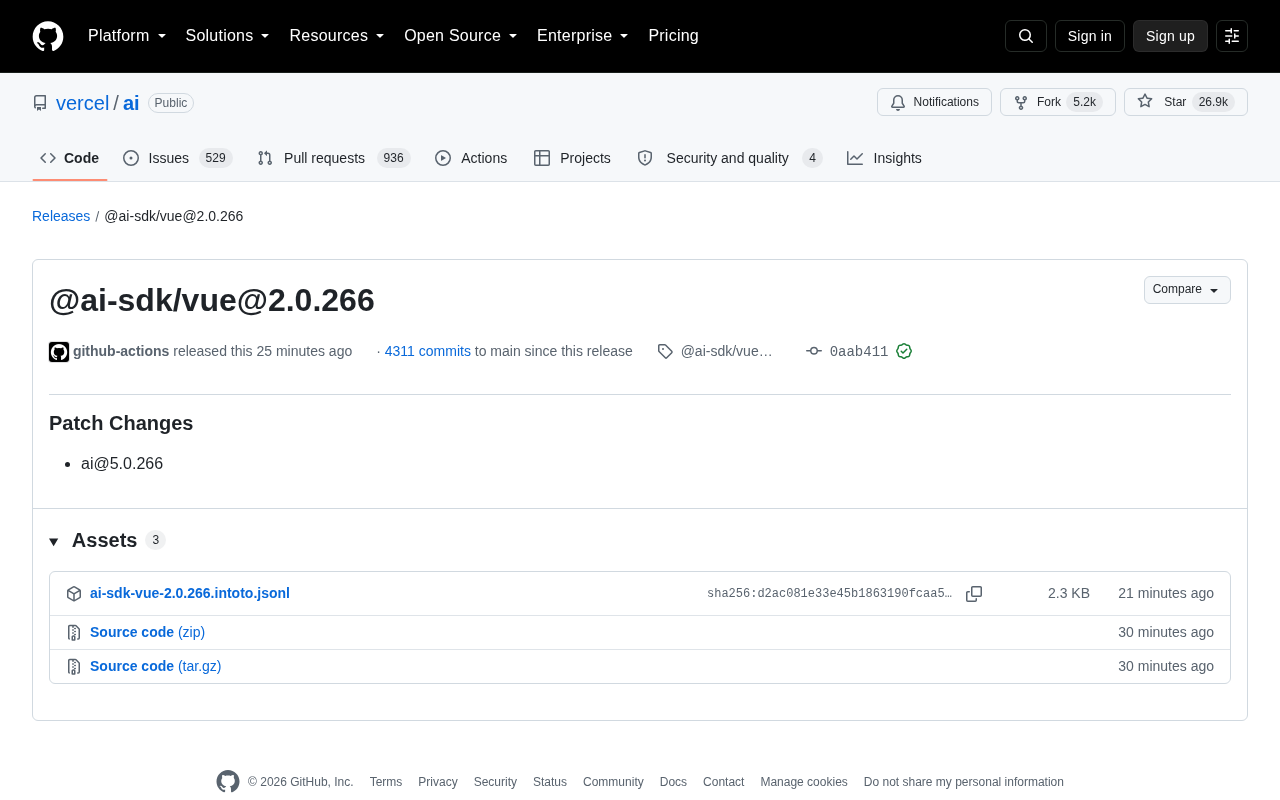
According to the GitHub Release page, @ai-sdk/vue@2.0.266 falls under Patch Changes, with its changes dependent on the updates in the core package ai@5.0.266. Patch releases typically focus on bug fixes, internal dependency upgrades, or minor optimizations — not breaking changes or major new features.
This version was published via GitHub Actions automation and verified with a GitHub GPG signature (key ID: B5690EEEBB952194), ensuring the trustworthiness and integrity of the release artifacts. This is now standard practice in modern open source projects for supply chain security.
What Is @ai-sdk/vue
@ai-sdk/vue is the official Vue ecosystem binding for the Vercel AI SDK. The Vercel AI SDK is a TypeScript toolkit for building AI-powered applications, offering a unified interface abstraction for major frontend frameworks including React, Vue, and Svelte.
Its core value lies in simplifying the development workflow for interacting with large language models (LLMs) — covering common scenarios such as streaming response handling, chat state management, and tool calling. For Vue developers specifically, @ai-sdk/vue wraps composable APIs like useChat and useCompletion, making it far more intuitive to integrate AI conversation capabilities into Vue components.
Vercel's ai repository has accumulated over 26.9k stars and 5.2k forks on GitHub, making it one of the most watched open source projects in this space. The frequent patch releases (4,311 commits to the main branch as of this release) also reflect the project's active maintenance pace.
Tool calling is a key capability of large language models that allows a model to recognize, during response generation, when it needs to invoke an external function or API. It returns a structured call request to the client, which the developer executes on the application side before passing the result back to the model. This mechanism enables LLMs to go beyond pure text generation and interact with real services like database queries, search engines, and computation tools.
@ai-sdk/vueabstracts the tool calling workflow — developers simply declare the tool's parameter schema, and the SDK automatically handles the model's call instructions, result passback, and multi-turn conversation state management. This significantly lowers the barrier to building action-capable AI agents in Vue applications.
How Developers Should Handle Version Updates
Given such a high-frequency release cadence, developers don't need to chase every patch immediately — but there are a few key things worth keeping in mind:
Why Version Sync Matters
Since @ai-sdk/vue is version-linked to the core ai package, if your project uses both, make sure their versions are consistent or compatible. Mismatched versions can lead to runtime errors.
Semantic Versioning (SemVer) is the standard version management convention in the npm ecosystem, formatted as
MAJOR.MINOR.PATCH. A major version bump signals breaking, incompatible changes; a minor bump indicates new backward-compatible features; and a patch bump represents backward-compatible bug fixes only.@ai-sdk/vueand theaicore package follow a linked release strategy, with their major and minor versions always corresponding (e.g., vue@2.x pairs with ai@5.x). This means mixing patch versions across the same major/minor release is generally safe, but mixing across major or minor versions is highly likely to cause type mismatches or API inconsistencies at runtime.
Upgrade Strategy for Patch Updates
Patch-level updates (the third number in semantic versioning) are theoretically backward-compatible, so upgrading is relatively low-risk. That said, in production environments it's still a good idea to validate in a test environment first — especially when a patch touches streaming or state management logic.
Keep an Eye on the Changelog
This release note is fairly brief, simply pointing to the changes in ai@5.0.266. Developers can dig into the core package's changelog for specifics on what was fixed, and assess whether any of those fixes are relevant to issues they've encountered in their own projects.
Summary
@ai-sdk/vue@2.0.266 is a routine patch update with limited standalone information — its primary value is staying in sync with the core package. High-frequency releases like this are normal for active open source projects and reflect the engineering rhythm of Vercel AI SDK's continuous refinement. For Vue developers building AI applications, keeping an eye on the official repository's release activity helps you take advantage of new features while avoiding potential compatibility risks.
Related articles

JobRunner MCP Server: AI Agents Can Now Fix Failed Java Jobs
JobRunner launches an open-source MCP server enabling AI agents to view cluster status, diagnose failures, and recover Java jobs—incident response from any cloud coding environment or existing agent.

MLAI Digital Launches 9 Security Agents: MCP Server Safeguards the Full Lifecycle of Agentic AI
MLAI Digital launches Security MCP Server with nine built-in specialized security agents covering vulnerability discovery, attack simulation, prompt injection detection, API and infrastructure assessment, and accelerated remediation—embedding security validation across the full Agentic AI lifecycle from development to production.

Running Isaac Lab on H100 GPUs: Exploring Better Approaches
Exploring optimization methods for running Isaac Lab on NVIDIA H100 GPUs, including MIG configuration, mixed precision, TensorRT acceleration, and community experience to improve robotics simulation and reinforcement learning efficiency.