AI SDK Vue 2.0.275 Fixes useObject Request Header Loss Issue

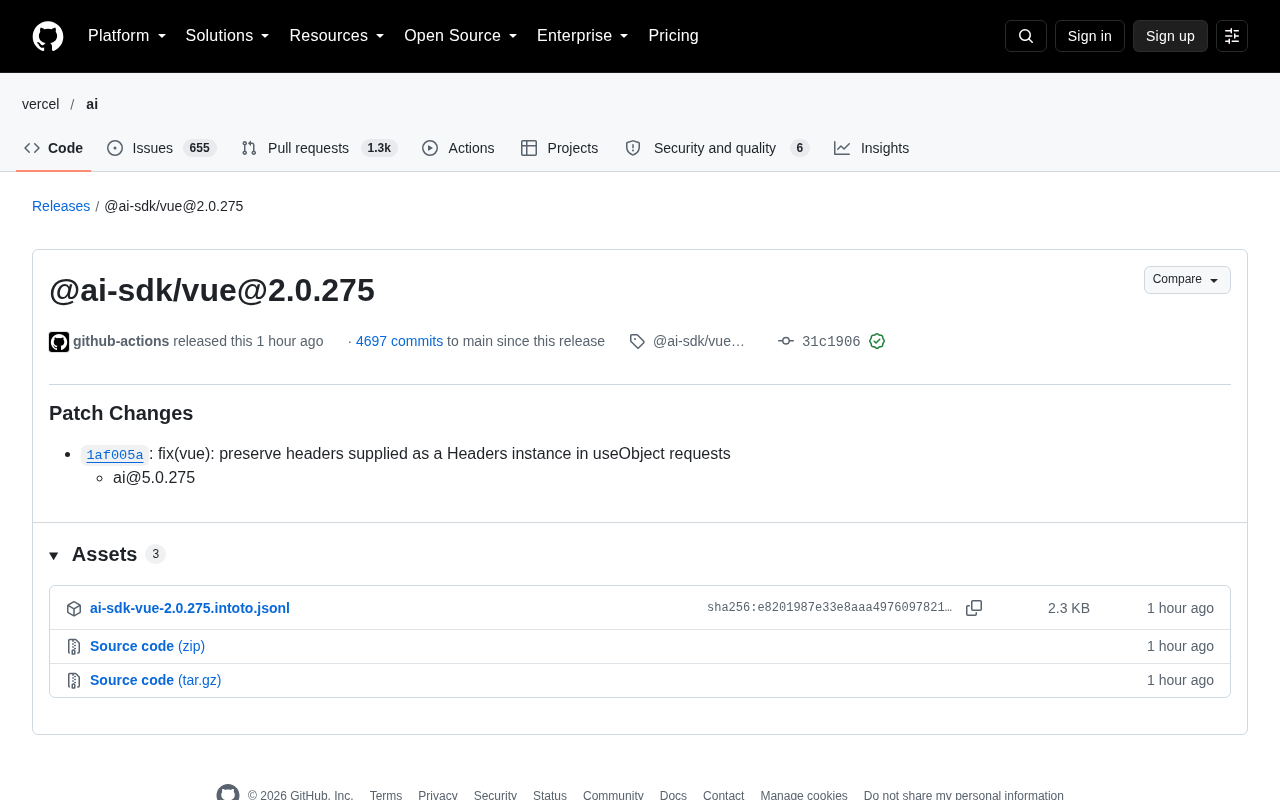
@ai-sdk/[email protected] fixes useObject failing to preserve Headers instance request headers.
@ai-sdk/vue releases patch 2.0.275, with the core change fixing useObject failing to correctly preserve request headers when passed as a Headers instance. This bug causes Vue AI applications relying on auth headers, tenant identifiers, or custom X- headers to experience request failures or backend identification issues, often without obvious errors, making troubleshooting difficult. The article notes that useObject targets structured object streaming, commonly used in forms and data extraction, and is especially sensitive to request context correctness. Since AI SDK maintains synchronized version numbers between core and framework packages with a high-frequency small-step patch strategy, this upgrade is a standard patch with no migration cost, and Vue projects passing custom headers or using Headers instances are advised to upgrade promptly.
Vercel's AI SDK has released the @ai-sdk/[email protected] patch version, with the core change centered on how the Vue adapter layer handles useObject request headers.
Behind this version number is a snapshot of AI SDK's continuous refinement within the Vue ecosystem—it's not a major feature release, but a targeted fix for a specific scenario.
What Was Fixed: Headers Instance Loss in useObject
According to the commit record on GitHub (commit 1af005a), this patch addresses an issue where useObject requests fail to correctly preserve header information when developers pass request headers as a Headers instance.
This problem may seem minor, but for applications that rely on authentication headers, custom tracking headers, or content negotiation headers, the impact is direct—requests may fail due to missing required header fields, or the backend may be unable to correctly identify the caller.
AI SDK's useObject is the core Hook Vue developers use to stream structured objects. In real projects, developers often need to inject API keys, tenant IDs, or custom X- headers into requests. If these headers are passed as standard Headers objects but silently dropped internally, troubleshooting becomes difficult, since the request itself may not throw any obvious error.
About Headers instances: In the Fetch API specification, Headers is a standard class used to represent a collection of key-value pairs for HTTP request or response headers. It behaves notably differently from plain JavaScript objects (such as { 'Authorization': 'Bearer xxx' }): Headers instances normalize header names for case sensitivity, automatically handle merging and appending of same-named headers, and provide methods like get(), set(), append(), and has(). Many request libraries and fetch implementations internally perform type checks on incoming headers. If the code only handles the plain object branch, headers passed as a Headers instance may be silently ignored. This is exactly the kind of edge case this patch fixes—it serves as a reminder that when wrapping a request layer, developers need to support plain objects, arrays, Headers instances, and other header representations simultaneously.
About the difference between useObject and useChat: useChat targets message-streaming conversation scenarios, where output is typically text or message arrays appended character by character; while useObject targets streaming generation of "structured objects," relying on streamObject under the hood to progressively parse model output according to a JSON Schema into a continuously completing JavaScript object. This means useObject callers often need to bind generation results directly to form fields, data tables, or dynamic components, making them more sensitive to the correctness of the request context (especially authentication and tenant identifiers). Precisely because of this, once headers are lost, the symptom isn't an obvious error but rather hidden problems like authentication failures or backend routing to the wrong tenant.
Why This Fix Deserves Attention
AI SDK now covers multiple frontend frameworks including React, Vue, and Svelte, and the stability of the Vue adapter layer directly affects a large number of teams building AI applications with Vue 3 + Composition API.
useObject's positioning within AI SDK is "letting the frontend directly consume structured streaming output." Compared to useChat, which targets conversation scenarios, useObject leans more toward form generation, data extraction, dynamic UI rendering, and other scenarios requiring typed results. In these scenarios, correct header transmission is often directly tied to permission verification, multi-tenant isolation, and usage statistics.
This fix also reflects AI SDK's iteration cadence: the core package [email protected] maintains synchronized version numbers with framework adapter packages, with frequent patch-level updates but focused changes. For production users, the value of such patches lies in "fixing a hidden issue without changing any code."
About AI SDK's package versioning strategy: AI SDK adopts a "core package + framework adapter packages" architecture. The core ai package carries framework-agnostic model invocation and streaming parsing logic, while adapter packages like @ai-sdk/react, @ai-sdk/vue, and @ai-sdk/svelte bridge core capabilities into each framework's reactivity system and lifecycle. These packages use synchronized version numbers (such as [email protected] and @ai-sdk/[email protected]), making it easy for developers to determine whether a problem belongs to the core layer or the adapter layer. Understanding this structure helps determine: this issue lies in the Vue adapter layer's header pass-through step, not in model invocation itself, so upgrading @ai-sdk/vue is sufficient—no changes to the core package are needed.
Practical Advice for Vue Developers
If you're using useObject from @ai-sdk/vue and your requests involve any of the following situations, we recommend upgrading to 2.0.275 as soon as possible:
- You pass custom authentication headers (such as Bearer Tokens or API Keys)
- You construct request headers via a
Headersinstance rather than a plain object - You rely on the backend to route or rate-limit based on specific headers
The upgrade method has no additional migration cost—it's a standard patch update.
AI SDK's iteration strategy has always leaned toward "small steps, fast pace," with each patch solving one specific problem, reducing the psychological burden on developers to keep up. For infrastructure libraries, this model is friendlier than major version jumps.
About Vue 3 + Composition API adapter semantics: useObject is a composable function that internally uses reactive primitives like ref, shallowRef, and watch to expose generation state (such as object, isLoading, error) and allows callers to interrupt streaming requests via stop(). The Composition API lets this Hook's state be naturally destructured for use within setup(). It's worth noting that useObject typically initiates requests after the component mounts, so if headers depend on reactive values only available at runtime (such as a token obtained after login), ensure these values are ready before the call—otherwise, even if headers are passed correctly, authentication failures may occur due to receiving empty values.
AI SDK's Engineering Approach, Seen Through a Single Patch
The @ai-sdk/[email protected] version itself isn't newsworthy, but it reveals how the AI SDK team invests in framework adaptation—not laying out all capabilities at once, but continuously fixing edge cases based on community feedback.
For teams currently evaluating AI frontend integration solutions, this kind of high-frequency, low-risk patch update is actually a positive signal: it shows the maintainers care about real-world details rather than just focusing on new feature releases.
Related articles

Felix Rieseberg Personal Homepage
Felix Rieseberg's personal homepage sparks attention on Hacker News. This article covers the Slack engineer's technical background, the rise and fall of nativefier, and the value of a developer homepage as a tech calling card.

@ai-sdk/vue 3.0.306 Patch Release Syncs with [email protected] Update
@ai-sdk/vue 3.0.306 released, synced with [email protected]. A routine patch release for the Vercel AI SDK ecosystem with no public API changes; the Vue adapter layer stays version-aligned with the core package.

Gemini 4 Argon API Launches: The Era of Million-Token Output Begins
Google launches Gemini 4 Argon with sparse MoE architecture, up to 1M output tokens, and a 68.90% Vals Index score, available across API, AI Studio, and the Gemini app.