AI SDK Vue 2.0.283 Patch Release: Dependency Chain Update Analysis

@ai-sdk/vue 2.0.283 patch released, primarily syncing upstream dependencies with no new features.
The AI SDK's Vue adapter package @ai-sdk/vue has released patch version 2.0.283, whose core content is solely synchronized dependency upgrades involving @ai-sdk/provider-utils@3.0.43 and ai@5.0.283, with no new APIs or functional changes. In the AI SDK's monorepo, framework adapters follow core package releases to ensure dependency consistency. Though release notes are a single line, dependency-layer changes can affect request construction and response parsing, and version mismatches may cause subtle bugs. The release is automated via github-actions with GPG verification. Developers should align ai and @ai-sdk/vue versions, monitor upstream changelogs, and manage frequent patches with update bots or batch upgrades.
AI SDK Vue 2.0.283 Patch Release: Dependency Chain Update Analysis
The AI SDK's Vue adapter package @ai-sdk/vue has released version 2.0.283. As the version number suggests, this is a routine patch-level update focused on synchronizing dependency upgrades. For developers building Vue applications with the AI SDK, understanding the substance of such patches helps determine whether it's worth updating immediately.
Patch Content: Dependency Updates at the Core
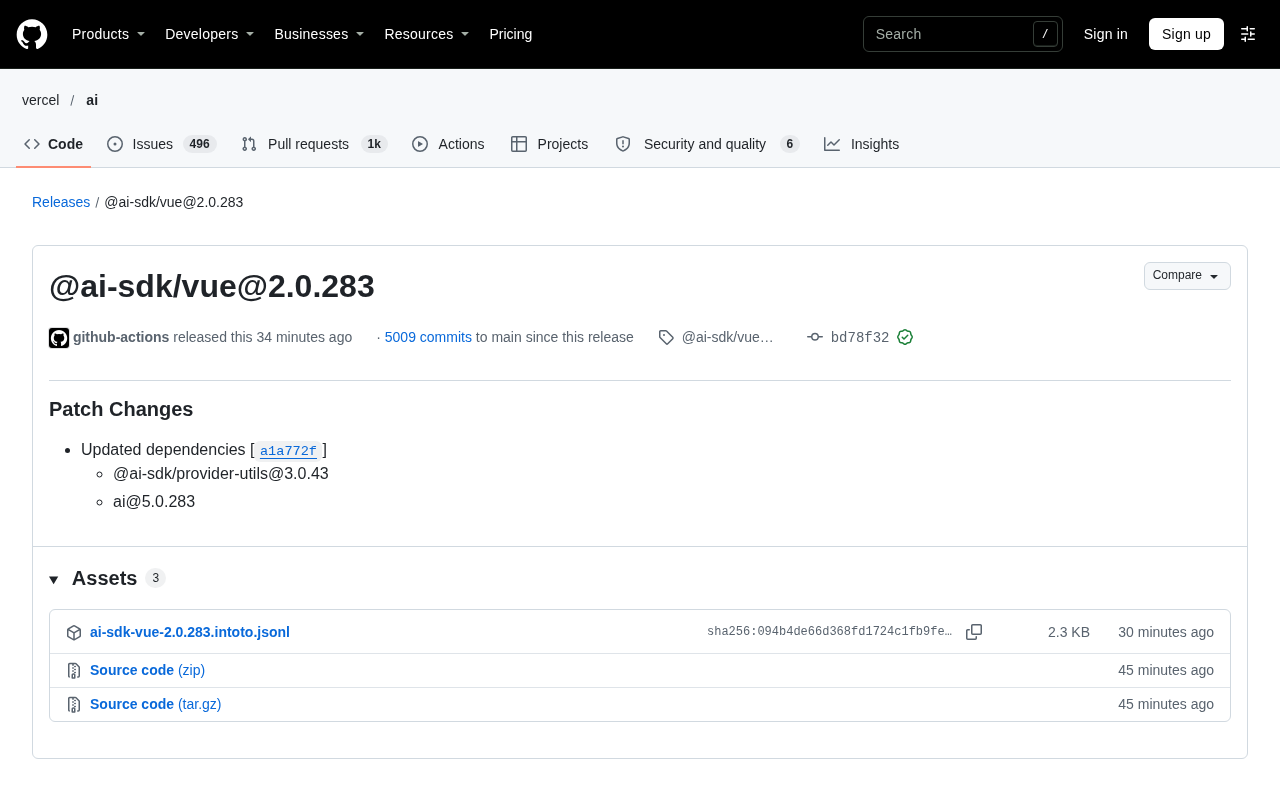
According to the release notes on GitHub, the core of this update is a "Patch Changes" entry: updated dependencies, specifically @ai-sdk/provider-utils@3.0.43 and ai@5.0.283.
This means @ai-sdk/vue itself introduces no new APIs or functional changes; instead, it aligns with the release cadence of the upstream core package ai and the utility package provider-utils. In the AI SDK's monorepo structure, this kind of coordinated release is the norm—whenever the core package ships, framework adapter layers typically follow in the same version sequence to maintain dependency consistency.
You may not have noticed, but the release notes indicate that this commit carries a GitHub verified signature (GPG key ID: B5690EEEBB952194), confirming that this is an official release produced by the automated workflow (github-actions) and that its source is trustworthy.
A monorepo is an engineering practice of managing multiple interrelated software packages within a single code repository. The AI SDK adopts this structure, maintaining the core package ai, the utility package provider-utils, and framework adapter packages (such as @ai-sdk/vue and @ai-sdk/react) in the same repository. The advantages are: all packages share the same build configuration and release process, dependency versions can be managed centrally, and cross-package changes can be completed and released together in a single commit. The trade-off is a massive volume of commits and densely incremented version numbers—what external users see in release notes is often just a single line saying "dependency updates." Understanding monorepos helps explain why patches to @ai-sdk/vue almost always coincide with version bumps in ai and provider-utils, and it also helps when troubleshooting: just because the adapter code hasn't changed doesn't mean the underlying behavior hasn't.
Why Patch Updates Still Deserve Attention
Many teams habitually ignore patch versions, but in fast-iterating toolchains like the AI SDK, changes at the dependency layer often have far-reaching effects.
The ai core package continues to evolve along the 5.x line, and provider-utils, as the utility library for the model provider abstraction layer, may see behavioral changes that affect underlying logic such as request construction and response parsing. If @ai-sdk/vue, as the Vue-side wrapper, doesn't synchronize dependency versions, version mismatches between the core package and the adapter layer can lead to subtle bugs—such as inconsistent type definitions or runtime behavior differences.
Therefore, even if the release notes contain only one line saying "Updated dependencies," it's advisable to keep related packages in the dependency tree at consistent versions, especially in team collaboration or multi-project sharing scenarios.
Semantic Versioning (SemVer) stipulates that a version number consists of major.minor.patch: a major version change indicates incompatible API changes, a minor version indicates backward-compatible feature additions, and a patch version indicates backward-compatible bug fixes. Under this convention, patch updates should theoretically not introduce breaking changes. But two caveats apply: first, SemVer only governs the public API surface; implicit behavioral changes in the dependency chain (such as request retry policies or minor serialization format adjustments) are not guaranteed. Second, monorepo projects may bundle upstream fixes in patch releases, and these fixes are "transparent" to the adapter layer. So when assessing patch risk, don't just look at the version number—examine the actual changes in the upstream packages as well.
A lockfile is a dependency-locking file automatically generated by package managers such as npm, pnpm, and yarn, recording the exact version and integrity hash of every package in the dependency tree. It ensures that different environments and team members install exactly the same dependency tree, and it is the cornerstone of reproducible builds. When upstream releases patches frequently, lockfiles generate frequent diffs, and teams need to decide whether to commit each time or batch updates. It's recommended to include lockfiles in code reviews and establish a separate PR process for dependency upgrades, avoiding mixing business changes with dependency changes in the same commit, which makes rollbacks harder.
Version Sequence and Engineering Cadence Observations
From the release information, this commit is on the main branch, after 5,009 cumulative commits. This number reflects the high iteration density of the AI SDK project.
For teams using @ai-sdk/vue, this raises a practical operational question: frequent patch releases mean the lockfile changes frequently. A sensible approach is to control the upgrade cadence through dependency management strategies—for example, using version range constraints combined with periodic batch upgrades, rather than manually following every release.
Meanwhile, the version numbers of the two dependency packages in this update (provider-utils@3.0.43, ai@5.0.283) and the adapter package version (vue@2.0.283) show alignment in their trailing numbers, which confirms the official unified multi-package release strategy—checking whether this set of versions matches is an effective starting point for troubleshooting compatibility issues.
GPG signature verification refers to digitally signing commits or tags using a key pair generated by GNU Privacy Guard; GitHub verifies the signature and displays a verified badge in the interface. In automated release workflows, the CI system (here, github-actions) holds the private key to sign the release commit, and recipients can use the corresponding public key to verify the authenticity of the source and the integrity of the content. For dependency supply chain security, this means you can confirm that the version was indeed produced by the official pipeline and is not a tampered or forged release. Note, however, that a signature only proves provenance—it does not mean the code has undergone a security audit. Before introducing a new version into production, it's still advisable to check for known vulnerabilities using dependency scanning tools (such as npm audit or Dependabot alerts).
Recommendations for Developers
For this type of patch release, consider the following approach:
- Align versions first: If your project uses both
aiand@ai-sdk/vue, ensure they are on an officially synchronized version combination, avoiding cross-version mixing. - Watch upstream changes: The substance of this update lies in the two upstream dependency packages. Checking the changelogs for
ai@5.0.283andprovider-utils@3.0.43is more informative than reading only the@ai-sdk/vuerelease notes. - Automate the upgrade process: Given frequent patches, configuring a dependency update bot or performing periodic batch upgrades is more sustainable than manually confirming each version.
Summary
@ai-sdk/vue@2.0.283 is a typical coordinated patch release with no new functionality; the focus is on version alignment across the dependency chain. For production projects prioritizing stability, such updates can be handled in batches according to your dependency management cadence; for development scenarios closely tracking upstream evolution, it's advisable to follow up in sync and verify the specific changes in the upstream packages. Understanding the release logic of monorepo projects helps teams make better upgrade decisions than fixating on a single package's release notes.
One-line Summary
@ai-sdk/vue 2.0.283 patch released, primarily synchronizing upstream dependencies with no new features.
Paragraph Summary
The AI SDK's Vue adapter package @ai-sdk/vue has released patch version 2.0.283, whose core content is solely synchronized dependency upgrades involving @ai-sdk/provider-utils@3.0.43 and ai@5.0.283, with no new APIs or functional changes. The article notes that in the AI SDK's monorepo structure, framework adapter layers follow the core package's releases to ensure dependency consistency. Although the release notes contain only one line, changes at the dependency layer can affect underlying logic such as request construction and response parsing, and version mismatches can lead to subtle bugs like type inconsistencies or runtime differences. The release was automated by github-actions and carries a GPG-verified signature, confirming its trustworthy source. The article recommends that developers prioritize aligning the version combination of ai and @ai-sdk/vue, monitor upstream package changelogs, and manage frequent patch releases through dependency update bots or periodic batch upgrades to avoid the maintenance burden of frequent lockfile changes.
Related articles

Glasshand: Giving AI Agents a Real iPhone and Mac
Glasshand lets AI agents rent real iPhones and Macs, supporting Claude Code, Codex, and more to post, book services, and test iOS apps on real devices. This article explains how it works, its use cases, and potential boundaries.

ChatGPT Images 2.6 Released: GIF Generation, Reference Image Reuse, and 50% Speed Boost
ChatGPT Images 2.6 released: prompt-to-GIF animation with frame-by-frame editing, reusable reference images for yourself, pets, or characters, 50% faster generation, plus Flare and Sunburst API model variants and SVG export for developers.

Rerun: Turn Your AI Subscription into an AI Coworker Team
Rerun, #3 on Product Hunt, turns your ChatGPT or Claude subscription into a team of AI coworkers that run on schedules or triggers, each with tools, a computer, and a shared workspace. It asks before risky actions, is open source (AGPL v3), and supports self-hosting.