@ai-sdk/vue 2.0.287 Patch Release: Vue Developers Get an AI SDK Ecosystem Update
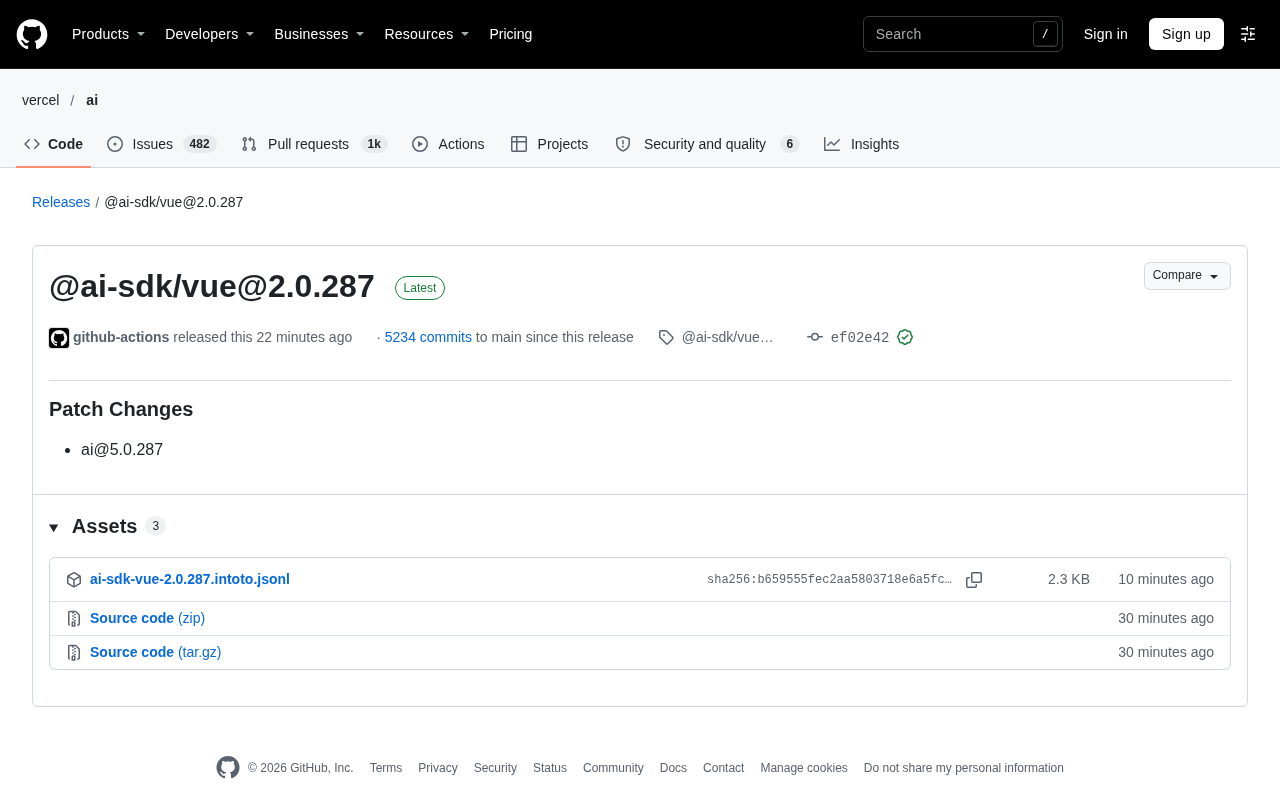
@ai-sdk/vue releases patch version 2.0.287, iterating in sync with the core package ai@5.0.287.
The article covers the release of `@ai-sdk/vue@2.0.287`: a patch-level update auto-published by GitHub Actions and signature-verified, with its version number aligned to the core package `ai@5.0.287`, reflecting a unified release pipeline for the core library and framework adapters. Such patches typically involve no breaking API changes, and their main value is maintaining behavioral consistency and more stable edge-case handling for streaming text and tool calls. Developers should check version correspondence, review the changelog, and test streaming before upgrading.
The AI toolchain in the Vue ecosystem recently saw a minor version iteration. @ai-sdk/vue released version 2.0.287, bringing a patch-level update to the official adapter layer that integrates large model capabilities into Vue applications. For developers currently integrating AI features into Vue projects, this kind of version change is worth a quick look.
Release Overview: A Typical Patch Update
From the release notes, @ai-sdk/vue@2.0.287 is a patch version (Patch Changes), automatically published by GitHub Actions, with the commit verified by GitHub's signature. The release notes also reference the core package ai@5.0.287, indicating that the Vue adapter layer maintains a synchronized version cadence with the AI SDK core library.
Releases like this typically do not involve major API changes; they mostly fix details, align dependency versions, or roll forward together with the core package. For existing projects, the upgrade cost is low, but it is still advisable to follow the usual process of reviewing the changelog and dependency tree before updating.
The Engineering Cadence Behind the Version Number
Looking at the commit history, the repository has accumulated 5,234 commits, indicating that the AI SDK project is in a state of high-frequency iteration. The alignment of the Vue package and core package version numbers (2.0.287 corresponding to ai@5.0.287) reflects a unified release pipeline: as core capabilities evolve, the framework adapter layers are released accordingly, ensuring a consistent cross-framework experience.
Semantic Versioning (SemVer) divides version numbers into three parts: major, minor, and patch, corresponding respectively to incompatible API changes, backward-compatible feature additions, and backward-compatible bug fixes. The 287 in 2.0.287 is the patch number, meaning this release in principle introduces no new APIs and breaks no existing usage; the upgrade risk is concentrated in behavioral details rather than the interface level. The patch number advancing to nearly three hundred also shows that this package has long corrected issues in a "small steps, quick pace" manner rather than batching up major version releases.
Related to this is the fixed/locked release strategy under the monorepo: when a repository contains a core package and multiple framework adapter layers, the toolchain can bump them all to the same version number on each release. This is exactly why the patch numbers of @ai-sdk/vue@2.0.287 and ai@5.0.287 match—it is no coincidence, but the result of enforced alignment by the release pipeline.
Practical Significance for Vue Developers
The role of @ai-sdk/vue is to expose AI SDK capabilities in a way that conforms to Vue's reactivity paradigm, letting developers consume results such as streaming text and tool calls within components using the Composition API approach. The patch version itself does not change this role, but it ensures behavioral consistency between the adapter layer and the core library.
If you are using this package to build chat interfaces, AI assistants, or content generation features, updates like this typically mean more stable edge-case handling. The upgrade method is the same as for regular npm packages; be sure to also check whether the ai core package version matches.
Pre-Upgrade Checklist
- Confirm the version correspondence between
aiand@ai-sdk/vuein your project - Check whether the release notes list any behavioral changes (this is a patch-level release, so typically there are no breaking changes)
- Verify in a test environment that streaming responses and component state updates work properly
The Composition API is the functional way of organizing logic introduced in Vue 3, centered on setup() and primitives such as ref, computed, and watch. The AI SDK's Vue adapter layer typically exposes capabilities in the form of composables—for example, returning a reactive message list, loading state, and error object, so components only need to bind these reactive references in the template to update automatically.
Streaming responses mean the model output is not returned all at once but pushed in chunks via SSE (Server-Sent Events) or ReadableStream. The adapter layer's job is to continuously write these asynchronous data chunks into Vue's reactive state, thereby driving the interface to render character by character. Tool calling means the model requests the execution of external functions with structured parameters, and the adapter layer needs to incorporate both the call request and the execution result into the reactive state flow. Therefore, if a patch-level update involves the timing of internal state updates, it may still affect the feel of streaming rendering.
How to Understand This Kind of High-Frequency Patch Release
The release cadence of the AI SDK ecosystem is noticeably faster than that of traditional frontend libraries, with the patch number already advancing to nearly three hundred. Behind this is the continuous change in model provider interfaces and the rapid growth in adapter layer requirements. For developers, there is no need to chase every patch, but keeping an eye on minor version upgrades can prevent you from being stuck on an outdated version when you encounter provider compatibility issues.
Combined with the verified signatures and automated release process on GitHub, it is clear that the project is fairly rigorous in its engineering standards. For teams relying on it to build production applications, this is a positive signal.
The frequent changes in model provider interfaces are the fundamental reason for the fast release cadence of AI SDK-type libraries. Different vendors differ in message formats, streaming chunk structures, tool call parameters, and error codes, and the adapter layer needs to quickly keep up as providers iterate; otherwise, upper-layer applications will encounter parsing failures or missing fields. Patch releases therefore often take on the responsibility of "catching up with upstream changes."
This also explains why the version correspondence should be checked before upgrading: the core package and framework adapter layers share type definitions and internal protocols, and upgrading only one of them may lead to type mismatches or inconsistent runtime fields. A more reliable practice is to use the same version range constraint for both in package.json and lock it with a lockfile, preventing cross-version combinations of adapter layer and core package in the dependency tree.
Conclusion
@ai-sdk/vue@2.0.287 is a routine patch release whose core value lies in maintaining synchronization between the Vue adapter layer and the AI SDK core library. It reminds Vue developers that AI capabilities are entering the frontend tech stack in the form of standardized SDKs, and that following the version cadence and understanding dependency relationships is more important than chasing any single version number.
One-line Summary
@ai-sdk/vue releases patch version 2.0.287, iterating in sync with the core package ai@5.0.287.
Paragraph Summary
The article introduces the release of @ai-sdk/vue@2.0.287: a patch-level update automatically published by GitHub Actions and verified by signature, with a version number aligned with the core package ai@5.0.287, reflecting the engineering pipeline that releases the core library and the various framework adapter layers together. The author notes that such patches typically involve no breaking API changes, and their main value lies in maintaining behavioral consistency between the adapter layer and the core library, providing more stable edge-case handling for capabilities such as streaming text and tool calling. The article advises Vue developers to verify the version correspondence between ai and @ai-sdk/vue, review the changelog, and validate streaming responses and component state updates in a test environment before upgrading. It also reminds readers that the AI SDK ecosystem iterates far more frequently than traditional frontend libraries, so they should focus on version matching rather than chasing every patch number.
Related articles

Hunter Rescues Educated Youth: The Mountain-Chasing System Launches a New Warm-Hearted Viral Drama Formula
Bilibili's early-access period short drama *Everyone Thinks I'm a Poor Hunter* opens with a snowy-night rescue of an educated youth. Hunter Chen Shan activates the mountain-chasing system, using realistic hypothermia first-aid details and mutual-probing character dynamics to deliver a warm-hearted period drama without the sleaze.

Riemann Hypothesis Proven by AI? The Truth Has Nothing to Do With Your Reality
34-year-old mathematician Levent Alpöge claims to have proven the Riemann Hypothesis and Generalized Riemann Hypothesis with Claude, releasing 17 million lines of formal verification code. This article sorts out the facts, debunks myths about RSA collapse and new material revolutions, and analyzes the true significance of mathematics-AI collaboration.

G3 Test Drive Gone Wrong: Why Is the "Dog Poop Gun" So Hard to Use?
Bilibili creator tests the G3 rifle, from skeleton barrel and 50-round drum to combat failure, calling it a "dog poop gun." Analyzing the gap between mods and real gameplay.