@ai-sdk/vue@3.0.287 Released: A Patch Update for the Vercel AI SDK

@ai-sdk/vue 3.0.287 patch release syncs core upstream dependencies — safe to upgrade for Vue projects.
Vercel AI SDK's Vue adapter `@ai-sdk/vue` has shipped version 3.0.287, a patch release with no new features or breaking changes. The update synchronizes upstream dependencies `ai@6.0.287` and `@ai-sdk/provider-utils@4.0.52`. The SDK belongs to the `vercel/ai` open-source repo (~26.9k stars) and provides a unified AI interface across React, Vue, and Svelte. Per SemVer, patch updates are backward-compatible, making this generally safe to apply — though developers using multiple related packages should verify version alignment to avoid conflicts.
Vercel's AI SDK ecosystem continues its rapid release cadence, with @ai-sdk/vue recently shipping version 3.0.287. This is a patch release focused on dependency updates, targeting developers building AI-powered applications with the Vue framework.
Release Overview
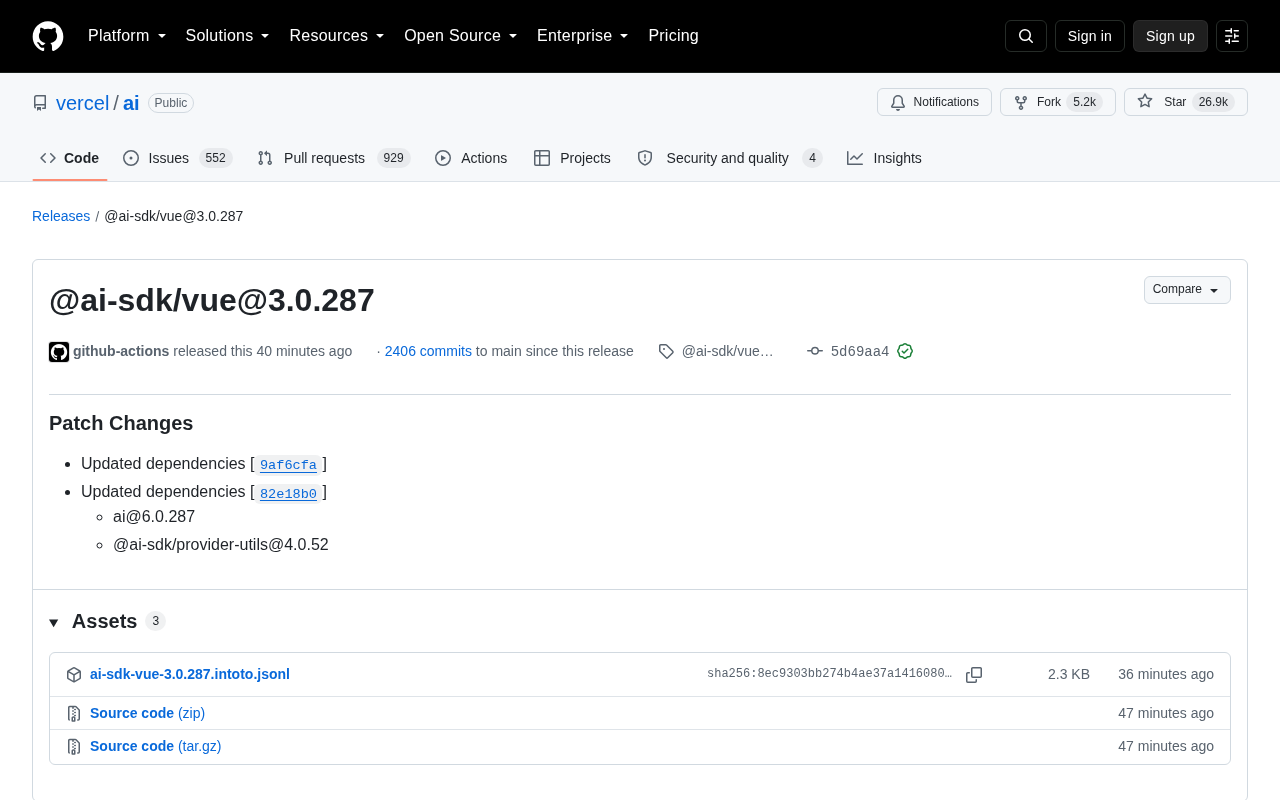
@ai-sdk/vue@3.0.287 is a patch-level update. The changes are concentrated in dependency synchronization rather than new features or breaking changes.
According to the GitHub Release page, this update includes:
- Updated dependencies (referencing commits
9af6cfaand82e18b0) - Synchronized core package upgrade to
ai@6.0.287 - Synchronized upgrade of
@ai-sdk/provider-utils@4.0.52
For teams that have already integrated this SDK into their projects, patch updates like this are generally safe to apply and allow you to pick up fixes and improvements from upstream packages.
About the Vercel AI SDK
@ai-sdk/vue is part of the Vercel AI SDK, housed in the vercel/ai open-source repository. The repo has accumulated approximately 26.9k stars and 5.2k forks, making it one of the most widely adopted toolkits for building AI-driven applications.
The AI SDK provides a unified interface that helps developers quickly integrate large language model capabilities across different frontend frameworks — such as React, Vue, and Svelte — covering common use cases like text generation, streaming output, and tool calling. @ai-sdk/vue is the Vue-specific adapter layer within this ecosystem.
The repository has accumulated around 2,405 commits to the main branch since the project's inception, reflecting a notably dense release cadence. This high-frequency patching is one of the primary ways the SDK stays in sync with the underlying model provider APIs.
@ai-sdk/provider-utils is an internal utility package within the Vercel AI SDK. It handles the abstraction of interface differences between various AI model providers (such as OpenAI, Anthropic, Google, etc.), including request format conversion, streaming response parsing, and error normalization. Framework adapter packages like @ai-sdk/vue depend on it to hide provider-specific API details, enabling developers to call different models with consistent code. Whenever a major provider updates its API spec or fixes compatibility issues, provider-utils is typically the first layer that needs to be updated — which then triggers cascading upgrades in the framework-level packages above it.
What Patch Updates Mean for Developers
Patch versions follow Semantic Versioning (SemVer) by incrementing the PATCH segment, and in theory contain only backward-compatible bug fixes. The core of this update is version synchronization with the ai core package and the provider-utils utility package.
Practical recommendations for developers:
- Projects with locked dependencies: Review the upstream
ai@6.0.287changelog before deciding whether to upgrade. - Projects that stay on the latest: Upgrading directly is generally low-risk and lets you benefit from upstream fixes immediately.
- Multi-package setups: Pay attention to the version correspondence between
@ai-sdk/vue,ai, and@ai-sdk/provider-utilsto avoid dependency conflicts.
It's worth noting that this release was published automatically via GitHub Actions and carries a verified GitHub signature, so its authenticity is assured.
Semantic Versioning (SemVer) splits version numbers into three segments — MAJOR.MINOR.PATCH: a MAJOR bump signals breaking API changes, MINOR indicates backward-compatible new features, and PATCH represents backward-compatible bug fixes only. In a monorepo SDK architecture, sub-packages (such as @ai-sdk/vue, ai, and @ai-sdk/provider-utils) often need to release in lockstep — even if a given sub-package has no code changes of its own, its PATCH version is incremented to align internal dependencies. This is a common practice in large multi-package repositories to maintain version consistency. If you use the ^ (caret) operator to pin versions in your package.json, running npm update will automatically fetch the latest PATCH within the same MINOR, keeping the risk relatively low.
Summary
@ai-sdk/vue@3.0.287 is a routine dependency-sync patch with no new features introduced. Its primary value lies in keeping pace with upstream package updates. For Vue projects that rely on the Vercel AI SDK, staying on top of these version bumps helps maintain healthy and stable dependencies. For details on specific fixes, it's worth consulting the changelogs for ai@6.0.287 and @ai-sdk/provider-utils@4.0.52 directly.
Related articles

Chain of Thought Isn't Just for AI: How Humans Can Use CoT to Improve Thinking Quality
Chain of Thought isn't just a prompt trick for large models. Starting from a Hacker News discussion, this article analyzes why CoT works for human thinking too, breaks down actionable ways to transfer it, and highlights the key differences between human CoT and machine CoT.
Cloudflare Teams Up with OpenAI: Closi…
Cloudflare Teams Up with OpenAI: Closing the Loop from Vulnerability Discovery to Defense with AI
Cloudflare uses OpenAI Daybreak to investigate security vulnerabilities and generate reviewable remediation plans, while developers use Codex to boost coding efficiency and quality.

Orca Multi-Agent Orchestration in Practice: A Guide to Parallel Collaboration with Claude and Codex
Orca is Stable AI's free open-source agent workbench supporting 34 agents like Claude Code and Codex in parallel. Learn its Git worktree isolation, multi-model orchestration, and mobile management.