@ai-sdk/vue@3.0.302 Released: What Vue Developers Need to Know About This Dependency Update

@ai-sdk/vue 3.0.302 patch release syncs dependency to ai@6.0.302 with no breaking changes.
`@ai-sdk/vue@3.0.302` is a typical patch-level dependency sync update, with the core change being an upgrade of the `ai` core package to `6.0.302`, along with several related dependency alignments. Published automatically via GitHub Actions with GPG signature verification, this release reflects AI SDK's monorepo architecture where `@ai-sdk/vue` wraps core functionality as Vue composables like `useChat` and `useCompletion`. As a patch update with no breaking changes, Vue projects can safely upgrade to benefit from core package stability improvements.
Version Overview
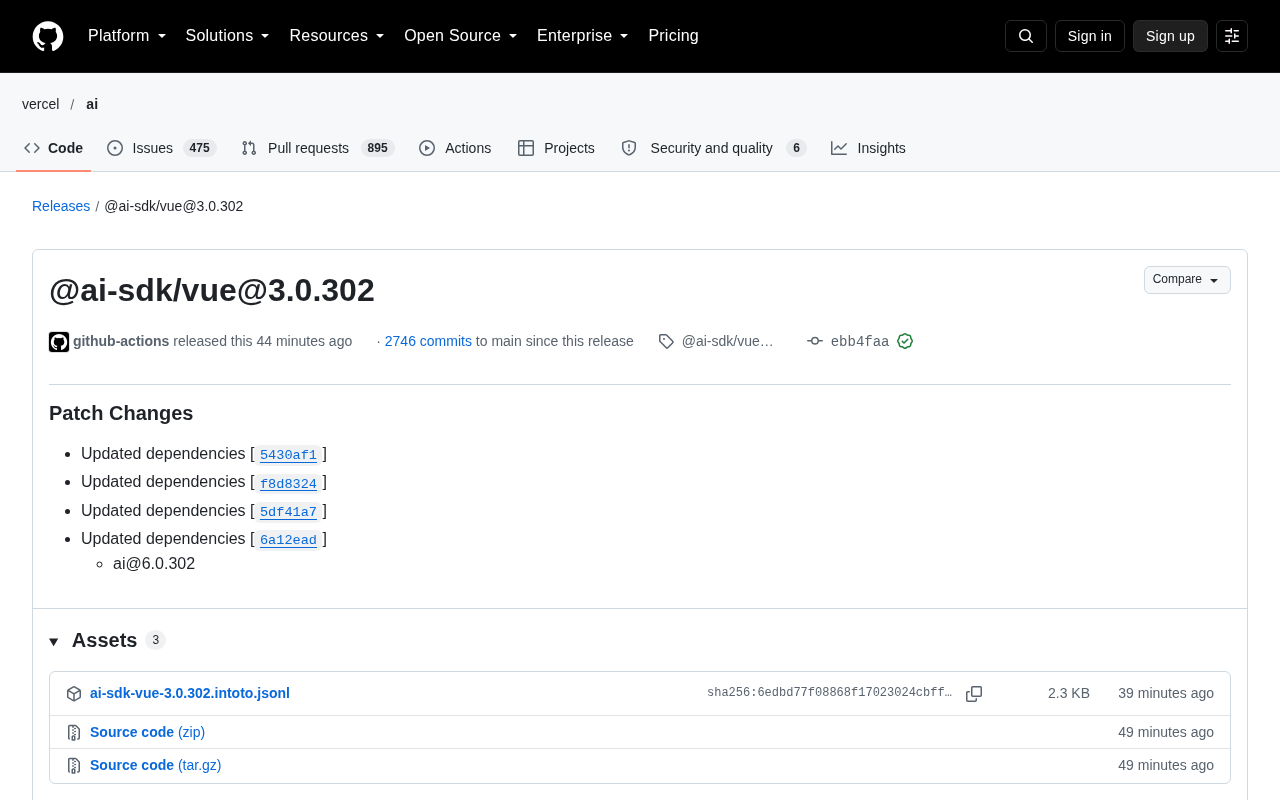
The Vue adapter package for AI SDK, @ai-sdk/vue, has released version 3.0.302 — a typical patch-level update. It was published automatically via GitHub Actions on October 7th, with commit hash ebb4faa, and passed GitHub's verified signature (GPG key ID: B5690EEEBB952194).
According to the release history, this update is a routine output from approximately 2,746 cumulative commits on the main branch. For developers who closely follow the AI SDK ecosystem, this kind of high-frequency, small-version iteration reflects the framework's active maintenance and ongoing stability.
What Changed: Dependency Sync at the Core
The key changes in 3.0.302 are centered around a dependency upgrade (Patch Changes) rather than any direct feature modifications. The release notes list multiple "Updated dependencies" entries, corresponding to commits 5430af1, f8d8324, 5df41a7, and 6a12ead.
The most significant change is the synchronization to ai@6.0.302. This means @ai-sdk/vue is keeping pace with the core ai package. AI SDK uses a monorepo architecture where the core logic lives in the ai package, while framework adapters like @ai-sdk/vue and @ai-sdk/react provide framework-specific wrappers on top. Whenever the core package releases a new version, the framework adapters typically follow with a corresponding dependency update.
Why Patch Updates Still Matter
Patch versions typically include bug fixes, dependency alignment, and internal optimizations — no breaking changes introduced. For teams building AI-powered applications with Vue, these updates are generally safe to adopt without worrying about major API-level adjustments. Staying in sync with the ai@6.x mainline also ensures Vue projects benefit from the stability improvements coming from core package fixes.
What is a Monorepo? A monorepo is an engineering strategy where multiple related packages or projects are managed within a single repository. AI SDK uses this model, allowing the core
aipackage and its framework adapters (@ai-sdk/vue,@ai-sdk/react,@ai-sdk/svelte, etc.) to share the same CI/CD pipeline and release cadence. When the core package fixes a bug or adds a new capability, the monorepo toolchain (typically Turborepo or Changesets) automatically detects dependency relationships and generates the corresponding version bump records for all affected sub-packages. This explains why the@ai-sdk/vue@3.0.302release notes show multiple "Updated dependencies" entries rather than explicit feature changes — the actual modifications happened in the upstream packages, and the adapter simply syncs its dependency declarations accordingly.
What This Means for Vue Developers
@ai-sdk/vue brings AI SDK capabilities — including streaming conversations, tool calls, and structured output — to Vue developers through composables that fit Vue's reactive paradigm (such as useChat and useCompletion). As the core package advances to 6.0.302, Vue ecosystem developers can simultaneously benefit from the underlying capability updates.
For projects using this package, here are some recommendations before upgrading:
- Verify compatibility between your current
aicore package version and@ai-sdk/vue, and aim to keep versions aligned; - For patch updates, you can upgrade directly via your package manager and run your existing test suite;
- Keep an eye on upcoming minor or major releases to evaluate potential interface changes ahead of time.
What are Composables? Composables (composition functions) are a core design pattern in Vue 3's reactivity system, used to encapsulate stateful logic into reusable functions — typically named with a
useprefix.@ai-sdk/vue'suseChatanduseCompletionare built on this pattern:useChatmanages multi-turn conversation message lists, streaming response state, and error handling;useCompletionfocuses on single-turn text completion scenarios. Both internally bridge Vue's reactive primitives (ref,computed, etc.) with AI SDK's streaming transport mechanism, so developers don't need to manually handle SSE (Server-Sent Events) or ReadableStream — conversation state can be bound directly in templates. This encapsulation approach mirrors the custom Hook pattern in the React ecosystem, while fully respecting Vue's reactive paradigm and template syntax conventions.
Summary
@ai-sdk/vue@3.0.302 is a patch release focused primarily on dependency synchronization, with the core change being an update to ai@6.0.302. While a single update like this carries limited new information on its own, it reflects the AI SDK's engineering discipline of maintaining high-frequency, consistent upkeep across multiple framework adapters. For Vue developers building AI applications, staying current with these version updates helps strike the right balance between stability and access to new capabilities.
Related articles

Chain of Thought Isn't Just for AI: How Humans Can Use CoT to Improve Thinking Quality
Chain of Thought isn't just a prompt trick for large models. Starting from a Hacker News discussion, this article analyzes why CoT works for human thinking too, breaks down actionable ways to transfer it, and highlights the key differences between human CoT and machine CoT.
Cloudflare Teams Up with OpenAI: Closi…
Cloudflare Teams Up with OpenAI: Closing the Loop from Vulnerability Discovery to Defense with AI
Cloudflare uses OpenAI Daybreak to investigate security vulnerabilities and generate reviewable remediation plans, while developers use Codex to boost coding efficiency and quality.

Orca Multi-Agent Orchestration in Practice: A Guide to Parallel Collaboration with Claude and Codex
Orca is Stable AI's free open-source agent workbench supporting 34 agents like Claude Code and Codex in parallel. Learn its Git worktree isolation, multi-model orchestration, and mobile management.