AI SDK Vue 3.0.304 Patch Update: The Versioning Strategy Behind Dependency Syncs

@ai-sdk/vue 3.0.304 is just a pure dependency patch syncing to core package ai@6.0.304.
Vercel AI SDK has released @ai-sdk/vue@3.0.304, a standard patch version that introduces no new APIs and whose changes are entirely concentrated on dependency updates from five commit hashes, ultimately aligning with the core package ai@6.0.304. The article explains why AI SDK uses a monorepo multi-package structure: core logic lives in the ai package, while framework adapters like Vue and React release independently to suit their different reactivity and state models, at the cost of dense adapter version numbers that are decoupled from core capabilities. Therefore, to judge behavioral changes, look at the ai package rather than the adapter version. When handling such updates, projects with strict lockfiles can upgrade as needed, range-version projects have effectively already received the update automatically, and before upgrading you should check the peer dependency resolution result and review the core package changelog.
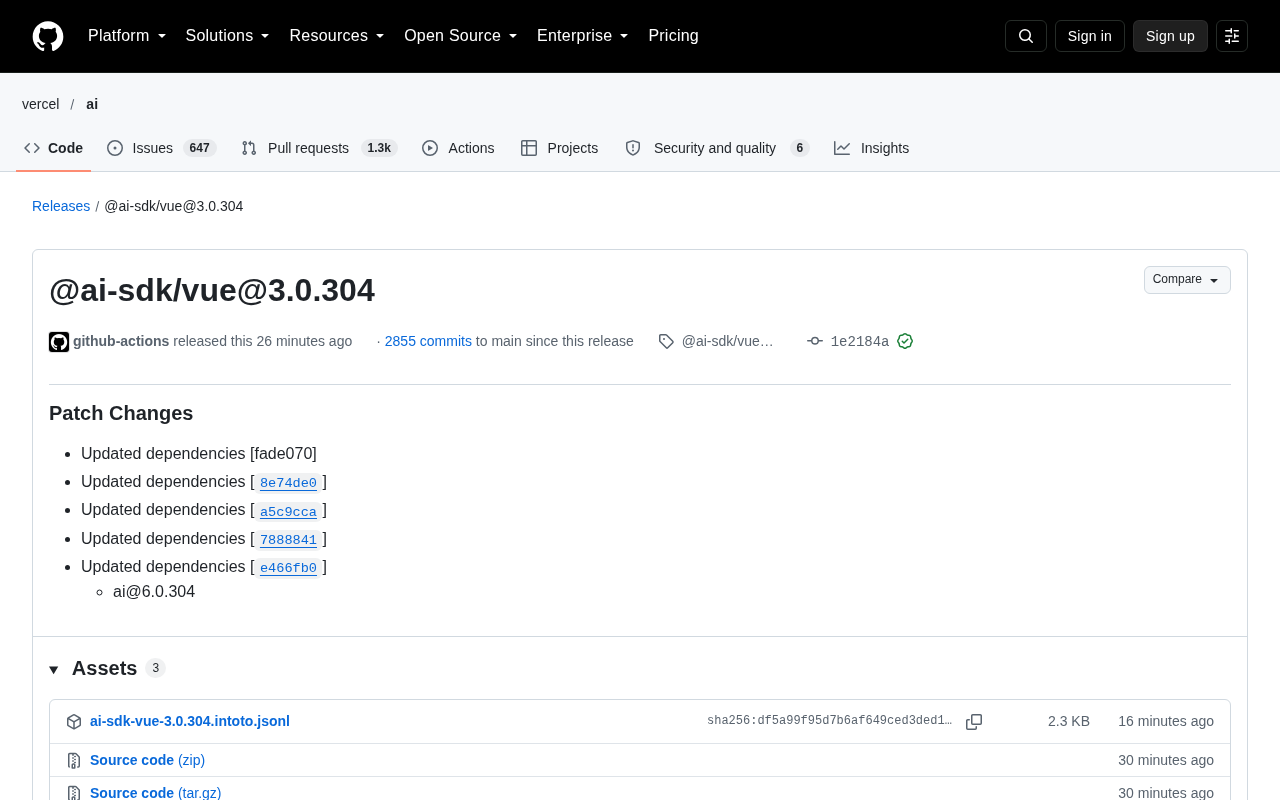
Vercel's AI SDK has released @ai-sdk/vue@3.0.304 on GitHub. Based on the release notes, this is a standard patch version (Patch Changes), and the core change is syncing several upstream dependencies, most notably ai@6.0.304. For developers using the Vue integration to bring large-model capabilities into their apps, this version doesn't introduce any new APIs—but it does reveal the multi-package versioning logic currently used by AI SDK.
What Actually Changed in This Update
The release notes show that all changes in this version are concentrated on dependency updates, involving five commit hashes (fade070, 8e74de0, a5c9cca, 7888841, e466fb0), ultimately pointing to the core package ai@6.0.304. In other words, @ai-sdk/vue itself has no independent code changes—it simply aligns the Vue binding layer's dependencies to the latest patch version of the core SDK.
This type of release is very common in SDK projects built on a monorepo architecture. AI SDK places its core logic in the ai package, while framework adapters like @ai-sdk/vue and @ai-sdk/react each release independently. When the core package fixes an underlying issue, the framework adapter needs to sync its dependency versions so that users can get the fix by upgrading the adapter.
Why Framework Adapters Release Independently
AI SDK's multi-package structure is rooted in a respect for the differences across framework ecosystems. Vue's reactivity system (ref, computed, watch) is fundamentally different from React's state model; forcing hooks like useChat into the core package would introduce a lot of conditional logic. By splitting into independent packages, each adapter can design the most natural API for its target framework.
The trade-off is that version numbers become dense. A version like 3.0.304 looks jumpy, but it's actually a patch counter maintained by the adapter itself. If developers only look at the @ai-sdk/vue version number, it's hard to tell whether the underlying capabilities have changed—the real signal is in the ai package version.
A monorepo (single repository) refers to managing multiple related software packages in a single Git repository, sharing build scripts, test configurations, and release processes. AI SDK, Babel, Vue 3 itself, and VitePress in the Vue ecosystem all use this structure. Its core advantage is that cross-package changes can be completed atomically in the same commit or PR, avoiding version drift between repositories; the trade-off is that releases require tools (such as Changesets, Lerna, pnpm workspace) to independently calculate version numbers and changelogs for each package. This is also why a single dependency sync produces five commit hashes: each commit may correspond to an independent change in some package, which the release process then aggregates to trigger a patch bump in the adapter.
Understanding the monorepo release model helps clarify the semantics of version numbers like 3.0.304: it describes the adapter's own patch sequence, not the functional progress of the core SDK.
peer dependency is a dependency declaration mechanism introduced by npm, meaning "this package requires the host environment to provide a certain package, but does not install it itself." In Vue projects using AI SDK, @ai-sdk/vue often declares ai as a peer dependency, leaving the application layer to decide which version to install. The benefit is avoiding duplicate installations of the same ai, which could cause type and runtime inconsistencies; the risk is that when a project has multiple packages requiring different ai versions, the package manager may keep only one of them, resulting in a "version being overridden" situation. pnpm is stricter about peer dependencies by default, often throwing an error rather than silently resolving, which is why the original article recommends confirming the actual resolved version before upgrading.
What Dependency Syncs Tell Us
A dependency update involving five commit hashes usually means the core package has accumulated several fixes in a short period. These fixes could be boundary handling for streaming responses, type corrections for tool calls, or provider-level compatibility adjustments. For projects using the Vue integration for AI capabilities, the direct benefit of upgrading to 3.0.304 is getting these core package fixes without having to separately pin the ai package version.
If your project manages AI SDK through pnpm or npm's peer dependency mechanism, it's worth confirming before upgrading whether the actual resolved version of the ai package has been pushed to an incompatible position by other dependencies. Dependency trees in multi-package monorepos can occasionally end up with the core package being required at different versions by multiple adapters.
How Developers Should Handle These Updates
For patch versions that are pure dependency syncs, the handling strategy depends on how the project manages dependencies. Projects that strictly lock dependencies with a lockfile can upgrade as needed without chasing every patch number; projects using range version numbers (like ^3.0.0) have effectively already received this update automatically, and the focus should be on whether the core package's behavior has changed.
A more valuable habit to develop: when upgrading @ai-sdk/vue, also check the ai package changelog. Framework adapter release notes often just say "Updated dependencies," while the real behavioral changes are recorded in the core package. Ignoring this can lead you down the wrong path when troubleshooting issues.
Related articles

Chain of Thought Isn't Just for AI: How Humans Can Use CoT to Improve Thinking Quality
Chain of Thought isn't just a prompt trick for large models. Starting from a Hacker News discussion, this article analyzes why CoT works for human thinking too, breaks down actionable ways to transfer it, and highlights the key differences between human CoT and machine CoT.
Cloudflare Teams Up with OpenAI: Closi…
Cloudflare Teams Up with OpenAI: Closing the Loop from Vulnerability Discovery to Defense with AI
Cloudflare uses OpenAI Daybreak to investigate security vulnerabilities and generate reviewable remediation plans, while developers use Codex to boost coding efficiency and quality.

Orca Multi-Agent Orchestration in Practice: A Guide to Parallel Collaboration with Claude and Codex
Orca is Stable AI's free open-source agent workbench supporting 34 agents like Claude Code and Codex in parallel. Learn its Git worktree isolation, multi-model orchestration, and mobile management.