AI SDK Vue 3.0.307 Released: Dependency Updates and Version Evolution

@ai-sdk/vue 3.0.307 patches dependencies to keep multi-package ecosystem version-consistent
@ai-sdk/vue released patch 3.0.307, an automated dependency-sync update bumping @ai-sdk/provider-utils to 4.0.59 and ai to 6.0.307, with no new APIs or breaking changes. In a multi-package ecosystem like AI SDK, the value of patch versions lies in maintaining version alignment between adapters and core packages. Vue developers face minimal upgrade cost but should check compatibility across ai, @ai-sdk/vue, and provider packages.
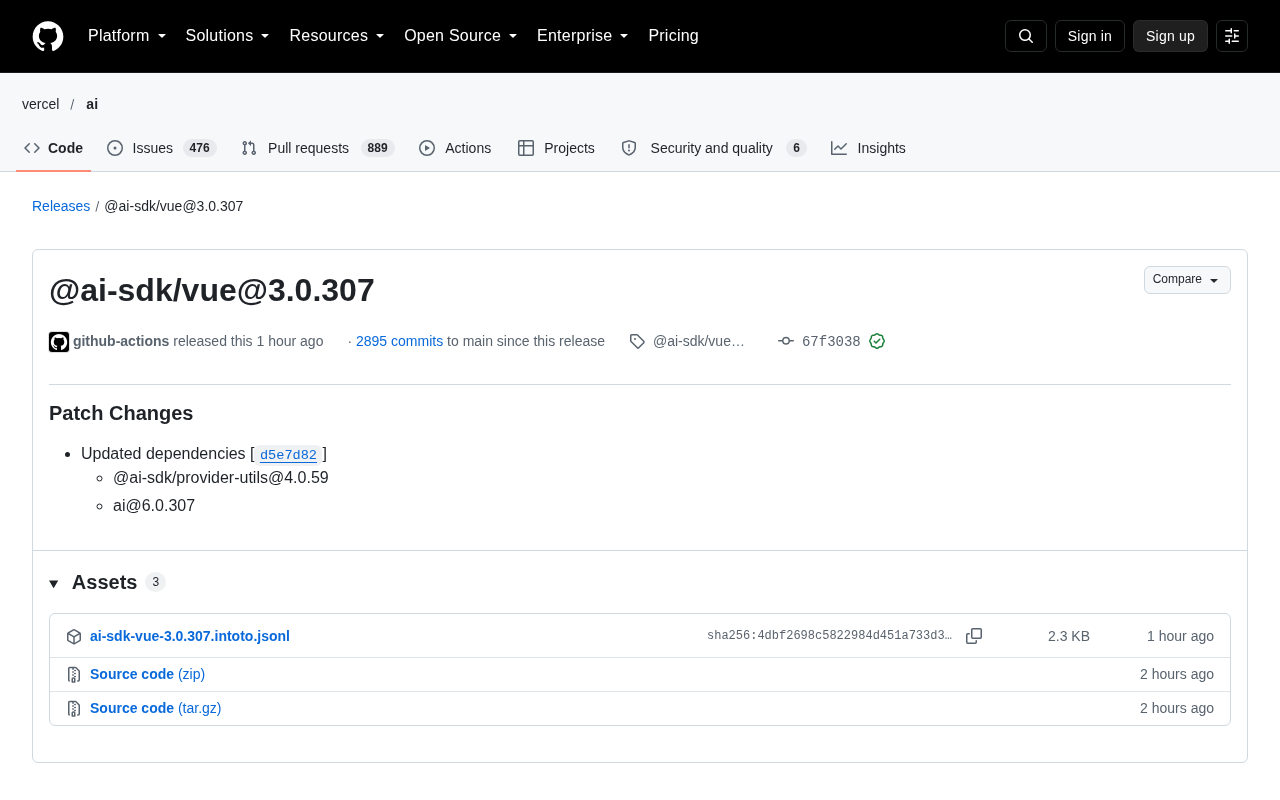
Vercel's AI SDK ecosystem continues to iterate at a rapid pace. Recently, @ai-sdk/vue released version 3.0.307, a typical patch update whose core changes center on synchronized upgrades across the dependency chain. For developers building AI applications with Vue and integrating large model capabilities through the AI SDK, understanding the cadence and impact of these small releases helps with better dependency management.
What's in This Update
Looking at the release record, the changes in @ai-sdk/vue@3.0.307 are very restrained — it's a patch version produced by an automated release pipeline. The specific changes include:
- Dependency update: Follows upstream
@ai-sdk/provider-utilsupgrade to version 4.0.59 - Core package sync: The companion
aipackage is synchronized to 6.0.307 - Release method: Automatically published by github-actions, with GPG-signed commit verification
This type of update introduces no new APIs or feature changes. Its main purpose is to keep the Vue adapter layer consistent with the AI SDK core package and utility package versions.
Why These Small Versions Matter
Many developers overlook patch version updates, thinking "no new features means no need to upgrade." But in a multi-package ecosystem like AI SDK, version alignment matters more than you might think.
@ai-sdk/vue is the UI integration layer of AI SDK for the Vue framework. It depends on @ai-sdk/provider-utils for model provider utility logic while maintaining an interface contract with the ai core package. When upstream utility packages fix edge cases, type definitions, or request handling details, the framework adapter layer needs to update its dependency declarations to propagate those fixes to end projects.
From another angle, the patch number 307 itself indicates a fairly high release frequency. Vercel employs a continuous automated release strategy for AI SDK, where every change to the core package triggers linked updates in downstream adapter packages.
Semantic Versioning (SemVer) and What the Patch Number Means
The "307" mentioned here is the last segment of a Semantic Versioning (SemVer) number. SemVer splits a version number into three parts — MAJOR.MINOR.PATCH: a major version bump means incompatible API changes, a minor version bump represents backward-compatible feature additions, and a patch bump contains only backward-compatible bug fixes. So the 307 in 3.0.307 indicates this is the 307th release for bug fixes or internal dependency adjustments, with no breaking changes.
It's worth noting, however, that AI SDK's patch numbers are unusually high (often in the hundreds), which is uncommon in practical engineering. It reflects a strategy of "release on every dependency change" under an automated pipeline, rather than accumulating hundreds of independent fixes. Understanding this prevents developers from being misled by high patch numbers into thinking large differences have accumulated — the actual code difference between adjacent patch numbers is often very small.
Version Linkage and peerDependencies in a monorepo
AI SDK uses a monorepo structure to manage ai, @ai-sdk/provider-utils, and the various framework adapter packages. In this structure, packages typically establish contracts through peerDependencies or pinned-version dependencies: adapters declare the expected version range of core packages, and the package manager validates compatibility during installation. When the core package publishes a patch fixing type or runtime details, adapters that don't update their dependency declarations may end up with "two copies of provider-utils in the dependency tree" or mismatched type definitions.
This is exactly why patch releases also need linkage: @ai-sdk/vue bumping its @ai-sdk/provider-utils dependency to 4.0.59 essentially re-confirms the version contract. For projects using pnpm, npm, or yarn, you can check for duplicate installations during upgrades with commands like pnpm why @ai-sdk/provider-utils to avoid inconsistent runtime behavior.
Practical Impact for Vue Developers
If you're building chat interfaces, streaming response components, or AI-driven interactive features with Vue + AI SDK, the practical impact of this update can be summarized as:
Extremely low upgrade cost. Patch versions don't involve breaking changes — usually just running the package manager update command is enough, with no business code changes required.
Dependency consistency matters more. If your project pins ai, @ai-sdk/vue, and a provider package (like @ai-sdk/openai), it's advisable to check their version compatibility matrix together to avoid type errors from adapter-core version mismatches.
Continuous tracking beats bulk upgrades. The benefit of frequent small versions is that each change surface is small and problems are easy to pinpoint; if you go long without upgrading and then jump across many versions at once, troubleshooting costs rise significantly.
AI SDK's Multi-Framework Strategy
This release also reveals Vercel's positioning of AI SDK: it's not a library bound to a single framework, but one that covers major frontend frameworks through adapter packages like @ai-sdk/react, @ai-sdk/vue, and @ai-sdk/svelte. Core logic is consolidated in the ai package and provider-utils, while framework adapters only handle their respective state management and reactive bindings.
The cost of this architecture is a large number of packages and the need for strict version synchronization, but the benefit is that developers on each framework get APIs idiomatic to that framework. Patch numbers like 307 are a direct reflection of this multi-package collaborative architecture in action.
Reactive Abstraction in Framework Adapters
The core responsibility of each AI SDK framework adapter is to map the UI-agnostic streaming state machine (such as message lists, loading states, and incremental text streams) onto each framework's own reactive system. In Vue, this means exposing state using primitives like ref, reactive, and computed, delivered as composables — for example, an API like useChat that returns destructurable reactive references. In React, the same semantics are implemented using useState and hook rules.
This design lets the core package maintain just one pure logic implementation, while adapters focus on "translating" it into framework-idiomatic patterns. The trade-off is that adapters must be updated whenever the core package's interface changes, which also explains why Vue, React, Svelte, and other adapters all emit patches in sync whenever the core package changes — they share the same interface contract, so version numbers must be strictly aligned.
Summary
@ai-sdk/vue@3.0.307 itself has no feature changes worth writing home about — its value lies in maintaining ecosystem version consistency. For AI application developers on the Vue stack, keeping moderate awareness of these patch releases and managing dependencies well with a semantic versioning strategy is the more pragmatic choice.
One-line Summary
@ai-sdk/vue releases 3.0.307 patch, syncing dependencies to keep the multi-package ecosystem version-consistent
Paragraph Summary
@ai-sdk/vue released patch version 3.0.307, an automated dependency-sync update bumping @ai-sdk/provider-utils to 4.0.59 and the ai core package to 6.0.307, with no new APIs or breaking changes. The article notes that in a multi-package ecosystem like AI SDK, patch versions matter for keeping adapters and core packages version-aligned to avoid type mismatches. For Vue developers, upgrade cost is minimal — just run the package manager update — but it's advisable to check the compatibility matrix of ai, @ai-sdk/vue, and provider packages together. The article also explains AI SDK's multi-framework strategy: core logic is consolidated in ai and provider-utils, while framework adapters handle only their own reactive bindings, resulting in many packages and strict version synchronization.
Related articles

Software Factory in Practice: Building an Evaluable Self-Evolving Development Pipeline with Codex and Claude Code
Deconstructing a Codex and Claude Code software factory: control/data plane separation, foreman prompts for consistency, automatic triggers, and data-driven evaluation.

WorkBuddy Full Guide: How an AI Coworker Takes Over Workplace Automation
What is WorkBuddy? This article analyzes the core capabilities of this full-scenario AI agent: autonomous execution with deliverable results, local file processing, multi-agent parallelism, and workplace automation workflows, helping you judge its essential difference from ordinary AI chat tools.

The Truth About AI Agents: A Hundred Lines of Code + an LLM, Deconstructing the Agent's Underlying Logic
AI agents aren't a new AI species—just a language model plus tools, a loop, and a goal. Here's the underlying logic: how 100 lines of Python hit a 75% fix rate, why the harness beats the model, and Gartner's "agent washing."