AI SDK Vue 3.0.309 Update: Dependency Patches and Ecosystem Evolution

@ai-sdk/vue releases patch 3.0.309, reflecting the AI frontend toolchain's standardization and high-frequency maintenance trend.
@ai-sdk/vue has released version 3.0.309, a Patch Changes update that syncs the dependency @ai-sdk/provider-utils to 4.0.61 and updates the ai core package to 6.0.309. Though the version number looks ordinary, it reflects Vercel AI SDK's continued investment in Vue. @ai-sdk/vue fills the gap of Vue 3 lacking official-level AI tooling, encapsulating streaming responses, state management, and error handling. The article notes that frequent patch releases signal active maintenance while also urging teams to establish dependency update processes, verify in test environments first, and check multi-provider switching features.
The Significance Behind a Routine Release
In the world of open-source software, version number bumps often reflect a project's true state better than news headlines. @ai-sdk/vue has released version 3.0.309, which looks like just an ordinary patch update, but for developers following the AI application development toolchain, it signals the continued iteration of the Vercel AI SDK ecosystem.
What's in the Update
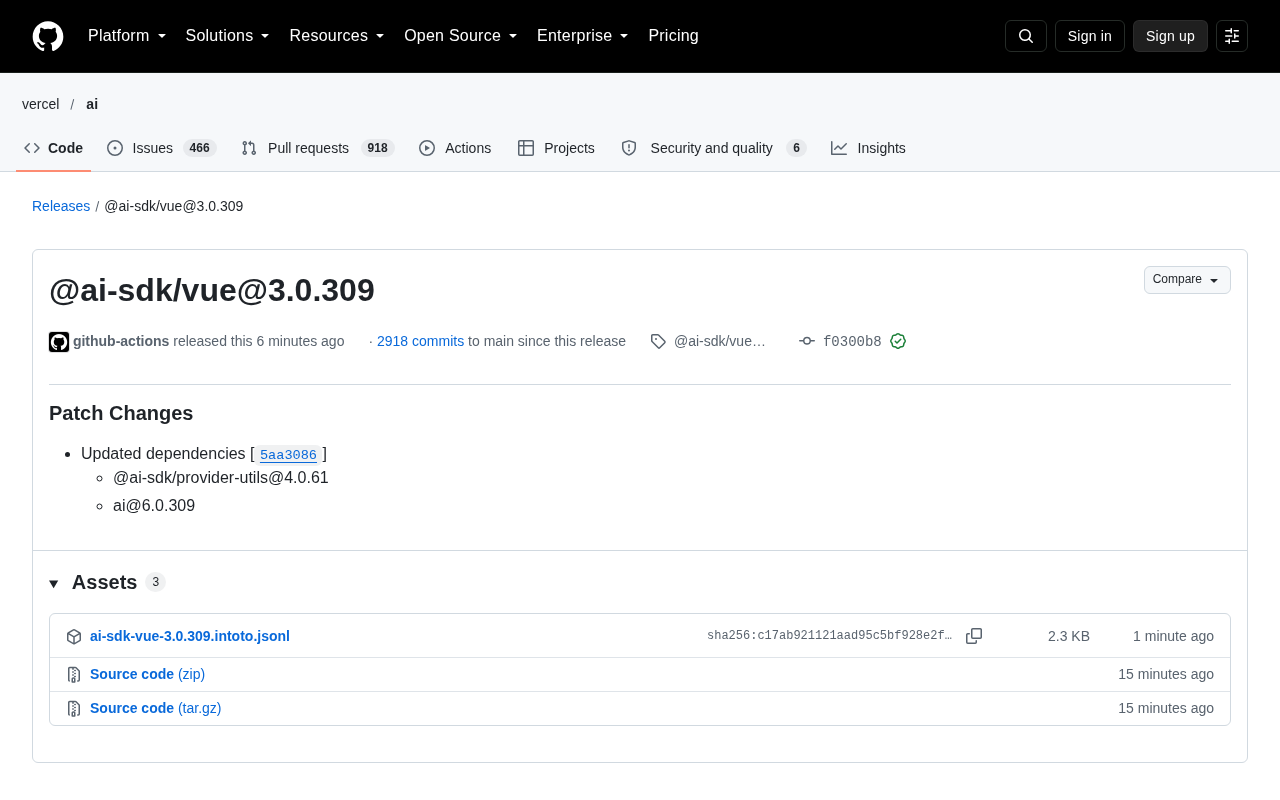
According to the release notes on GitHub, this update falls under the Patch Changes category. The core change is updating the dependency @ai-sdk/provider-utils to version 4.0.61, along with syncing the ai core package to 6.0.309. Looking at the commit history, this release came after 2918 commits of accumulated work since the previous release.
Patch versions in semantic versioning typically mean backward-compatible bug fixes and minor optimizations. For teams already using @ai-sdk/vue in production, these updates generally don't require large-scale adjustments to existing code, so the upgrade cost is low.
Semantic Versioning (SemVer) is a versioning convention widely adopted by the open-source community, formatted as MAJOR.MINOR.PATCH. MAJOR indicates incompatible API changes, MINOR indicates backward-compatible feature additions, and PATCH indicates backward-compatible bug fixes. In this example's 3.0.309, the major version 3 is relatively stable, the minor version 0 indicates no feature-level changes were introduced recently, and the patch number reaching 309 reflects the maintenance team's continuous fine-grained fixes and dependency syncing. It's worth understanding that semantic versioning is only a "convention" rather than a mandatory constraint — whether patch-level backward compatibility is truly achieved in practice still depends on the maintainers' discipline. Therefore, checking the CHANGELOG and related dependency changes before upgrading is more reliable than simply trusting the version number.
Why Vue Developers Should Care
The Vue ecosystem has long lacked official-level tooling support in the AI application development space. @ai-sdk/vue fills this gap by providing Vue 3 applications with a standardized interface for interacting with AI models. This package encapsulates common needs such as streaming response handling, state management, and error handling, so frontend developers don't have to build an AI interaction layer from scratch.
Keeping dependencies in sync is equally important. @ai-sdk/provider-utils, as the underlying utility library, handles protocol differences between various AI providers. Its version advancing means compatibility with new model APIs is continuously improving.
"Streaming response handling" refers to how AI models (especially large language models) don't return all content at once when generating text, but instead stream it back token by token via Server-Sent Events or chunked transfer. The frontend needs to maintain an incrementally updatable state container, rendering as it receives, otherwise users face a long blank wait. These requirements naturally align with reactive frameworks: Vue 3's ref, reactive, and Composition API make the "receive a chunk, update once" pattern concise, and watchEffect can drive view refreshes. @ai-sdk/vue abstracts this pattern into reusable composables, so developers only need to bind state without handling the underlying read loop and cancellation logic themselves.
The Development Rhythm Behind the Version Number
The version number 3.0.309 reveals some information. The high patch number indicates the project is in a high-frequency maintenance state, with the development team continuously fixing issues and optimizing details. The accumulation of 2918 commits also confirms this is a highly active code repository.
For technology decision-makers, frequent patch updates are a double-edged signal. On one hand, it shows the project is actively maintained with quick issue response; on the other hand, it means teams need to establish corresponding dependency update processes to avoid compatibility issues caused by version lag.
High-frequency patch releases are quite common in mature toolchain projects, often backed by continuous integration and automated release pipelines. After developers merge commits, the pipeline automatically runs tests, builds, generates the CHANGELOG, and pushes the new version, so patch numbers accumulate quickly. This rhythm is both friendly and comes with hidden costs for users: friendly in that issues get fixed quickly, and hidden costs in that dependency management needs supporting mechanisms. In practice, it's recommended to pin the minor version range (e.g., using ~3.0.309 instead of ^3.0.0), and combine with automation tools for regular batch upgrades, avoiding the debugging difficulties that come from long stagnation followed by jumping across many versions at once.
How to Evaluate This Update
If your project is using @ai-sdk/vue, it's recommended to verify this update in a test environment first. Focus on checking whether features related to @ai-sdk/provider-utils work correctly, especially scenarios involving multi-provider switching.
For Vue teams that haven't adopted this library yet, this version can serve as an entry point for evaluation. By examining its dependency relationships and API design, you can determine whether it fits your tech stack and AI feature requirements.
Observations from an Ecosystem Perspective
AI SDK's multi-framework support strategy is worth noting. Vercel maintains adapter packages for React, Vue, Svelte, and other frameworks simultaneously — this layout shows that AI capabilities are transforming from an add-on feature of frontend frameworks into an infrastructure-level requirement. The continued updates of @ai-sdk/vue are a footnote to this trend.
The takeaway for developers is: AI integration is becoming standardized. In the past, every team had to handle streaming, token management, and error retry on their own; now these capabilities are being abstracted into reusable libraries. Following the evolution of such tools helps make wiser choices in technical decisions.
The reason multi-framework adapter packages can share the same underlying capabilities lies in the design of the abstraction layer. Utility libraries like @ai-sdk/provider-utils are responsible for smoothing over differences between AI providers in request formats, authentication methods, and streaming protocols, exposing a unified interface to upper-layer framework adapters; each framework package (Vue, React, Svelte) only needs to handle its own framework-specific state binding and lifecycle concerns. The benefit of this layering is that when a model vendor introduces a new API, it only needs to be adapted once at the provider layer, and users across all frameworks benefit. This also explains why minor version advances in dependencies deserve attention — they often represent compatibility boundaries quietly expanding.
One-line Summary
@ai-sdk/vue releases patch version 3.0.309, reflecting the ongoing standardization and high-frequency maintenance trend of the AI frontend toolchain.
Paragraph Summary
@ai-sdk/vue has released version 3.0.309, a Patch Changes category update whose core change is syncing the dependency @ai-sdk/provider-utils to 4.0.61 and updating the ai core package to 6.0.309. Although the version number looks ordinary, it reflects Vercel AI SDK's continued investment in the Vue direction. @ai-sdk/vue fills the gap of Vue 3 lacking official-level tooling support in AI application development, encapsulating common capabilities like streaming responses, state management, and error handling. The article notes that frequent patch releases indicate active project maintenance while also reminding user teams to establish dependency update processes. For teams currently using or evaluating this library, it's recommended to verify in a test environment first, focusing on multi-provider switching features, and to judge whether it fits their tech stack based on dependency relationships and API design.
Related articles

Chain of Thought Isn't Just for AI: How Humans Can Use CoT to Improve Thinking Quality
Chain of Thought isn't just a prompt trick for large models. Starting from a Hacker News discussion, this article analyzes why CoT works for human thinking too, breaks down actionable ways to transfer it, and highlights the key differences between human CoT and machine CoT.
Cloudflare Teams Up with OpenAI: Closi…
Cloudflare Teams Up with OpenAI: Closing the Loop from Vulnerability Discovery to Defense with AI
Cloudflare uses OpenAI Daybreak to investigate security vulnerabilities and generate reviewable remediation plans, while developers use Codex to boost coding efficiency and quality.

Orca Multi-Agent Orchestration in Practice: A Guide to Parallel Collaboration with Claude and Codex
Orca is Stable AI's free open-source agent workbench supporting 34 agents like Claude Code and Codex in parallel. Learn its Git worktree isolation, multi-model orchestration, and mobile management.