@ai-sdk/vue 3.0.312 Patch Release: Dependency Updates and the AI SDK Ecosystem

@ai-sdk/vue releases 3.0.312 patch, synchronizing dependency versions with limited impact on Vue AI developers.
@ai-sdk/vue releases patch version 3.0.312, with the core change being dependency synchronization: @ai-sdk/provider-utils upgraded to 4.0.62 and the ai package upgraded to 6.0.312. This update is classified as Patch Changes, typically containing no new features or breaking changes, but may propagate underlying fixes through the dependency chain. The article explains the role of provider-utils as a provider adaptation utility library and the compatibility strategy of version linkage under a monorepo. For Vue developers building chat interfaces with composables like useChat, business code most likely requires no changes, but it is recommended to perform the upgrade and focus on testing streaming rendering and error handling scenarios. Overall, this release reflects Vercel's continued investment in multi-framework AI integration.
@ai-sdk/vue 3.0.312 Patch Release: Dependency Updates and the AI SDK Ecosystem
The AI SDK ecosystem is moving fast again with another small step. Vercel's @ai-sdk/vue package has released version 3.0.312, a patch update primarily involving dependency synchronization. For developers building AI applications with Vue, these version iterations may seem minor, but they reflect the activity level of the entire AI SDK toolchain.
Version Update Overview
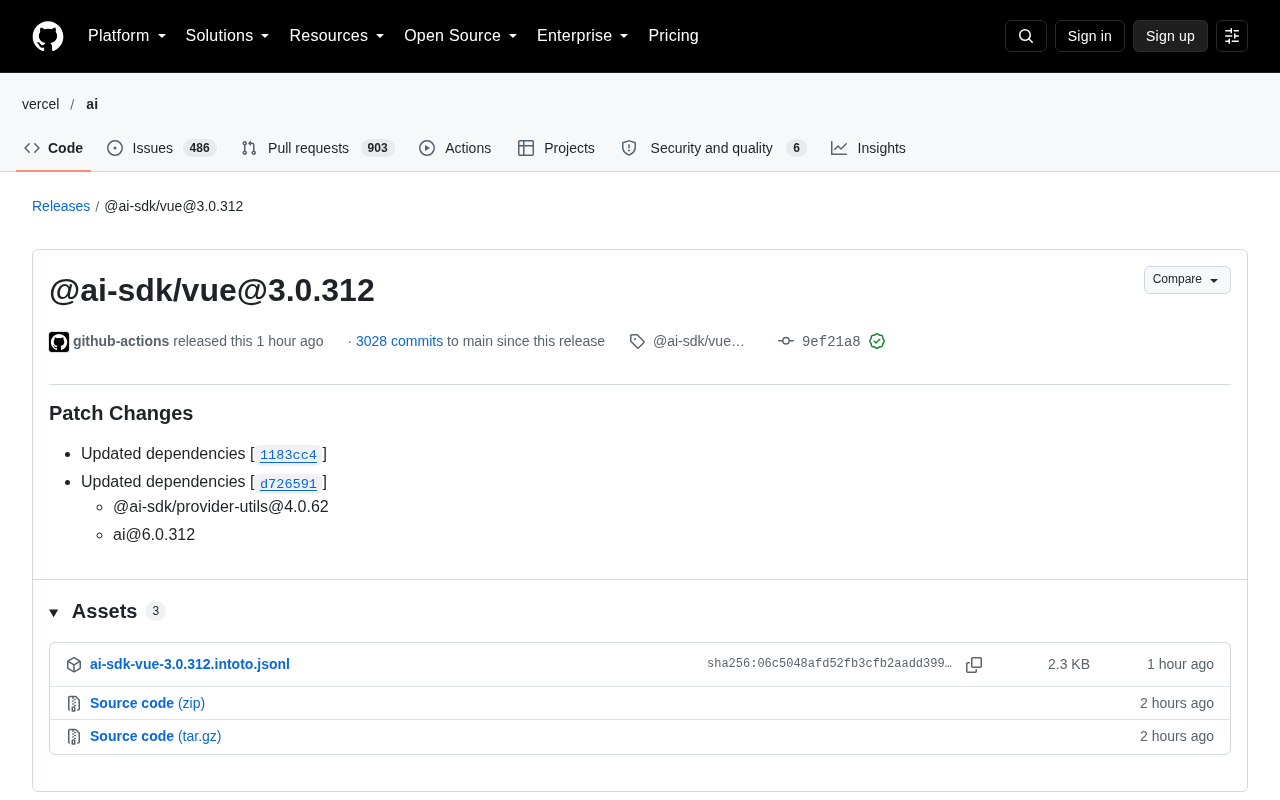
According to the release notes on GitHub, @ai-sdk/vue@3.0.312 is classified as Patch Changes, i.e., a patch-level update. The core content is the update of two dependencies: @ai-sdk/provider-utils upgraded to 4.0.62, and the ai package synchronized to 6.0.312. These dependency updates were triggered by commits 1183cc4 and d726591, and are transitive dependency updates.
Such patch versions typically do not include new features or breaking changes; their purpose is to fix minor issues in the underlying toolchain, align version numbers, or propagate upstream fixes. For regular developers, the upgrade cost is minimal, but it is advisable to check whether the dependency chain includes behavioral changes.
Patch Changes follow Semantic Versioning (SemVer), where the version number format is major.minor.patch, and a patch update means the patch number is incremented. Under SemVer conventions, patch versions should only contain backward-compatible bug fixes and should not introduce new features or breaking changes. However, in actual monorepo ecosystems, patch updates are often used to synchronize dependency versions, propagate upstream fixes, or align internal package version numbers. Therefore, developers cannot judge the scope of changes solely by the version number; they still need to check the changelog or commit history to confirm whether behavioral changes are involved.
Dependency Chain Explained: provider-utils and the ai Package
@ai-sdk/provider-utils is the low-level utility library in the AI SDK responsible for provider adaptation, encapsulating common logic such as model invocation, streaming response handling, and error mapping. Its version advancing to 4.0.62 indicates that this module is still being iterated frequently. The ai package is the core package of the AI SDK, providing APIs such as generateText and streamText, with version numbers aligned to the 6.0.312 / 3.0.312 cadence of @ai-sdk/vue.
This version linkage is a typical characteristic of monorepo management: all packages share version numbers or increment according to fixed rules to ensure cross-package compatibility. When developers use composables like useChat from @ai-sdk/vue, the underlying implementation actually depends on the streaming capabilities of the ai package, so dependency updates may indirectly affect runtime behavior.
Monorepo is a strategy of managing multiple related packages in a single code repository. The AI SDK adopts a monorepo model, where packages such as @ai-sdk/vue, @ai-sdk/react, ai, and @ai-sdk/provider-utils share the same build, test, and release processes. Common version management approaches include fixed versions (all packages have the same version number) and independent versions (each package increments independently). In this article, @ai-sdk/vue is at 3.0.312 while the ai package is at 6.0.312, indicating that the two use independent version numbers but remain synchronized through the release process. The advantage of a monorepo is that cross-package modifications can be committed at once and tested uniformly, reducing compatibility risks; the cost is complex dependency relationships, where patch updates may indirectly affect multiple packages through the dependency chain.
Practical Impact on Vue AI Developers
If you are using @ai-sdk/vue to build chat interfaces or AI assistants, this update most likely does not require changes to your business code. However, it is recommended to perform a dependency upgrade and run your tests, especially in scenarios involving streaming rendering and error handling. Patch updates sometimes fix edge cases, such as resource cleanup when canceling requests or fault tolerance in SSE parsing.
From an ecosystem perspective, the continuous releases of @ai-sdk/vue indicate that Vercel remains committed to multi-framework support. Similar to the React version @ai-sdk/react, the Vue version aims to lower the barrier to integrating AI capabilities into frontends, allowing developers to handle asynchronous streams using familiar reactive syntax.
Composable is the core pattern of the Vue 3 Composition API, referring to functions that start with use and encapsulate reusable state logic. The useChat provided by @ai-sdk/vue is a composable: it internally manages reactive data such as the message list, loading state, and error state, and exposes methods like sendMessage and reload. Similar to React Hooks, composables can only be called within a setup function or another composable, and each call creates an independent state instance. Understanding the reactive lifecycle of composables helps troubleshoot rendering timing issues during streaming updates, such as synchronizing message appending with scroll positioning.
SSE (Server-Sent Events) is an HTTP-based server push technology that allows the server to continuously send events to the client as a text stream. In AI chat scenarios, SSE is commonly used to stream model-generated tokens, enabling the frontend to render responses character by character. Unlike WebSocket, SSE is one-way communication (server to client), is simpler to implement, and natively supports reconnection. The streaming responses of the AI SDK typically rely on SSE or similar streaming HTTP protocols at the底层, so fixes involving SSE parsing fault tolerance and resource cleanup when connections are canceled in patch updates directly affect the stability of streaming rendering.
Conclusion
@ai-sdk/vue@3.0.312 is a routine patch release, with dependency synchronization at its core. It contains limited information on its own, but as a microcosm of the AI SDK toolchain, it reminds developers to keep dependencies updated and pay attention to changes in underlying packages. For production projects, it is recommended to lock versions and regularly review changelogs to avoid the uncertainty brought by passive upgrades.
One-line Summary
@ai-sdk/vue releases 3.0.312 patch, synchronizing dependency versions with limited impact on Vue AI developers.
Paragraph Summary
@ai-sdk/vue releases patch version 3.0.312, with the core change being dependency synchronization: @ai-sdk/provider-utils upgraded to 4.0.62 and the ai package upgraded to 6.0.312. This update is classified as Patch Changes, typically containing no new features or breaking changes, but may propagate underlying fixes through the dependency chain. The article explains the role of provider-utils as a provider adaptation utility library and the compatibility strategy of version linkage under a monorepo. For Vue developers building chat interfaces with composables like useChat, business code most likely requires no changes, but it is recommended to perform the upgrade and focus on testing streaming rendering and error handling scenarios. Overall, this release reflects Vercel's continued investment in multi-framework AI integration.
Related articles

Chain of Thought Isn't Just for AI: How Humans Can Use CoT to Improve Thinking Quality
Chain of Thought isn't just a prompt trick for large models. Starting from a Hacker News discussion, this article analyzes why CoT works for human thinking too, breaks down actionable ways to transfer it, and highlights the key differences between human CoT and machine CoT.
Cloudflare Teams Up with OpenAI: Closi…
Cloudflare Teams Up with OpenAI: Closing the Loop from Vulnerability Discovery to Defense with AI
Cloudflare uses OpenAI Daybreak to investigate security vulnerabilities and generate reviewable remediation plans, while developers use Codex to boost coding efficiency and quality.

Orca Multi-Agent Orchestration in Practice: A Guide to Parallel Collaboration with Claude and Codex
Orca is Stable AI's free open-source agent workbench supporting 34 agents like Claude Code and Codex in parallel. Learn its Git worktree isolation, multi-model orchestration, and mobile management.