@ai-sdk/vue 3.0.330 Released: Routine Update and Stable Version Iteration

@ai-sdk/vue releases patch 3.0.330, only syncing dependency ai to 6.0.330 with no functional changes.
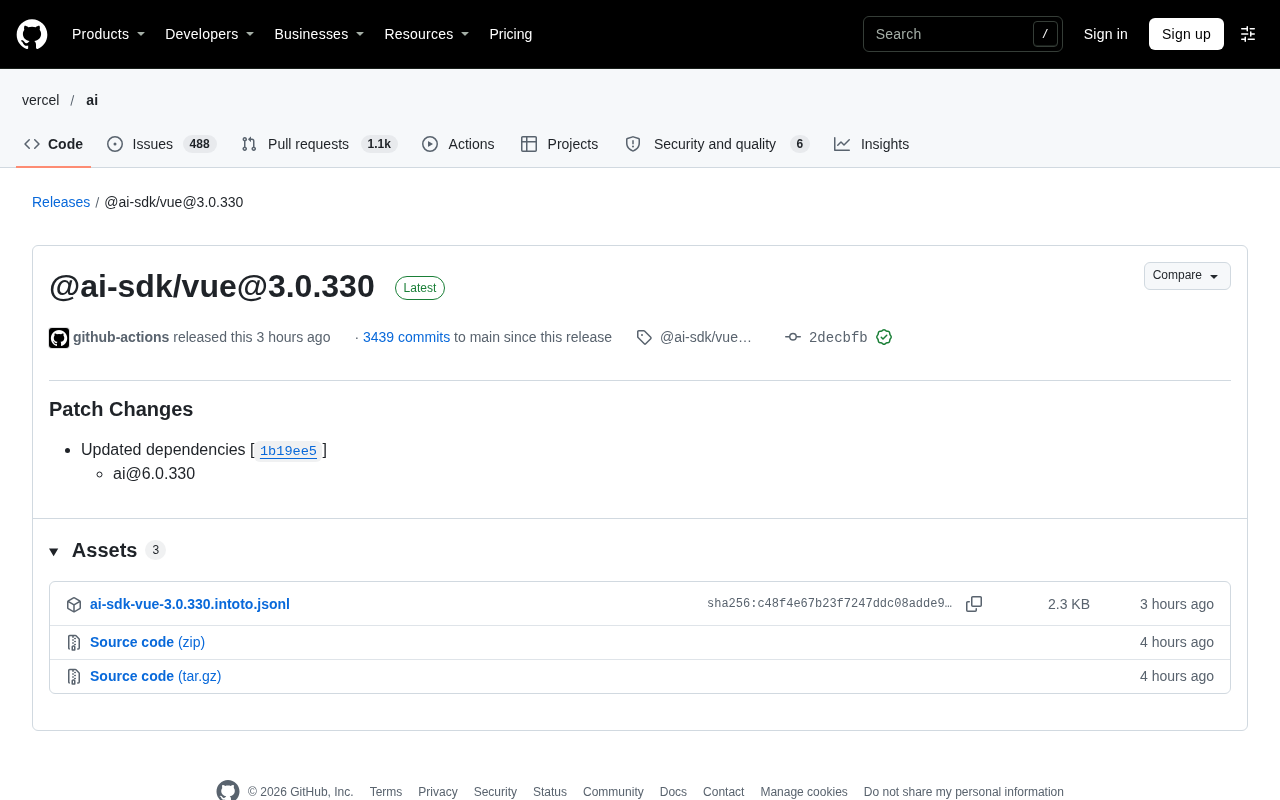
The AI SDK's Vue adapter package @ai-sdk/vue has released version 3.0.330, a routine patch release aimed at dependency synchronization. The only core change is updating the underlying `ai` package to 6.0.330, with no new APIs or functional changes in the adapter itself. The version was auto-published to the main branch by GitHub Actions, with verified commit signatures and 3439 cumulative commits since the last release; the fine-grained version number is a direct result of high-frequency automated releases. The article notes that keeping the adapter and core package versions consistent avoids type definition and runtime behavior discrepancies. For developers, this is a low-risk stability maintenance update requiring no migration steps, though re-running existing tests after updating the lockfile is recommended.
The Vue adapter package for AI SDK, @ai-sdk/vue, has released version 3.0.330. This is a routine patch release focused primarily on dependency updates, continuing the project's high-frequency iteration cadence.
Core Changes in This Version
The main change in this release is an update to the dependency ai@6.0.330. According to the changelog, this patch-level update was triggered by commit 1b19ee5 and falls under Patch Changes. This means the underlying core package ai has been upgraded to the corresponding 6.0.330 version, while @ai-sdk/vue itself introduces no new APIs or functional changes.
For developers using the Vue framework to integrate AI capabilities, this type of coordinated dependency update is a common practice to ensure version consistency across packages in the ecosystem. Keeping @ai-sdk/vue in sync with the ai version helps avoid type definition or runtime behavior discrepancies caused by version mismatches.
Semantic versioning and patch updates: The 3.0.330 mentioned in the article is a patch version under Semantic Versioning (SemVer). SemVer specifies a version format of major.minor.patch, where an increment in the patch position indicates backward-compatible bug fixes or internal dependency adjustments that introduce no new features and break no existing APIs. This is precisely the versioning rationale behind the article's emphasis that "no new APIs or functional changes are introduced" and that "upgrade risk is low." Understanding patch semantics helps developers judge upgrade urgency and the scope of regression testing—patch versions typically only require verifying that the build and existing test cases pass.
Layered architecture of the ai core package and adapter packages: AI SDK adopts a design that separates the core package from framework adapter packages. The ai package carries framework-agnostic underlying capabilities such as model invocation, streaming responses, tool calling, and message protocols; @ai-sdk/vue is the Vue-facing adapter layer that encapsulates core capabilities into composables aligned with Vue's reactivity system, such as interfaces like useChat and useCompletion that manage conversation state and streaming rendering. The two layers publish packages independently with linked versions, so the adapter package locks the matching core package version in its dependency declaration to avoid mismatches in type definitions or runtime behavior.
Release Process and Engineering Practices
This version was automatically published by GitHub Actions, with the release branch being main and a cumulative 3439 commits since the last release. The commit records carry GitHub verified signatures, reflecting the project's standardized practices around supply chain security. The release page includes 3 asset files, consistent with the typical artifacts of an npm package release.
From an engineering perspective, this CI-driven release model ensures automated version incrementing and changelog generation, and it also explains why such fine-grained version numbers like .330 appear—this is the direct result of high-frequency automated releases.
The role of repository lockfiles: The article recommends "running existing test cases after updating the lockfile," where the lockfile refers to package-lock.json, pnpm-lock.yaml, or yarn.lock. It precisely records the resolved version and integrity hash of every package in the dependency tree, ensuring that different machines and CI environments install exactly the same dependencies. When @ai-sdk/vue is upgraded and the ai core package version changes along with it, the lockfile is rewritten in sync; if the lockfile is committed without verification, hidden differences in transitive dependencies may be introduced, so re-running tests after upgrades is the standard practice to intercept such risks.
Significance for Developers
If you are using @ai-sdk/vue to build AI interaction features in Vue applications, this update is a recommended security and stability maintenance follow-up. Upgrading works the same as with any regular npm package, with no additional migration steps required. Note that since this is a patch version, upgrade risk is low, but it is still recommended to run your existing test cases after updating the lockfile.
For teams not yet using this package, @ai-sdk/vue provides the official adapter layer for accessing AI SDK capabilities within the Vue ecosystem. The existence of this version shows that the project remains actively maintained, and you can watch for whether new feature releases are published in the future.
Summary
@ai-sdk/vue 3.0.330 is a routine release aimed at dependency synchronization, introducing no breaking changes. It reflects the ongoing maintenance cadence of the AI SDK ecosystem on the Vue front rather than the landing of a new feature.
Related articles

RePlan-VLA: Progress-Aware Replanning Breakthrough for Long-Horizon Robotic Manipulation
The RePlan-VLA framework converts VLA models' short-horizon capabilities into reliable long-horizon execution through progress-aware adaptive replanning, improving success rates by 21.9% and 10.4% on RoboCasa365 and CALVIN, and validating real-world deployment on a Franka Research 3 robot.

Geometric Bridge Flow Matching: A New Breakthrough in Blind Rigid Motion Correction
Geometric bridge flow matching enables blind rigid motion correction in head CBCT, achieving 37.1 dB PSNR and 0.27 mm RPE on simulated data in ~9.1 minutes, outperforming existing methods.

Google Releases Gemini 4 Hydrogen: 2.5x Faster Without Sacrificing Intelligence
Google releases the lightweight Gemini 4 Hydrogen: 2.5x faster task completion, AA Intelligence Index of 54 beating its flagship sibling, 7.3s single-step on Agent Arena faster than Claude and GPT rivals, four thinking levels with pay-as-you-need pricing, now available across AI Studio and more.