AI SDK Vue 3.0.338 Released: The Version Strategy Behind a Dependency Update

@ai-sdk/vue 3.0.338 patch update focuses on syncing upstream dependencies, reflecting a high-frequency, small-step strategy.
@ai-sdk/vue released patch 3.0.338 with no new APIs or breaking changes; the main change syncs two upstream dependencies: @ai-sdk/provider-utils@4.0.69 and ai@6.0.338. This dependency alignment is common in monorepo-managed SDK projects and ensures consistent behavior between framework bindings and the core package. High patch numbers reflect small-step iteration rather than stability issues, and semantic versioning still holds. The release ran through GitHub Actions with a verified signature. Ordinary projects can simply upgrade, while teams with pinned dependencies should check lockfile compatibility. Tracking such routine patch output helps assess project maintenance health.
A Patch Release That Reflects AI SDK's Maintenance Rhythm
The Vue binding package for AI SDK, @ai-sdk/vue, has released version 3.0.338. Judging from the release record on GitHub, this is a typical patch update: no new APIs, no breaking changes, and the core action is synchronizing two upstream dependencies—@ai-sdk/provider-utils@4.0.69 and ai@6.0.338.
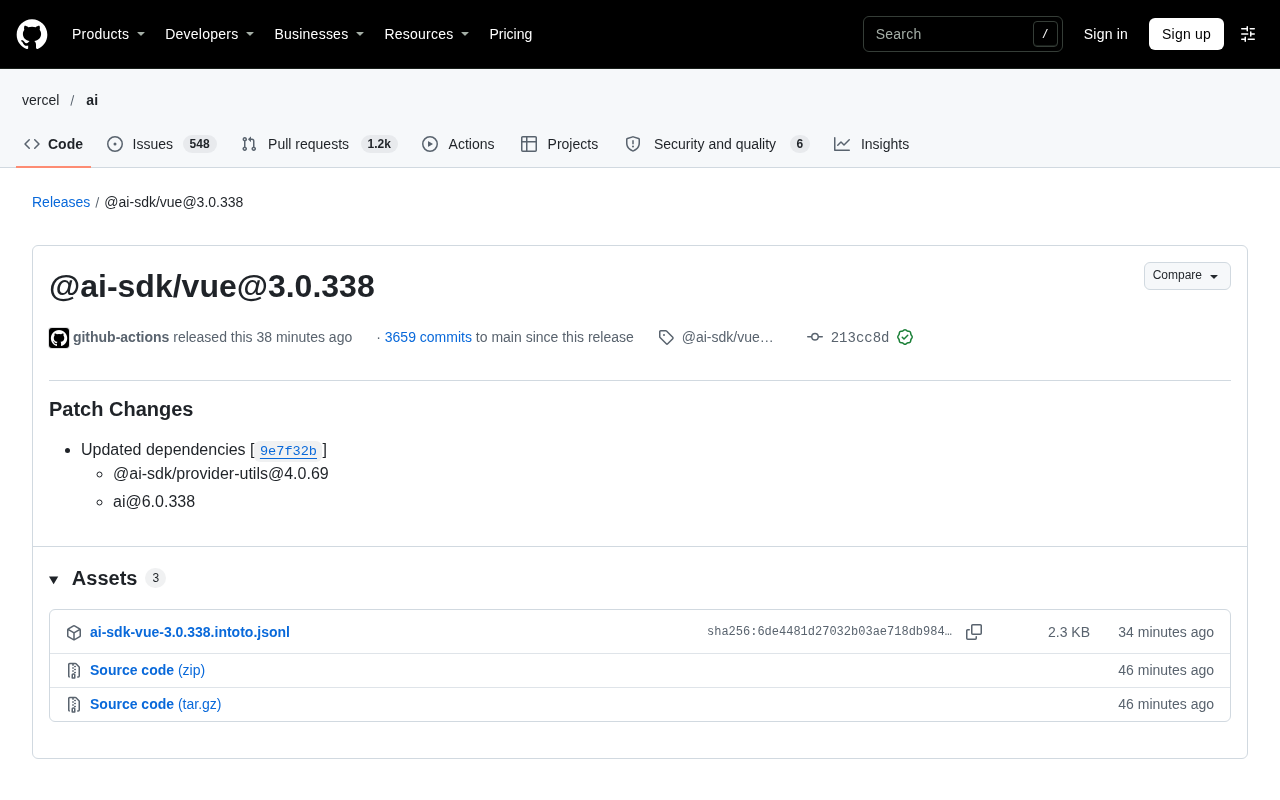
This is already a routine release after the repository's 3,659th commit. The number itself says one thing: AI SDK follows a high-frequency, small-step iteration approach, where patch version numbers accumulate quickly rather than saving up for major releases.
What's Hidden in a Patch Update
Dependency Synchronization Is the Main Work
The only specific change in this release is: "Updated dependencies [9e7f32b]". @ai-sdk/provider-utils was bumped to 4.0.69, and ai was bumped to 6.0.338.
This pattern is very common in monorepo-managed SDK projects. When the core package ai or the utility package provider-utils fixes some underlying issue, all framework binding packages (Vue, React, Svelte, etc.) need to publish a version alongside it to ensure users get consistent behavior when installing. For developers using @ai-sdk/vue, this update itself requires no code changes, but keeping versions aligned is recommended to avoid behavioral differences between the binding package and the core package.
monorepo is a development model that manages multiple related packages in a single code repository. In projects like AI SDK, the core package ai, the utility package provider-utils, and the various framework binding packages (Vue, React, Svelte, etc.) all reside in the same repository. The benefit is centralized dependency management—a single change can trigger tests across all packages; but the cost is that version alignment must be guaranteed at release time—when the core package updates, all binding packages need to publish new versions in sync, otherwise users may encounter behavioral inconsistencies between the binding package and the core package. This patch update to @ai-sdk/vue is exactly the standard action under this mechanism.
Why the Version Numbers Move So Fast
A version number like 3.0.338 can easily raise doubts for new users, but in reality it reflects release frequency rather than instability. The patch number only represents "backward-compatible fixes and dependency synchronization", and semantic versioning rules still hold. What really matters is the major version number—the Vue binding is at 3.x, the core ai package is at 6.x, and the two are independent version lines.
For tool libraries like AI SDK that target large model calls, upstream provider interfaces change frequently, and keeping up through small patches is a reasonable choice. Compared with saving up a major release every six months, publishing each fix independently makes rollback and issue diagnosis simpler.
Semantic Versioning (SemVer) stipulates that a version number follows the format major.minor.patch: a major version change indicates incompatible API modifications, a minor version indicates backward-compatible feature additions, and a patch number indicates backward-compatible bug fixes. Therefore, the 338 in 3.0.338 only represents the 338th patch release and does not imply quality or stability issues. Note that each package in AI SDK independently follows semantic versioning, and the Vue binding's 3.x and the core ai package's 6.x are two independent version lines that cannot be directly compared.
Practical Impact on Users
Upgrade Recommendations
For ordinary projects, simply upgrading to the patch version is enough; no business code changes are needed. If a project has pinned the version of @ai-sdk/provider-utils or ai, check whether the lock file is compatible with the dependency ranges declared in 3.0.338.
For teams that perform dependency audits in CI, what is worth noting in this change is signature verification: this version was published by GitHub Actions, and the commit carries a GitHub-verified signature. From a supply chain security perspective, this is a positive signal, indicating that the release process goes through the official automated channel.
Lockfile such as package-lock.json, yarn.lock, or pnpm-lock.yaml records the exact version of every dependency actually installed in the project. When a binding package declares version ranges for @ai-sdk/provider-utils or ai, the lockfile determines the version ultimately resolved. If the project directly pins older versions of these upstream packages, upgrading @ai-sdk/vue may cause installation failure or behavioral inconsistency due to unsatisfied version ranges. After upgrading, it is recommended to run npm ls @ai-sdk/provider-utils ai to check the actually resolved versions and ensure compatibility with the dependency ranges declared in 3.0.338.
When to Pay Attention to Release Logs
A patch release itself carries limited information, but continuously tracking the release rhythm can help judge project activity. At the time of this release, the repository had accumulated 3,659 commits, and the publisher is listed as github-actions, indicating that the automated release pipeline is running normally. If you are evaluating whether to introduce AI SDK into a production project, the steady output of routine patches like this says more about maintenance status than a single feature release.
Conclusion
@ai-sdk/vue@3.0.338 is an unsurprising patch update whose core is dependency alignment. Its value lies not in new features, but in maintaining version consistency between the Vue binding and the AI SDK core package. For the vast majority of users, simply upgrading is enough with no additional action required; for teams concerned about project health, this high-frequency, automated release rhythm is itself a signal worth referencing.
One-line Summary
@ai-sdk/vue 3.0.338 is a patch update focused on syncing upstream dependencies, reflecting a high-frequency, small-step iteration strategy.
Paragraph Summary
@ai-sdk/vue released patch version 3.0.338 with no new APIs or breaking changes; the main change is synchronizing two upstream dependencies: @ai-sdk/provider-utils@4.0.69 and ai@6.0.338. This kind of dependency alignment is common in monorepo-managed SDK projects and aims to ensure consistent behavior between framework binding packages and the core package. The high patch numbers reflect a small-step iteration strategy rather than stability issues, and semantic versioning rules still hold. The release was automated by GitHub Actions and the commit carries a verified signature, reflecting the official automated process. Ordinary projects can simply upgrade, while teams with pinned dependencies should check lockfile compatibility. Continuously tracking the steady output of such routine patches helps assess project maintenance health.
Related articles

Prospero: A Lightweight Native AI Coding Tool Built with ImGui
Prospero is a bloat-free native AI coding tool built with ImGui, emphasizing lightweight design, high performance, and low dependencies. This article analyzes its design philosophy, technical choices, and the divergence between platformization and toolization in AI coding tools.

WebRTC Abused: New Variant of Credit Card Skimming Scripts on Shopping Sites
Security researchers found skimming scripts on popular shopping sites using WebRTC data channels to exfiltrate credit card data. This article analyzes the technical原理, differences from traditional Magecart attacks, and defense strategies for e-commerce platforms in third-party script governance and CSP policies.

Single GB10 Card Hits 101 tok/s: Inkling 2 Mini Performance Tested on vLLM
A developer shared on Hacker News running Inkling 2 Mini with vLLM on a single GB10 at 101 tok/s. This article analyzes the technical context, the significance of vLLM with small models on single cards, and caveats for interpreting tok/s metrics.