@ai-sdk/vue 4.0.116 Released: Dependency Update Patch

Vercel AI SDK's Vue binding releases patch 4.0.116, syncing upstream deps with no breaking changes.
`@ai-sdk/vue@4.0.116` is a routine patch-level maintenance release of Vercel AI SDK's Vue framework binding, automatically built and published by GitHub Actions. It introduces no new features or breaking changes — the update solely syncs two upstream dependencies: core library `ai@7.0.116` and the provider utility package `@ai-sdk/provider-utils@5.0.49`. This coordinated dependency update maintains version consistency across the SDK. For most Vue projects the risk is minimal; however, teams using custom AI providers should run regression tests after upgrading, as `provider-utils` may include low-level adapter logic changes.
Version Overview
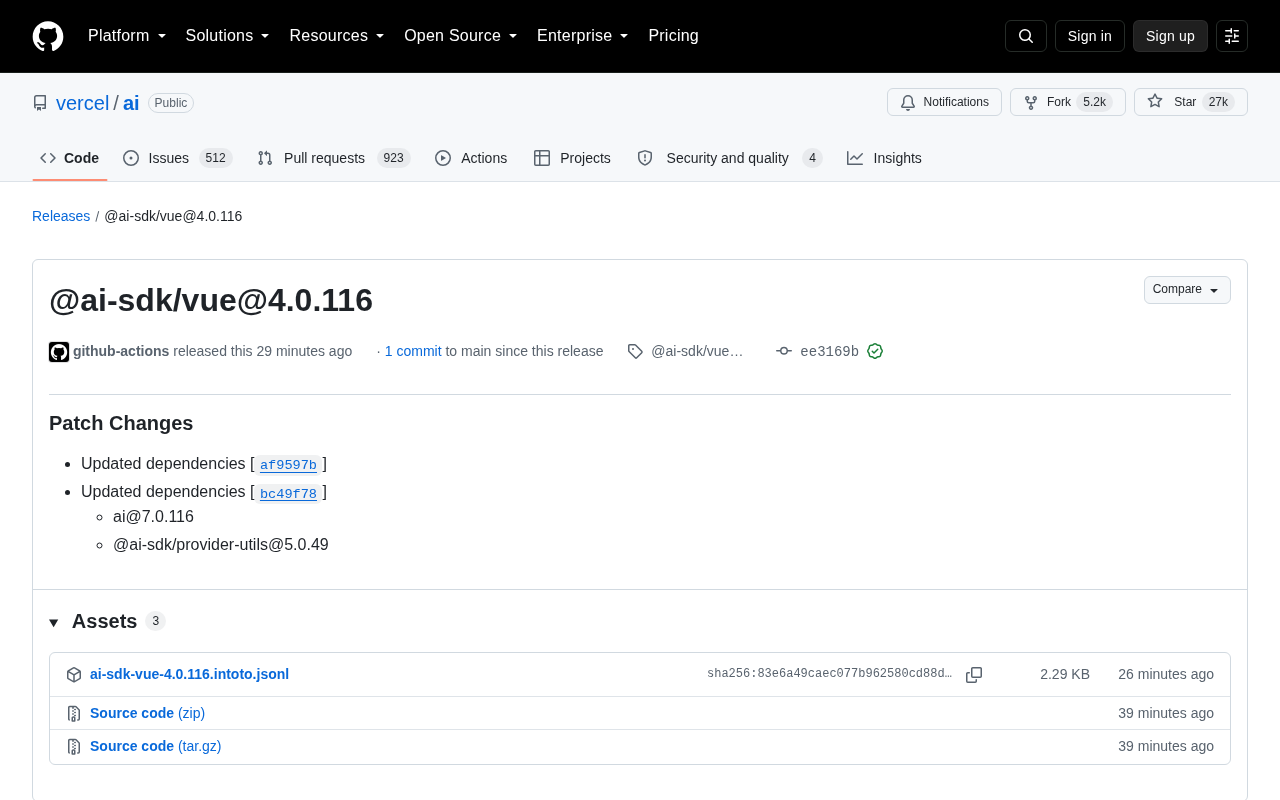
Vercel's AI SDK ecosystem recently published @ai-sdk/vue@4.0.116, automatically built and released by GitHub Actions on September 25th. This is a patch-level update focused on syncing upstream dependencies — no new features or breaking changes are included.
The core of this release is a coordinated dependency upgrade, covering two key packages: ai@7.0.116 and @ai-sdk/provider-utils@5.0.49. For developers using the AI SDK with Vue, this is a routine maintenance update that's safe to adopt.
What's Changed
The Patch Changes section of this release explicitly lists two dependency updates (corresponding to commits af9597b and bc49f78):
- ai@7.0.116: Core AI SDK library version bump.
- @ai-sdk/provider-utils@5.0.49: Update to the provider utilities package, which typically includes fixes and optimizations to underlying provider adapter logic.
The purpose of these patch releases is to keep the entire SDK dependency tree consistent. When the core ai package ships a fix or minor adjustment, all framework binding packages (Vue, React, Svelte, etc.) publish corresponding versions to prevent version mismatches across packages.
It's worth noting that @ai-sdk/vue's version number (4.0.x) is versioned independently from the core ai package (7.0.x) — they're linked via dependency declarations. When upgrading the Vue binding package, be sure to check whether the pinned core library version matches your project's requirements.
@ai-sdk/provider-utils is the foundational utility package within Vercel AI SDK responsible for abstracting differences between AI providers. It provides unified request formatting, response parsing, streaming, and error normalization — so whether you're calling OpenAI, Anthropic, Google Gemini, or a locally deployed Ollama instance, all traffic passes through this abstraction layer. Developers implementing custom providers (e.g., integrating a private model service) must also conform to the interfaces defined by this package. As a result, even patch-level changes to provider-utils can affect custom provider compatibility — which is why teams in that situation are advised to run regression tests after upgrading.
What This Means for Vue Developers
@ai-sdk/vue is Vercel AI SDK's official framework binding for the Vue ecosystem, enabling developers to quickly integrate LLM chat, streaming responses, tool calling, and other AI capabilities into Vue applications. The Vercel AI repository on GitHub has accumulated over 27k stars and 5.2k forks, making it one of the leading solutions for frontend AI integration today.
For production projects, it's recommended to review the changelog for any behavioral changes on the dependency side before upgrading. While this is a pure patch update with low risk overall, teams using custom providers should still run appropriate regression tests, given the underlying provider-utils adapter logic may have been adjusted.
The core of @ai-sdk/vue's framework bindings is a set of Vue Composables — such as useChat, useCompletion, and useAssistant. These composables encapsulate state management for LLM interactions, including real-time streaming text rendering, request lifecycle control (send, abort, retry), and error handling — so developers don't need to manually deal with low-level APIs like SSE (Server-Sent Events) or ReadableStream. Compared to calling provider SDKs (OpenAI, Anthropic, etc.) directly, the advantage of using a framework binding is its native integration with Vue's reactivity system: data changes automatically trigger view updates, significantly reducing the complexity of adding AI features.
Summary
@ai-sdk/vue@4.0.116 is a typical dependency-sync patch update with no new features. Its core value lies in tracking upstream changes from ai@7.0.116 and provider-utils@5.0.49. Vue projects using this SDK are encouraged to upgrade on their regular cadence to maintain a healthy and up-to-date dependency graph.
Related articles

Chain of Thought Isn't Just for AI: How Humans Can Use CoT to Improve Thinking Quality
Chain of Thought isn't just a prompt trick for large models. Starting from a Hacker News discussion, this article analyzes why CoT works for human thinking too, breaks down actionable ways to transfer it, and highlights the key differences between human CoT and machine CoT.
Cloudflare Teams Up with OpenAI: Closi…
Cloudflare Teams Up with OpenAI: Closing the Loop from Vulnerability Discovery to Defense with AI
Cloudflare uses OpenAI Daybreak to investigate security vulnerabilities and generate reviewable remediation plans, while developers use Codex to boost coding efficiency and quality.

Orca Multi-Agent Orchestration in Practice: A Guide to Parallel Collaboration with Claude and Codex
Orca is Stable AI's free open-source agent workbench supporting 34 agents like Claude Code and Codex in parallel. Learn its Git worktree isolation, multi-model orchestration, and mobile management.