@ai-sdk/vue 4.0.117 Released: A Look at This Vercel AI SDK Patch Update

@ai-sdk/vue 4.0.117 patch release syncs with ai@7.0.117 core dependency — no breaking changes.
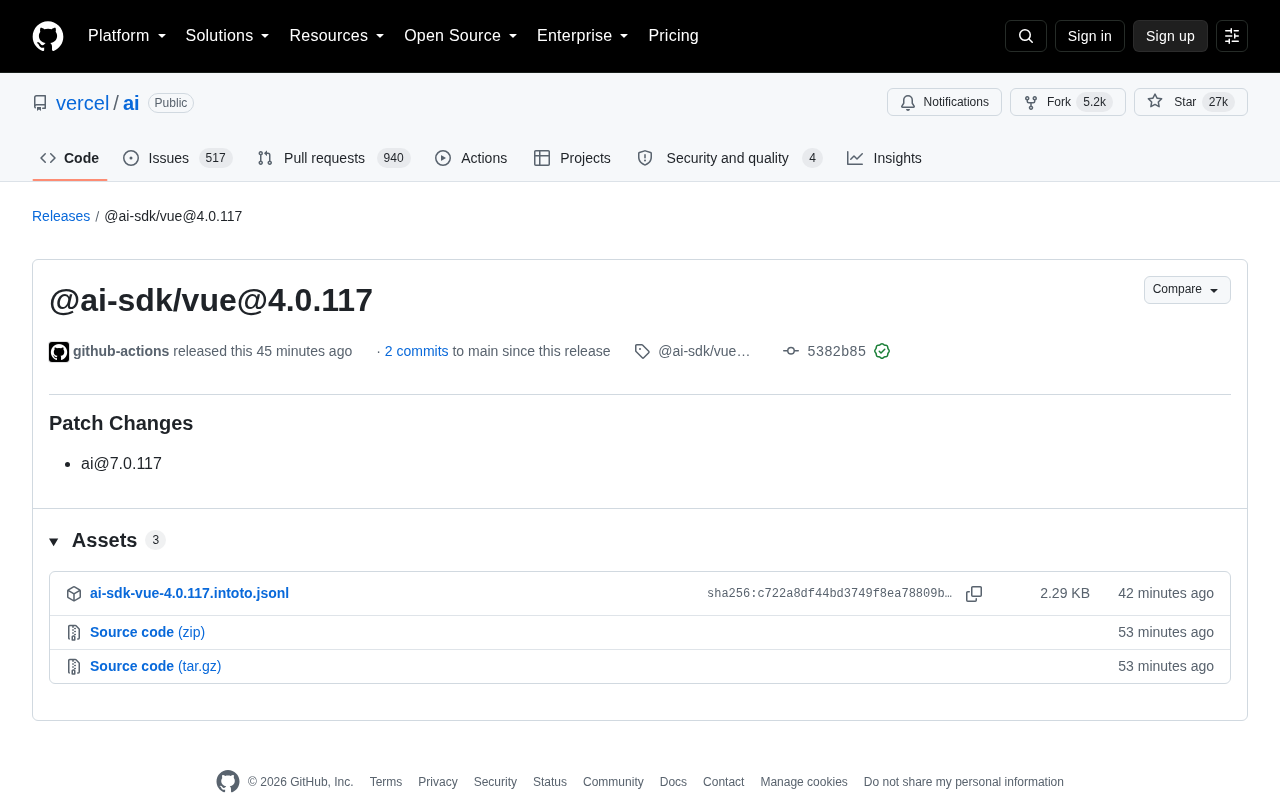
`@ai-sdk/vue@4.0.117` is a routine patch update to Vercel AI SDK's Vue framework adapter, with the core change being a sync to upstream dependency `ai@7.0.117`. Vercel AI SDK is a leading toolkit for building AI-powered apps, boasting 27k+ GitHub stars and offering a unified interface for multiple LLMs with deep streaming support. The Vue adapter enables framework-native AI integration via the Composition API. This patch introduces no new features or breaking changes and was published via a verified, automated GitHub Actions workflow. Developers are advised to review the `ai` core changelog and validate in a test environment before deploying to production.
Vercel's widely followed open-source project, the AI SDK, has received another update — @ai-sdk/vue has been released at version 4.0.117. As a patch-level update, it primarily follows the core dependency ai@7.0.117. While the version bump is modest, staying in sync with upstream dependencies is always worth tracking for developers building AI applications in the Vue ecosystem.
What's in This Update
According to the GitHub Release records in the Vercel AI repository, @ai-sdk/vue@4.0.117 is a typical patch release. The core change is a dependency upgrade — syncing to ai@7.0.117. Patch releases generally don't introduce breaking changes; they're primarily used for bug fixes, internal dependency updates, and version consistency maintenance.
This version was published via an automated GitHub Actions workflow and carries a verified signature from GitHub, ensuring the integrity and trustworthiness of the release artifact. This combination of automation and signature verification reflects the engineering maturity Vercel brings to its open-source project maintenance.
About Vercel AI SDK
Vercel AI SDK is one of the most popular toolkits for frontend and full-stack developers building AI-powered applications. It has accumulated over 27k stars and 5.2k forks on GitHub, with a highly active community. It provides a unified interface for integrating various large language models (LLMs) and includes abstractions for common AI application patterns such as streaming responses and message state management.
@ai-sdk/vue is the official Vue framework adapter for this SDK. It allows Vue developers to integrate AI capabilities in a framework-native way — using the Composition API and reactive state — making it straightforward to implement features like chat interfaces and text completion. Similar to its React counterpart, the Vue package aims to reduce the complexity of AI integration.
The core design philosophy of Vercel AI SDK is "Provider Agnostic" — it abstracts away the API differences between model providers through a unified layer. Developers can switch between OpenAI, Anthropic, Google Gemini, Mistral, and other leading LLMs simply by changing the provider configuration, without modifying any business logic. The SDK also treats streaming responses as a first-class citizen, leveraging the Web Streams API for real-time token-by-token rendering — a critical factor for user experience in chat and interactive scenarios. Additionally, the SDK is split into multiple sub-packages: ai (core runtime), @ai-sdk/react, @ai-sdk/vue, @ai-sdk/svelte, and others, forming a layered "core + framework adapter" architecture that allows teams across different tech stacks to adopt AI capabilities with minimal friction.
Why Patch Updates Matter
For projects running in production, keeping up with patch updates like this one has real value. Iterations to the core ai package often include improvements to underlying model protocols, error handling, and performance. Keeping framework adapters in sync ensures that Vue applications won't run into compatibility issues caused by version mismatches.
Recommended Actions for Developers
- For projects following Semantic Versioning (SemVer), patch upgrades are generally safe — running
npm updateshould be fine. - It's a good idea to review the full Changelog in the repository before upgrading, to confirm whether
ai@7.0.117contains any fixes relevant to your use case. - If your project has strict stability requirements, validate the update in a testing environment before deploying to production.
Semantic Versioning (SemVer) is the most widely adopted version naming convention in the open-source ecosystem. The format is MAJOR.MINOR.PATCH: a major version change indicates incompatible breaking changes; a minor version change means new backward-compatible features have been added; and a patch version change represents backward-compatible bug fixes or internal maintenance. This release bumps @ai-sdk/vue from 4.0.116 to 4.0.117 — a patch-level change that theoretically has no impact on existing API usage. The npm update command follows SemVer rules by default; when a dependency is pinned as ^4.0.x in package.json, it will automatically pull the latest patch version, making this type of update safe to include in routine dependency maintenance.
Closing Thoughts
@ai-sdk/vue@4.0.117 is a routine dependency-sync patch release that introduces no new features, but it reflects Vercel AI SDK's commitment to high-frequency maintenance and staying closely aligned with its core library. For developers building AI applications in the Vue ecosystem, keeping an eye on these updates helps maintain project health and stability. Since the official release notes are fairly brief, it's worth consulting the detailed changelog of the ai core package for specifics on what changed functionally.
Related articles

Chain of Thought Isn't Just for AI: How Humans Can Use CoT to Improve Thinking Quality
Chain of Thought isn't just a prompt trick for large models. Starting from a Hacker News discussion, this article analyzes why CoT works for human thinking too, breaks down actionable ways to transfer it, and highlights the key differences between human CoT and machine CoT.
Cloudflare Teams Up with OpenAI: Closi…
Cloudflare Teams Up with OpenAI: Closing the Loop from Vulnerability Discovery to Defense with AI
Cloudflare uses OpenAI Daybreak to investigate security vulnerabilities and generate reviewable remediation plans, while developers use Codex to boost coding efficiency and quality.

Orca Multi-Agent Orchestration in Practice: A Guide to Parallel Collaboration with Claude and Codex
Orca is Stable AI's free open-source agent workbench supporting 34 agents like Claude Code and Codex in parallel. Learn its Git worktree isolation, multi-model orchestration, and mobile management.