@ai-sdk/vue 4.0.131 Released: Patch Update for Vue AI SDK

Vercel's Vue AI SDK adapter releases a routine patch, syncing the core ai@7.0.131 dependency.
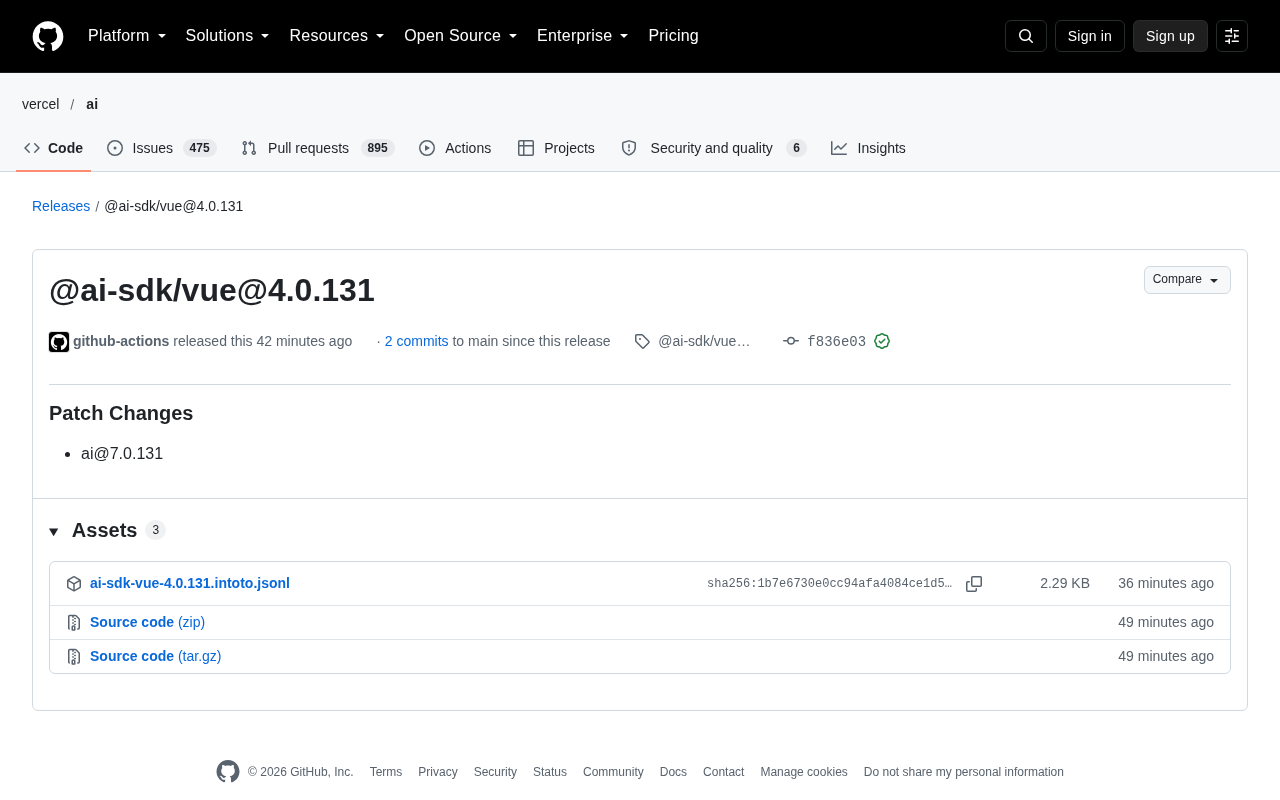
`@ai-sdk/vue@4.0.131` is a routine patch release of Vercel AI SDK's official Vue adapter, published via GitHub Actions and verified with GPG signing. The sole listed change is a dependency bump to `ai@7.0.131`, a result of the SDK's monorepo architecture where core fixes trigger synchronized adapter releases across React, Vue, and Svelte. The package provides Composition API composables like `useChat` and `useCompletion` for Vue developers. This backward-compatible patch is safe to upgrade after validating key workflows in a non-production environment.
Release Overview
Vercel's AI SDK ecosystem continues to evolve with the release of @ai-sdk/vue@4.0.131 as a patch version. This release was published via GitHub Actions automation at commit hash f836e03, and verified through GitHub's signing mechanism using GPG key ID B5690EEEBB952194.
Based on the release information, this is a routine maintenance update. The core change is a dependency bump to ai@7.0.131. For developers building AI applications with Vue, patch releases like this typically indicate bug fixes or compatibility improvements at the underlying level — not breaking API changes.
What Is @ai-sdk/vue
@ai-sdk/vue is the official Vue adapter package for the Vercel AI SDK. The AI SDK is a TypeScript toolkit for building AI-powered applications — it provides a unified interface for integrating with various large language models (such as OpenAI, Anthropic, and others), along with capabilities like streaming responses, tool calling, and structured output.
Different frontend frameworks have their own adapter layers: React developers use @ai-sdk/react, while Vue developers rely on @ai-sdk/vue. It provides Composition API-style composable functions like useChat and useCompletion, enabling developers to integrate chat and completion interfaces in a Vue-idiomatic way.
Composition API is a logic-reuse mechanism introduced in Vue 3, allowing developers to encapsulate related state and behavior into "composables" (typically prefixed with use). Compared to the Options API from Vue 2, Composition API makes it easier to share logic across components and offers better TypeScript type inference. @ai-sdk/vue is built on this paradigm — it wraps streaming request state management (such as messages, isLoading, error) and action methods (such as append, reload, stop) into functions like useChat. Developers simply call these inside a <script setup> block to get full AI interaction capabilities, without manually managing fetch requests or response stream parsing.
What a Patch Update Means
This update is a Patch-level change under Semantic Versioning (SemVer), where only the last digit increments — indicating it contains only backward-compatible bug fixes, with no new features or API changes. The release notes explicitly list a single change: the dependency upgrade to ai@7.0.131.
This suggests that @ai-sdk/vue itself may not have directly modified any business logic. Instead, it follows the release cadence of the core ai package. The AI SDK is managed as a monorepo, where the core package and various framework adapters maintain synchronized versioning. When a bug is fixed in the core package, the adapters publish corresponding releases to maintain consistency across the ecosystem.
Monorepo is an engineering practice of managing multiple related packages or projects within a single repository. The Vercel AI SDK uses this structure — core logic lives in the ai package, while framework adapters like @ai-sdk/react, @ai-sdk/vue, and @ai-sdk/svelte exist as independent sub-packages. The advantage of this architecture is that fixes in the core package can be atomically synchronized with adapter packages, keeping the entire ecosystem consistent at a single point in time. The trade-off is that adapter changelogs can be brief — the actual fix details require tracing back to the core ai package's release notes. This explains why the @ai-sdk/vue@4.0.131 release notes only mention the dependency upgrade without elaborating on specific bug details.
Should Developers Upgrade
For projects already using @ai-sdk/vue in production, patch releases are generally safe to upgrade with low risk. Recommended steps include:
- Review the specific changelog for
ai@7.0.131to confirm whether the core package fixes affect any features you're actively using. - Validate on a non-production branch first, ensuring that key flows like streaming responses and tool calling are unaffected.
- Use a lock file (e.g.,
pnpm-lock.yaml) to manage dependency versions and avoid unexpected indirect dependency drift.
Since the original release notes only provide dependency change information without detailing the specific bugs fixed, developers who need deeper insight should refer to the upstream ai package's release history.
Summary
@ai-sdk/vue@4.0.131 is a typical maintenance patch release, with the core change being a sync to ai@7.0.131. It reflects the Vercel AI SDK's steady release cadence and continued support for the Vue ecosystem. For Vue developers building AI applications, keeping the SDK on a recent patch version helps ensure you're receiving the latest stability fixes.
Related articles

Chain of Thought Isn't Just for AI: How Humans Can Use CoT to Improve Thinking Quality
Chain of Thought isn't just a prompt trick for large models. Starting from a Hacker News discussion, this article analyzes why CoT works for human thinking too, breaks down actionable ways to transfer it, and highlights the key differences between human CoT and machine CoT.
Cloudflare Teams Up with OpenAI: Closi…
Cloudflare Teams Up with OpenAI: Closing the Loop from Vulnerability Discovery to Defense with AI
Cloudflare uses OpenAI Daybreak to investigate security vulnerabilities and generate reviewable remediation plans, while developers use Codex to boost coding efficiency and quality.

Orca Multi-Agent Orchestration in Practice: A Guide to Parallel Collaboration with Claude and Codex
Orca is Stable AI's free open-source agent workbench supporting 34 agents like Claude Code and Codex in parallel. Learn its Git worktree isolation, multi-model orchestration, and mobile management.