@ai-sdk/vue 4.0.132 Released: Dependency Sync Update Explained

@ai-sdk/vue 4.0.132 released with dependency sync to align with the AI SDK core package.
`@ai-sdk/vue@4.0.132` is a patch-level update that aligns the Vue adapter's dependencies with the core `ai@7.0.132` package, introducing no new features or breaking changes. This kind of update is common in monorepo-based SDKs and helps prevent version drift that can cause type conflicts, API behavior deviations, or runtime dual-instance issues. The release was automated via GitHub Actions CI with GPG signature verification for supply chain transparency. Teams using the AI SDK to build Vue applications should upgrade both `@ai-sdk/vue` and `ai` together, and validate in a test environment before pushing to production.
The Vue adapter package for the AI SDK ecosystem, @ai-sdk/vue, has released version 4.0.132. This is a typical patch-level update, with changes focused entirely on dependency synchronization. While minor in scope, this kind of release is critical for maintaining stability across the entire toolchain — especially for developers building AI applications with Vue.
What's in This Update
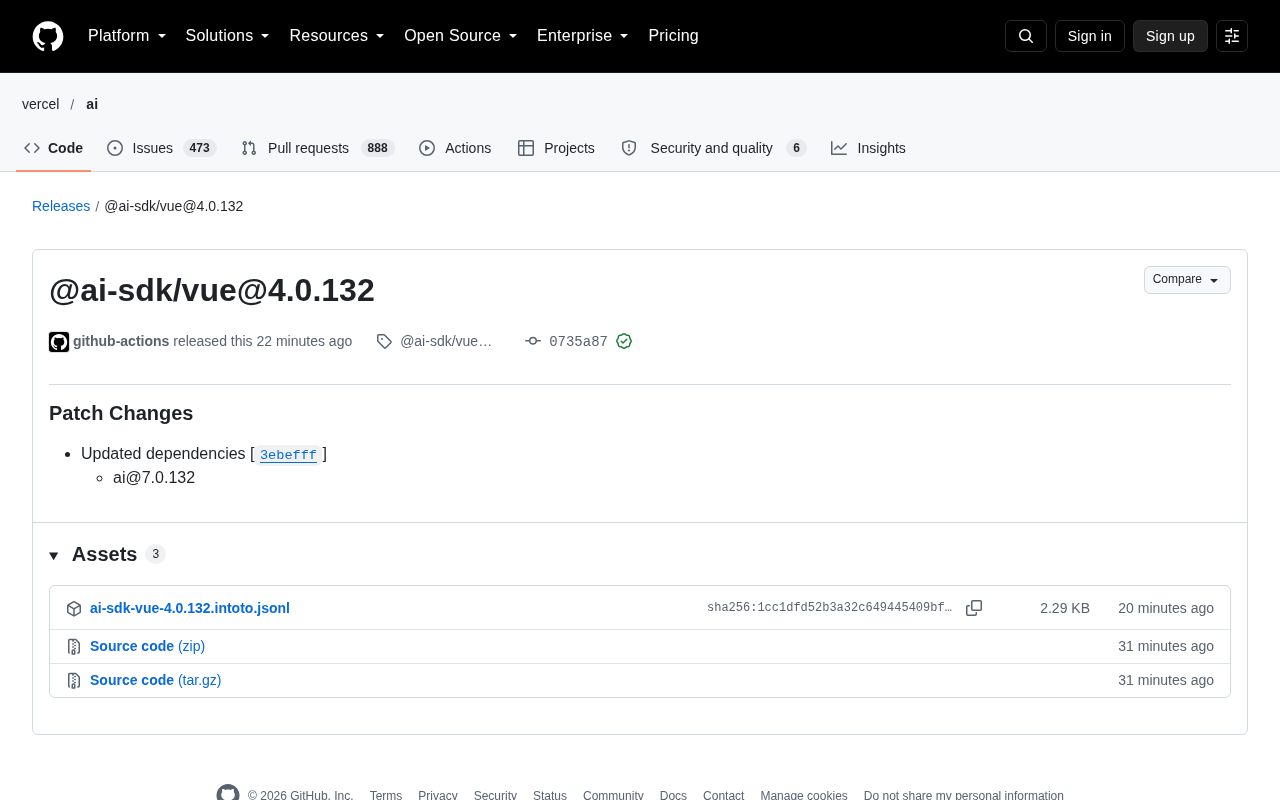
According to the official Release Notes, @ai-sdk/vue@4.0.132 falls under Patch Changes, with the primary action being an upstream dependency sync:
- Updated dependencies to align with the
ai@7.0.132core package version. - The release was automatically published via CI (github-actions) and verified with a GitHub GPG signature (Key ID: B5690EEEBB952194).
In other words, this version introduces no new features — it simply follows the versioning cadence of the main ai package to stay in alignment. This pattern is very common in SDK projects managed as monorepos: when the core package upgrades, each framework adapter (Vue, React, Svelte, etc.) publishes a corresponding patch release to maintain compatibility.
Why Dependency Sync Updates Matter
Many developers tend to overlook patch releases that "only update dependencies," assuming they're inconsequential. In practice, however, version mismatches are a common source of runtime errors.
@ai-sdk/vue is the Vue framework wrapper for the AI SDK, relying on the core ai package for foundational capabilities such as message stream handling, tool calling, and state management. When ai upgrades to 7.0.132, failing to sync the adapter package can lead to inconsistent type definitions, API behavior deviations, and other subtle issues.
The significance of version 4.0.132, therefore, is ensuring that Vue-based projects can seamlessly adopt the behavior aligned with ai@7.0.132, avoiding hidden bugs caused by version drift.
A note on version drift: Version drift is a common engineering challenge in monorepo ecosystems. In an SDK composed of multiple sub-packages, dependencies are declared via
peerDependenciesordependencies. When the core package releases a new version and adapters don't keep up, npm/pnpm's dependency resolution algorithm may install two different versions of the core package simultaneously innode_modules— causing a "dual instance" problem. This leads to shared state failures and runtime errors that pass type checks but break at runtime. For TypeScript projects, version mismatches can also trigger type definition conflicts: even when the logic is correct,tscmay throw hard-to-trace type errors.
Upgrade Recommendations
For teams that have already integrated the AI SDK into their projects, here are some practical guidelines for handling this update:
Keep Core and Adapter Package Versions in Sync
Since @ai-sdk/vue's version number stays in sync with the trailing version number of the core ai package (both use .132), it's recommended to upgrade both at the same time rather than updating just one:
npm install @ai-sdk/vue@4.0.132 ai@7.0.132
About the monorepo architecture: The AI SDK uses a monorepo architecture (typically managed with Turborepo or pnpm workspaces), where the core
aipackage and framework adapters (@ai-sdk/vue,@ai-sdk/react,@ai-sdk/svelte, etc.) are developed together in the same repository. This structure allows changes across packages to be committed atomically, with patch version numbers (the trailing digit) typically kept in sync for easy cross-referencing. That's why@ai-sdk/vue@4.0.132andai@7.0.132share the same trailing number — it's an intentional versioning convention maintained by the project. Users only need to remember the "matching trailing version" rule to quickly verify alignment during upgrades, without having to read through every Release Note.
Verify the Release Signature
This release was verified with a GitHub verified signature, confirming the authenticity of the artifact's origin. For production environments with higher security requirements, consider incorporating signature verification into your dependency audit process.
About GitHub Verified Signatures: GitHub's Verified Signature mechanism is based on GPG (GNU Privacy Guard) asymmetric encryption. The publisher signs a Git tag or commit locally using a private key, and GitHub verifies it using the pre-uploaded public key, displaying a "Verified" badge in the UI. The GPG Key ID
B5690EEEBB952194used in this release belongs to the GitHub Actions bot account, indicating that the entire publishing process was handled by automated CI — reducing the risk of malicious code being introduced through manual operations. For enterprise projects, consider supplementing dependency audit tools (such asnpm auditor Socket.dev) with additional verification of publish signatures for critical dependencies, forming a multi-layered supply chain security strategy.
Patch Releases Are Safe to Upgrade
Following Semantic Versioning (SemVer) conventions, patch-level updates should not contain breaking changes. For most projects, this type of upgrade carries low risk — though it's still advisable to validate in a test environment before deploying to production.
Summary
@ai-sdk/vue@4.0.132 is a purely dependency-alignment update with no new features, but it ensures version consistency between the Vue adapter layer and the AI SDK core. For AI application projects under continuous iteration, staying current with these patch releases helps avoid potential issues from version mismatches — and is a healthy, routine practice for maintaining a well-managed dependency tree.
Related articles

Software Factory in Practice: Building an Evaluable Self-Evolving Development Pipeline with Codex and Claude Code
Deconstructing a Codex and Claude Code software factory: control/data plane separation, foreman prompts for consistency, automatic triggers, and data-driven evaluation.

WorkBuddy Full Guide: How an AI Coworker Takes Over Workplace Automation
What is WorkBuddy? This article analyzes the core capabilities of this full-scenario AI agent: autonomous execution with deliverable results, local file processing, multi-agent parallelism, and workplace automation workflows, helping you judge its essential difference from ordinary AI chat tools.

The Truth About AI Agents: A Hundred Lines of Code + an LLM, Deconstructing the Agent's Underlying Logic
AI agents aren't a new AI species—just a language model plus tools, a loop, and a goal. Here's the underlying logic: how 100 lines of Python hit a 75% fix rate, why the harness beats the model, and Gartner's "agent washing."