@ai-sdk/vue 4.0.133 Released: Routine Patch with Dependency Updates

@ai-sdk/vue 4.0.133 is a dependency-sync patch release with no changes to the Vue adapter logic.
`@ai-sdk/vue@4.0.133` is a routine patch release for the Vercel AI SDK's Vue adapter, containing no logic-level changes. The sole update is syncing upstream dependencies to `ai@7.0.133` and `@ai-sdk/provider-utils@5.0.57`. This pattern stems from the AI SDK's monorepo architecture, where upstream updates trigger batch patch releases across all framework adapters. It's a low-risk upgrade, though developers should note the version gap between the Vue package (4.x) and the core package (7.x) — a normal result of independent versioning. Compatibility should be assessed via dependency declarations, not version numbers.
Version Overview
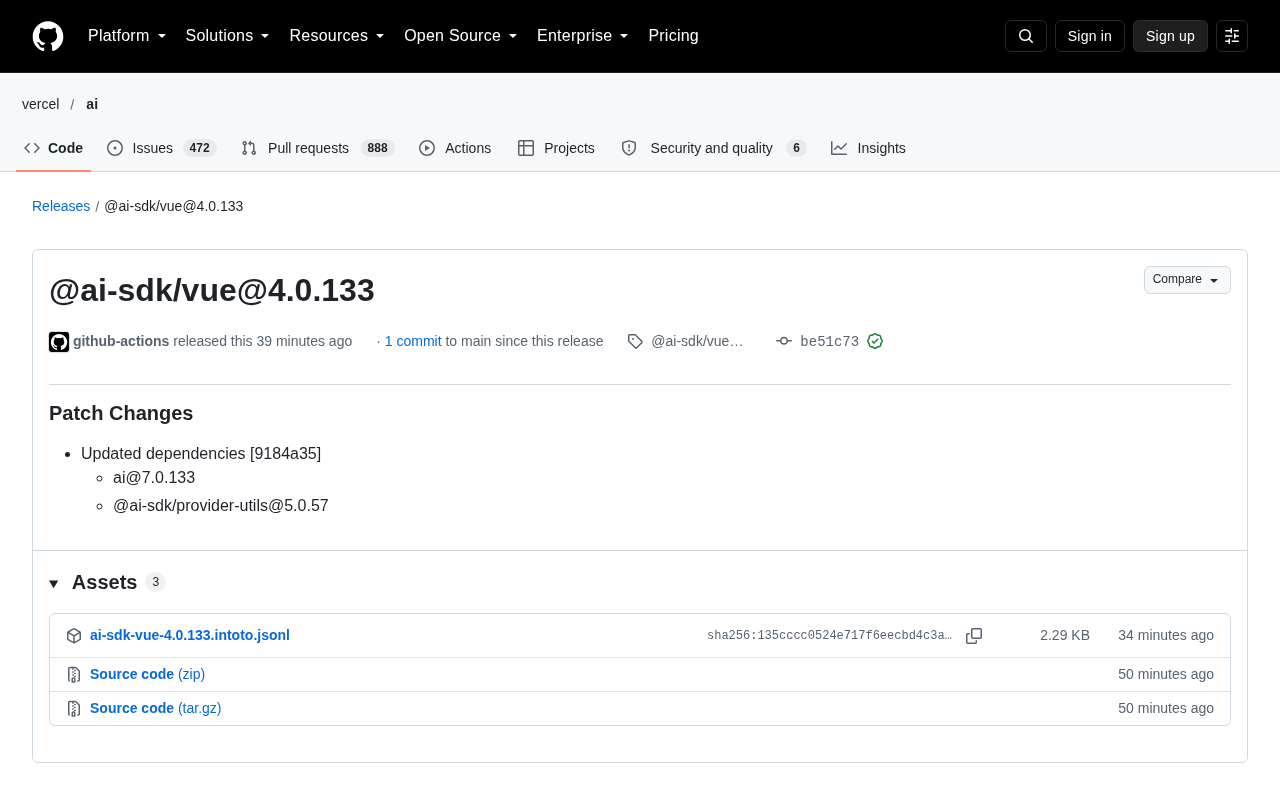
@ai-sdk/vue@4.0.133 was recently auto-published to the main branch via GitHub Actions. This is the Vue adapter package for the Vercel AI SDK, designed to help Vue developers quickly integrate large language model capabilities into frontend projects — including streaming conversations, message management, and state synchronization.
According to the release notes, this is a patch release with no breaking changes. The update focuses entirely on syncing upstream dependencies, making it a low-risk routine maintenance upgrade for existing projects.
What Changed in This Release
Based on the release notes, all changes in this version are dependency updates:
- ai@7.0.133: Core AI SDK package upgraded in sync
- @ai-sdk/provider-utils@5.0.57: Model provider utilities library updated
The associated change is tagged as [9184a35], indicating this release was triggered by upstream dependency changes. In other words, the logic code within @ai-sdk/vue itself was not directly modified — the version bump simply aligns it with the updated core package ai and the underlying provider-utils library.
This release pattern is common in projects like the AI SDK that use a monorepo structure. When the core package is updated, all framework adapters (Vue, React, Svelte, etc.) publish corresponding patch versions in bulk to keep the entire toolchain version-consistent.
Monorepo is an engineering approach where multiple related packages or projects are managed within a single repository. The Vercel AI SDK uses this structure to centralize the core ai package, framework adapters (@ai-sdk/vue, @ai-sdk/react, etc.), and underlying utilities (like @ai-sdk/provider-utils) under one roof. The advantage is that cross-package changes can be committed atomically, and CI/CD pipelines can trigger tests and releases across all sub-packages uniformly — eliminating the need to manually track version dependencies across separate repos.
The trade-off is that releases tend to appear in "batch cascades." Even if an adapter package like @ai-sdk/vue has no logic changes of its own, it still needs to publish a new patch version whenever its upstream dependencies release a new version — simply to update the dependencies declaration in package.json. That's exactly the context for this 4.0.133 release: the only change comes from the upstream dependency upgrade, while the adapter code itself remains untouched.
What This Means for Developers
Should You Upgrade Immediately?
For the vast majority of projects, upgrading a patch version is safe. If you're currently on the 4.0.x series, upgrading to 4.0.133 typically requires nothing more than running your package manager's update command — no changes to business logic needed.
That said, since this update also pulls in changes from the core ai@7.0.133 package, it's worth reviewing the core package's own changelog after upgrading to confirm whether it includes any fixes or behavioral adjustments relevant to your use case. Changes introduced through transitive dependencies can sometimes extend beyond the scope of the adapter layer itself.
Reading the Version Numbers
One thing worth noting is the version number divergence: the Vue adapter remains at 4.x while the core ai package is already at 7.x. This is the result of each sub-package in the AI SDK managing its own versioning independently — packages increment their major versions at their own pace, with compatibility ranges locked via dependency declarations. When debugging issues, don't assume that similar version numbers imply feature parity.
This strategy of independently incrementing major versions per sub-package is known as Independent Versioning, as opposed to Fixed/Locked Versioning where all packages share the same version number (as seen in early Babel or Lerna projects). Independent versioning allows each package to evolve at its own API stability pace, without forcing a major version bump across all packages just because one sub-package introduced a breaking change. For consumers, however, this means you need to carefully review each package's compatibility declarations when upgrading — rather than relying on version number intuition.
In practice, @ai-sdk/vue's package.json declares its compatibility range with the ai core package via peerDependencies or pinned dependencies version ranges. That declaration is the correct way to determine whether two packages are "functionally aligned" — not a simple comparison of major version numbers.
Summary
@ai-sdk/vue@4.0.133 is a typical dependency-driven patch release, with its core value being synchronization with the upstream ai core package rather than the introduction of new features. For developers building AI-powered applications on the Vue stack, this type of update highlights a sound engineering practice: keeping your dependency chain up to date prevents subtle issues caused by version mismatches. Teams that have the bandwidth should incorporate these updates into their routine dependency maintenance workflow.
Since the original release notes are limited in detail, if you need to dive deeper into specific changes, it's recommended to consult the full Changelog and corresponding commit history in the official AI SDK repository.
Related articles

Chain of Thought Isn't Just for AI: How Humans Can Use CoT to Improve Thinking Quality
Chain of Thought isn't just a prompt trick for large models. Starting from a Hacker News discussion, this article analyzes why CoT works for human thinking too, breaks down actionable ways to transfer it, and highlights the key differences between human CoT and machine CoT.
Cloudflare Teams Up with OpenAI: Closi…
Cloudflare Teams Up with OpenAI: Closing the Loop from Vulnerability Discovery to Defense with AI
Cloudflare uses OpenAI Daybreak to investigate security vulnerabilities and generate reviewable remediation plans, while developers use Codex to boost coding efficiency and quality.

Orca Multi-Agent Orchestration in Practice: A Guide to Parallel Collaboration with Claude and Codex
Orca is Stable AI's free open-source agent workbench supporting 34 agents like Claude Code and Codex in parallel. Learn its Git worktree isolation, multi-model orchestration, and mobile management.