@ai-sdk/vue 4.0.145 Released: Another Minor Update for the Vue AI SDK
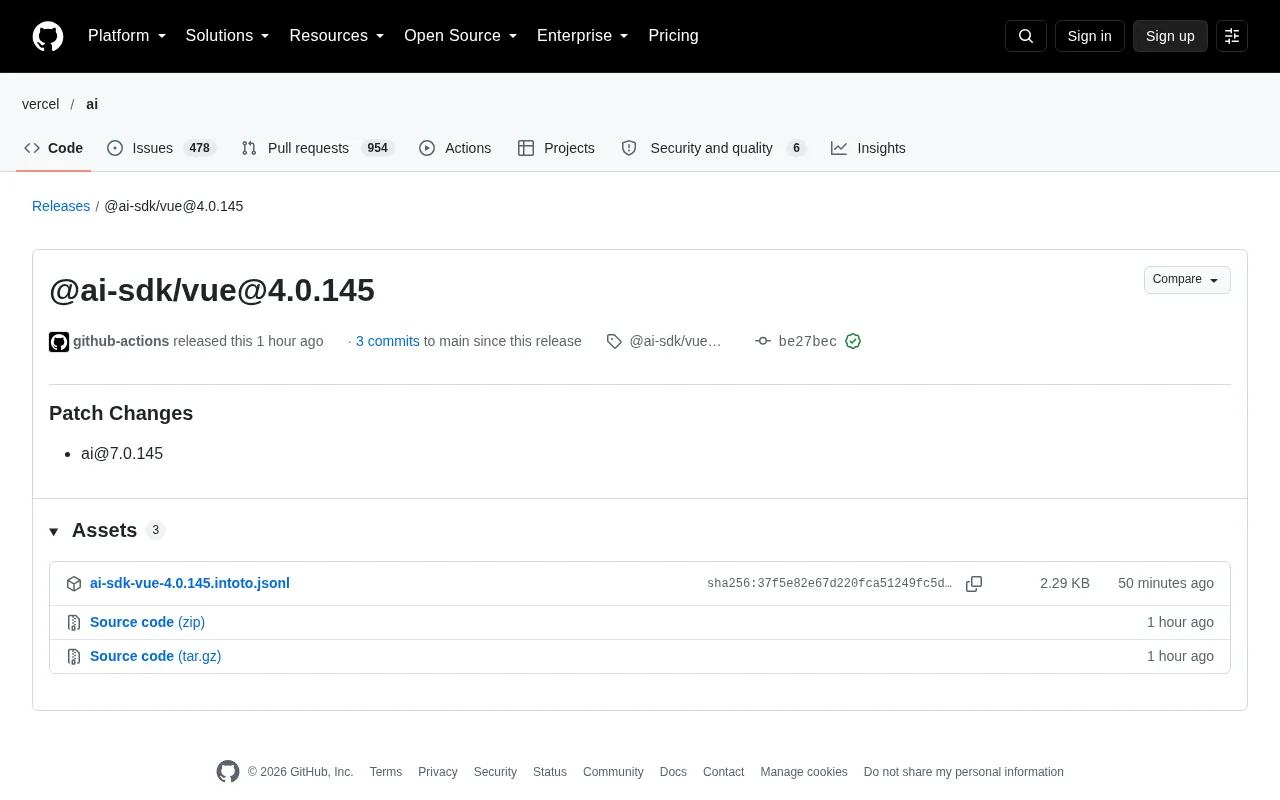
Vercel releases @ai-sdk/vue 4.0.145, a patch syncing the core package and continuing Vue adapter maintenance.
@ai-sdk/vue released version 4.0.145, a patch-level update that mainly syncs the core package ai@7.0.145, auto-published by github-actions with 3 commits and GPG verification. The article notes that although patch versions have no breaking changes, they often include subtle fixes for streaming boundaries, error handling, and type definitions. The package offers useChat and useCompletion composables, wrapping the AI SDK's unified model interface into reactive Vue APIs.
Behind an unassuming version number, AI capabilities in the Vue ecosystem are steadily advancing
Recently, Vercel's AI SDK released version 4.0.145 of its Vue adapter package @ai-sdk/vue. Judging by the version number, this is just a routine patch update, but given the evolution of the overall AI SDK ecosystem, this small release is still worth the attention of Vue developers.
Basic release information
According to the GitHub Releases page, @ai-sdk/vue@4.0.145 was recently published by the github-actions bot, contains 3 commits, and comes with GPG signature verification. The release notes classify this change as "Patch Changes," primarily involving a dependency sync on the core package ai@7.0.145.
This means the focus of this update is not new features or API changes, but rather keeping the Vue adapter layer consistent with the underlying AI SDK core version, fixing potential minor issues, and syncing upstream changes.
Why patch updates are still worth noting
For developers building Vue applications with the AI SDK, version synchronization itself is important. The AI SDK's core package ai carries capabilities such as model invocation, streaming response handling, and tool-calling orchestration, while @ai-sdk/vue provides composables like useChat and useCompletion, letting Vue developers integrate LLM capabilities in a declarative way.
Although patch versions do not introduce breaking changes, they often include subtle fixes for edge cases in streaming responses, error handling, and type definitions. Keeping up with such versions helps avoid known pitfalls in complex interactive scenarios.
In the npm ecosystem, a patch version (the third digit of a semantic version number) usually means a backward-compatible bug fix that does not change the public API. For an adapter layer like @ai-sdk/vue that directly depends on the core package ai, a patch sync often means the upstream core package made minor adjustments to interface details, and the adapter needs to follow to keep behavior consistent. Skipping patch versions generally won't immediately break functionality, but you may miss fixes for response format changes from specific model providers, edge cases in streaming chunk boundaries, or TypeScript type narrowing. Therefore, enabling automated dependency updates in CI (such as Dependabot or Renovate) along with testing is a low-cost way to keep up with such versions.
The positioning of AI SDK's Vue adapter
The core philosophy of the AI SDK is to provide a unified model interface, so developers don't have to write different invocation logic for each model provider. The Vue adapter package wraps this capability into APIs that follow Vue's reactive paradigm, lowering the barrier to integrating AI features into Vue projects.
As can be seen from the dependency relationships in this release, @ai-sdk/vue maintains a tight version-following strategy with the core package ai. The benefit of this strategy is strong ecosystem consistency—when troubleshooting, developers can cross-reference the core package's changelog.
Composables are the core organizing pattern of Vue 3's reactive system, reusing logic through functions called in setup() that return reactive state and methods. The useChat and useCompletion provided by @ai-sdk/vue are exactly this kind of function: internally they maintain refs for the message list, loading state, and streaming text, and call the core package's streaming interface underneath, mapping asynchronous incremental data into reactive variables that can be rendered directly in templates. Their value lies in consolidating the boilerplate of "sending a request—processing streaming chunks—updating the UI" into one place, while naturally fitting with Vue's lifecycle and reactive tracking, sparing developers from manually managing AbortController and state synchronization.
How developers should respond
If you are using @ai-sdk/vue in your project, it's recommended to upgrade to 4.0.145 or higher via your package manager, and check whether the ai core package is updated in sync. Since this is a patch-level change, you usually don't need to modify your business code.
For developers who haven't integrated it yet, this release also provides an observation window: AI SDK's Vue support is still actively maintained with a stable iteration cadence, making it a viable candidate for integrating LLM capabilities into Vue projects.
It should be noted that the release information itself is fairly concise, without detailed feature descriptions or migration guides. What's more worth watching going forward is whether the AI SDK will introduce more features oriented toward the Composition API in the Vue ecosystem, and how it will integrate with server-side rendering scenarios.
Semantic Versioning (SemVer) specifies version numbers in the form major.minor.patch: major version upgrades may contain breaking changes, minor versions add backward-compatible features, and patch numbers only make compatibility fixes. Based on this, 4.0.145 is patch-level with low upgrade risk, but you should still verify that the major and minor versions of @ai-sdk/vue and the ai core package match, to avoid hidden incompatibilities caused by mixing the adapter layer and core package across minor versions. For production projects, it's recommended to regression-test key paths such as streaming output, error retries, and tool calling after upgrading, rather than relying solely on the surface meaning of the version number.
One-line Summary
Vercel releases @ai-sdk/vue 4.0.145 patch version, syncing the core package and continuing to maintain the Vue adapter.
Paragraph Summary
@ai-sdk/vue released version 4.0.145, a patch-level update that mainly syncs the core package ai@7.0.145, automatically published by github-actions, containing 3 commits and passing GPG signature verification. The article notes that although patch versions have no breaking changes, they often include subtle fixes for streaming response boundaries, error handling, and type definitions, and are worth following for Vue developers. The package provides composables like useChat and useCompletion for Vue, wrapping the AI SDK's unified model interface into reactive APIs. The AI SDK maintains a tight version-following strategy with the core package, ensuring strong ecosystem consistency. Developers are advised to upgrade and confirm the core package is synced, with no need to change business code.
Related articles
AWS AgentCore Gateway: Connecting AI A…
AWS AgentCore Gateway: Connecting AI Agents to Enterprise Backends with MCP
How AWS AgentCore Gateway acts as a primary MCP server to aggregate REST APIs, Lambda, and existing MCP services? Analyzing its AST real-time mapping, zero cold start, semantic search for tool overload, session isolation, and key injection security design, plus the architectural approach to decoupling enterprise AI agents from backends.

One Link Gives Figma AI a New Skill: Hands-On with MCP Connectors
Paste one MCP server link and the AI Agent in Figma gains new tool capabilities. We break down the setup flow, 20+ one-click apps, read/write permissions and execution policies, and the public HTTPS requirement.

Cognition SWE-2 in Practice: One Prompt to Handle the Whole Product Launch Process
Analyzing a YouTube creator's prompt for using Cognition SWE-2 to launch a product: a landing page, seven-email sequence, and non-buyer follow-up tool, plus how the 'test and report' constraint changes AI delivery quality.