@ai-sdk/vue 4.0.150 Released: The Version Alignment Logic Behind Dependency Updates

@ai-sdk/vue 4.0.150 released with only dependency updates, no feature changes; version chains evolve independently.
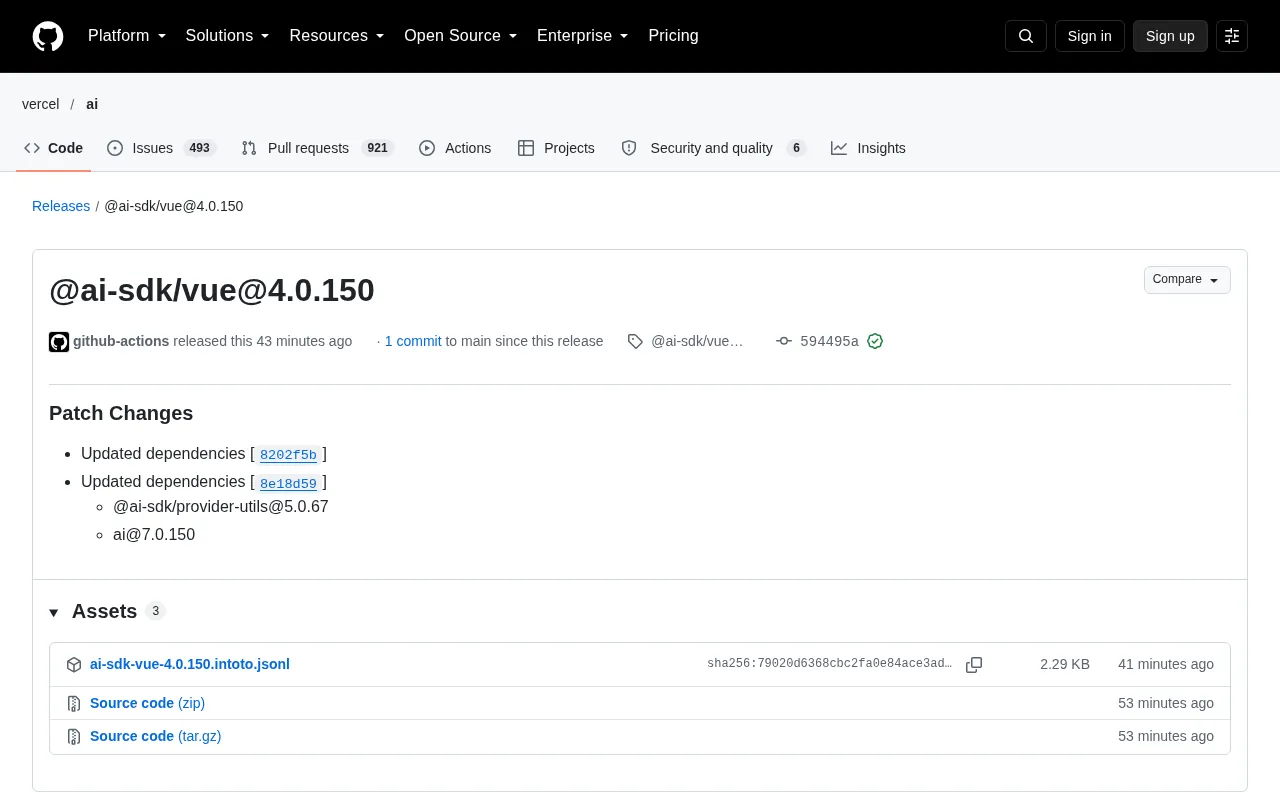
The Vue adapter layer of Vercel's AI SDK, @ai-sdk/vue, has released version 4.0.150—a patch update with no new APIs or features, only updating dependencies @ai-sdk/provider-utils and ai to 5.0.67 and 7.0.150 respectively. The article notes that the AI SDK's package structure consists of the core package ai, the utility package @ai-sdk/provider-utils, and the framework adapter layer @ai-sdk/vue, with each package evolving independently, causing version number mismatches (Vue package at 4.x, core package at 7.x). While patch updates go unnoticed by ordinary developers, they have real value for monorepo maintainers or those troubleshooting version conflicts, as they lock in a validated version combination that serves as a compatibility snapshot. The release is automated via GitHub Actions with signature verification, with artifacts hosted on GitHub Releases, ensuring traceability. Upgrade advice: regular projects can run npm update; if multiple packages are locked, explicitly align versions and run conversation flow tests.
A Minor Version Update Reveals the AI SDK's Release Cadence
The Vue adapter layer of Vercel's AI SDK, @ai-sdk/vue, has released version 4.0.150. Judging from the release notes, this version introduces no new APIs or feature changes—it's a typical patch release: the core changes are two dependency updates, pointing to @ai-sdk/provider-utils@5.0.67 and ai@7.0.150 respectively.
For developers who only call useChat in their business code, this kind of update usually goes unnoticed. But if you're a monorepo maintainer, or need to troubleshoot version conflicts, understanding the relationships between these version numbers has real value.
Three Packages, One Version Chain
The AI SDK has a multi-layered package structure: ai is the core package, providing low-level capabilities like streaming responses and tool calls; @ai-sdk/provider-utils encapsulates common utility functions for various model providers; and @ai-sdk/vue is the framework adapter layer for Vue 3, wrapping the core APIs into composables.
This 4.0.150 patch change simultaneously raises the minimum versions of the latter two. You might not have noticed the version number mismatch—the Vue package is at 4.x, while the core ai package is already at 7.x. This gap isn't an anomaly but the result of each package evolving independently: the adapter layer is relatively stable, while the core package iterates faster as model capabilities expand.
Why Patch Updates Are Worth Noticing
The dependency update itself doesn't produce behavioral changes, but it locks in a set of validated version combinations. For projects using a lockfile, this amounts to an official "compatibility snapshot." When you encounter peer dependency warnings for @ai-sdk/provider-utils in CI, aligning versions to the combination declared in 4.0.150 is often faster than trial and error.
In the npm ecosystem, a patch version usually refers to the third segment of a semantic version (SemVer), such as the 150 in 4.0.150, indicating backward-compatible bug fixes. A peer dependency is a type of npm dependency declaration that requires the host project to provide a specified version of a package, commonly seen in plugin or adapter libraries. When peer dependency versions don't match, npm outputs warnings that may lead to runtime errors. The AI SDK's adapter layer may declare the compatible range of the core package via peer dependency, so aligning version numbers avoids such warnings.
A lockfile (such as package-lock.json or yarn.lock) is a lock file generated by the package manager that records the exact versions and sources of all dependencies, ensuring consistent installation across different environments. When dependencies are updated, the lockfile updates to the new version combination, forming a "compatibility snapshot." In CI, if the lockfile doesn't match the version ranges declared in package.json, it may cause installation failures or behavioral differences. Therefore, the version combination locked by an official patch update can serve as a reference for teams to align dependencies.
Engineering Details of the Release Process
This release was automatically created by the github-actions bot, with the commit carrying a GitHub-verified signature (GPG key ID starting with B5690EEE). The release page also lists 3 assets, indicating that artifacts are hosted on GitHub Releases rather than only on npm.
Automated releases plus signature verification mean the correspondence between version numbers and commits is trustworthy, and audits can trace directly to the source. For teams using the AI SDK in production, the integrity of this chain is more worth recording in your dependency strategy than the feature list.
Upgrade Recommendations
For regular projects, running npm update @ai-sdk/vue is enough to get this patch. If your project also locks ai and @ai-sdk/provider-utils, it's recommended to explicitly align to the version numbers in the release notes to avoid the lockfile resolving a cross-version combination. After upgrading, run your existing conversation flow tests to confirm that streaming responses and tool call behavior are unchanged—that's sufficient to cover the risk surface of a patch-level update.
GitHub Actions is a CI/CD service provided by GitHub that can automate build, test, and release processes. GPG signatures are used to verify the authenticity of commits or tags; GitHub automatically signs bot commits, ensuring the correspondence between version numbers and commits is trustworthy. GitHub Releases is used to host release artifacts (such as tarballs or binaries), complementing the npm registry. This automated release plus signature verification process improves supply chain security and facilitates audit tracing.
Related articles

Grok Bot vs ChatGPT Agent: Which AI Agent Is More Powerful?
How does Grok Bot differ from ChatGPT Agent? This comparison examines how they work: Grok Bot has a cloud computer and runs persistently inside tools to execute multi-step tasks automatically; ChatGPT Agent operates web pages in a browser and is more mature at general tasks. Includes selection advice.

Walmart Agent Gateway: AI Shops for You Automatically—Why Is Amazon Going the Opposite Way?
Walmart's Agent Gateway lets ChatGPT, Gemini and other AI assistants access its product catalog to search, compare and add to cart, with spending limits and per-purchase approval. Amazon blocks external AI agents—two retail giants, opposite paths. Currently US-only, India may follow.

Walmart Opens Shopping to AI Agents: ChatGPT and Gemini Can Place Orders
Walmart launches Agent Profiles, allowing AI agents like ChatGPT, Gemini, and Meta Muse to shop for users with spending limits, per-transaction approval, and isolated orders—no Walmart Plus required. This article analyzes how it works and its industry impact, in stark contrast to Amazon's blocking of AI agents.