AI SDK Vue 4.0.155 Patch Update: Dependency Sync and Ecosystem Coordination

@ai-sdk/vue 4.0.155 patch update syncs core dependencies, reflecting monorepo version alignment and automated release maturity.
This article analyzes the significance of the @ai-sdk/vue@4.0.155 patch update. Published automatically by github-actions and introducing no new APIs, it mainly bumps the ai core package to 7.0.155 and @ai-sdk/provider-utils to 5.0.70. The article notes that the Vue adapter and core package share the same patch number, reflecting AI SDK's version alignment strategy under monorepo management to ensure cross-package dependency determinism. The provider-utils update may involve edge-case fixes or type refinements for request adaptation, indirectly affecting composables like useChat. Automated releases and GPG signature verification demonstrate engineering maturity. For Vue developers, the upgrade brings no API changes, but provider-utils compatibility with custom providers should be checked; testing before deploying is recommended. Though small, patch versions signal ecosystem health and long-term maintainability.
A Seemingly Ordinary Patch Update
In the version iterations of open-source projects, patch releases often don't attract as much attention as major updates, yet they are frequently a barometer of ecosystem health. The release of @ai-sdk/vue@4.0.155 is exactly such an example: it introduces no new features, but through a series of dependency updates, it ensures that the Vue ecosystem stays aligned with the AI SDK core.
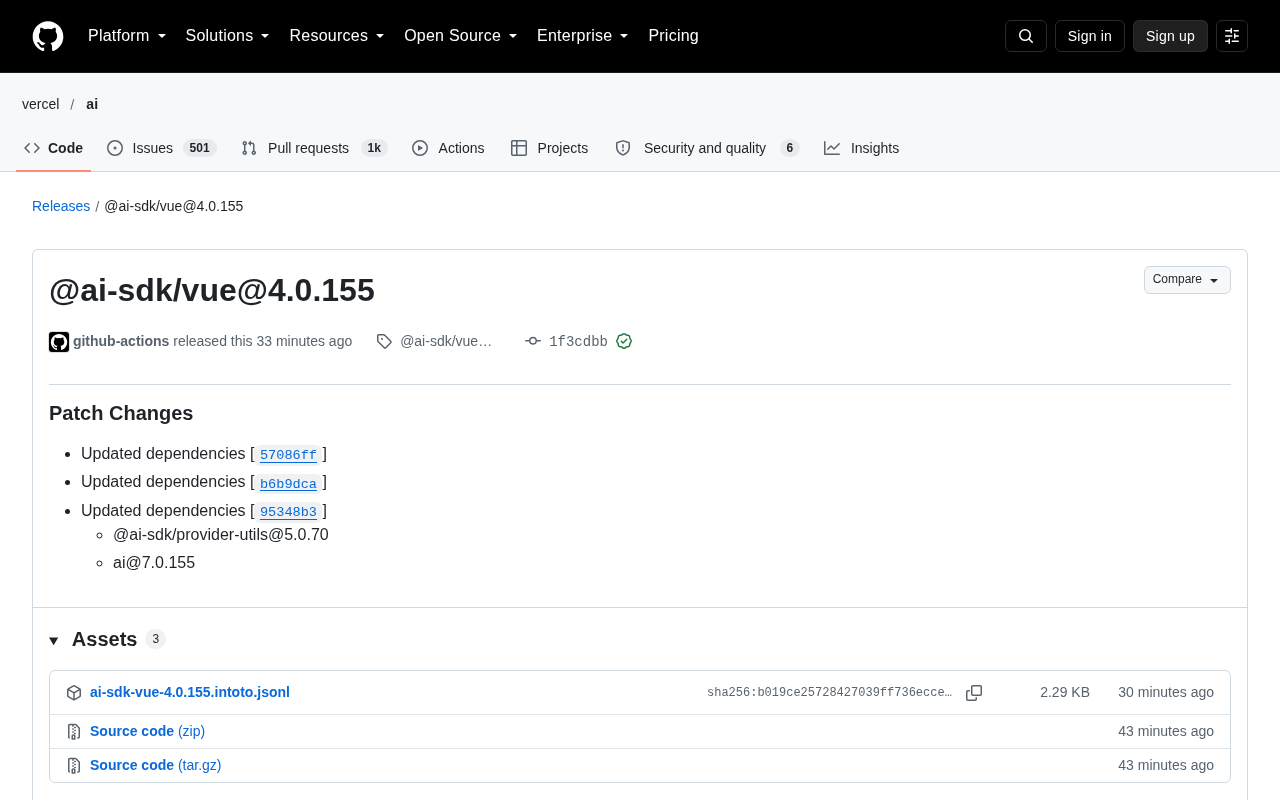
According to the release records on GitHub, this update was automatically published by the github-actions bot and came with a GitHub-verified signed commit. The patch notes list three dependency updates, corresponding to commits 57086ff, b6b9dca, and 95348b3, ultimately bumping @ai-sdk/provider-utils to 5.0.70 and syncing the core package ai to 7.0.155.
The Version Alignment Logic Behind the Dependency Chain
From the version numbers, it's clear that the version of @ai-sdk/vue (4.0.155) and the core package ai (7.0.155) match in their patch numbers—this is no coincidence. AI SDK is managed as a monorepo, and the framework adapter packages (such as Vue, React, Svelte) typically roll out releases following the patch number of the core package to ensure determinism in cross-package dependencies.
The bump of @ai-sdk/provider-utils to 5.0.70 hints at minor adjustments in the underlying toolchain. This package handles request adaptation and utility functions for different AI providers (such as OpenAI and Anthropic), and its patch updates often involve edge-case fixes or refinements of type definitions. For Vue developers, this means that when using composables like useChat, the stability of underlying requests may be indirectly improved.
Why Even Minor Versions Are Worth Noticing
Many developers are accustomed to using ^ or ~ ranges in package.json to lock versions, but for rapidly iterating libraries like AI SDK, behavioral differences can exist even between patch versions. This update explicitly lists the commit hashes of dependency changes, making it easy for teams that need it to trace specific changes. If your project has high requirements for the determinism of AI requests, it's advisable to check the changelog of @ai-sdk/provider-utils before upgrading to confirm there are no adjustments that affect your current usage.
monorepo is a strategy of managing multiple related packages in a single code repository. AI SDK places the core package ai, framework adapter packages (such as @ai-sdk/vue), and the utility package @ai-sdk/provider-utils all in one repository, sharing the build, test, and release processes. The advantage of this model is that cross-package changes can be committed atomically, version numbers can be planned uniformly, and dependencies are easier to keep consistent. The challenge, however, is that the release cadence of each package needs to be coordinated, typically using fixed versioning or independent version numbers while keeping patch numbers aligned. The fact that @ai-sdk/vue 4.0.155 and ai 7.0.155 share the same patch number in this article is a typical manifestation of version alignment under a monorepo, ensuring that the framework adapter package and the core package strictly match at the patch level.
GPG signing (GNU Privacy Guard) is a digital signature mechanism based on public-key cryptography, commonly used to verify the identity of software publishers and the integrity of data. In open-source projects, maintainers can sign Git commits or release tags with a private key, and users can verify the signature with the corresponding public key to confirm that the code indeed comes from a trusted source and has not been tampered with. GitHub automatically verifies and displays a "Verified" badge, along with the key ID used for signing. The "GitHub-verified signed commit" and "GPG key ID" mentioned in the release records are manifestations of this mechanism. For enterprise users, incorporating GPG signature verification into the dependency check process can reduce the risk of supply chain attacks and ensure that the packages used match the official releases.
The Maturity of the Automated Release Process
Several details in the release records are worth noting: the commits were created by the github-actions bot, carry GitHub-verified signatures, and include a GPG key ID. This indicates that the AI SDK project has established a complete automated release pipeline—from change detection and version number incrementing to npm publishing and GitHub Release generation, all completed by CI.
This model is becoming increasingly common in mature open-source projects. Its benefits are reducing human error and ensuring that every version has a traceable signed record. For enterprise users, signature verification can be part of supply chain security. However, automated releases also mean that patch notes are usually brief—like this one, which only lists dependency updates without explaining what specifically was fixed. Developers who want details need to jump to the corresponding commits or the release pages of related packages.
The Practical Impact on Vue Developers
If you are using @ai-sdk/vue to build AI features, this update will not bring any API-level changes. It is more like routine maintenance to ensure that the Vue adapter layer you use is in sync with the core SDK and provider toolchain.
When actually upgrading, you can pay attention to two things: first, the ai core package goes from some version of 7.0.x to 7.0.155; if you previously locked an earlier patch version, you may also receive other fixes. Second, the update to @ai-sdk/provider-utils may affect the compatibility of custom providers, especially those projects that directly depend on the type definitions of that package. It is recommended to run existing tests in the development environment first before pushing to production.
From a broader perspective, AI SDK maintains consistency across framework adapter packages through high-frequency patch releases, a strategy that reduces the cognitive burden on developers switching between frameworks. Vue developers don't need to track every change in the core SDK separately; they just need to follow the version number of the adapter package.
Conclusion: Ecosystem Signals in Patch Versions
@ai-sdk/vue@4.0.155 itself has no story, but it reflects the engineering maturity of the AI SDK project: automated releases, signature verification, and dependency synchronization. For technology decision-makers, such details reflect a project's long-term maintainability better than new features. The next time you see a similar patch update, take a closer look at the dependency chain—it often reveals the true state of ecosystem coordination.
One-line Summary
@ai-sdk/vue 4.0.155 patch update syncs core dependencies, demonstrating monorepo version alignment and automated release maturity.
Paragraph Summary
This article analyzes the significance of the @ai-sdk/vue@4.0.155 patch update. The update was automatically published by github-actions and introduces no new APIs. It mainly upgrades the core package ai to 7.0.155 and @ai-sdk/provider-utils to 5.0.70. The article points out that the Vue adapter package and the core package share the same patch number, reflecting AI SDK's version alignment strategy under monorepo management, ensuring cross-package dependency determinism. The provider-utils update may involve edge-case fixes or type refinements for request adaptation, indirectly affecting the stability of composables like useChat. The automation of the release process and GPG signature verification demonstrate the project's engineering maturity. For Vue developers, the upgrade brings no API changes, but attention should be paid to provider-utils compatibility with custom providers; testing before going live is recommended. Although patch versions are small, they are a signal of ecosystem health and long-term maintainability.
Related articles

Firebase AI Logic + Gemini Nano 4: A Practical Guide to Android AI Development
How Firebase AI Logic and Gemini Nano 4 help Android developers ship generative AI: App Check and prompt templates ensure security, hybrid routing cuts latency and cost, Spend Caps control budgets, and AI monitoring provides observability.

Microsoft AI Agent Breakthroughs: More Efficient, Better at Code and Weather Forecasting
Microsoft Research Focus Issue 97: ForkPilot cuts agent inference costs, Cabra reveals coding agents' code-understanding gap, Teletune learns workflows from logs, PBC improves extended forecasts, BioEMU-2 opens preview.

Prime Intellect Releases Prime Mega MoE: Trainable Fused MoE Kernel with 3.11x Forward Speedup
Prime Intellect releases Prime Mega MoE, adding backpropagation to DeepSeek's fused Mega MoE kernel for trainability. Up to 3.11x forward speedup and 34% faster Qwen3 MoE training steps in prime-rl.