@ai-sdk/vue 4.0.157 Released: Dependency Updates and Ecosystem Evolution

@ai-sdk/vue 4.0.157 released as a dependency-sync patch with no new APIs.
The article introduces the patch version 4.0.157 of AI SDK's Vue adapter layer `@ai-sdk/vue`. This version introduces no new APIs or breaking changes; the core is four dependency synchronization updates, upgrading `ai` to 7.0.157 and `@ai-sdk/provider-utils` to 5.0.71. It explains provider-utils' infrastructure role in request construction, streaming parsing, and tool calls, and notes that under a coordinated release strategy, patch versions may still carry behavioral adjustments, requiring attention to dependency tree consistency. The release was automated via GitHub Actions with GPG signature, reflecting a mature CI/CD pipeline. For Vue developers, the impact depends on dependency strategy; after upgrading, regression testing of streaming responses and tool calls is recommended. It also notes this reflects AI SDK's continued investment in frontend framework adapter layers.
Version Overview: A Patch Update Focused on the Dependency Chain
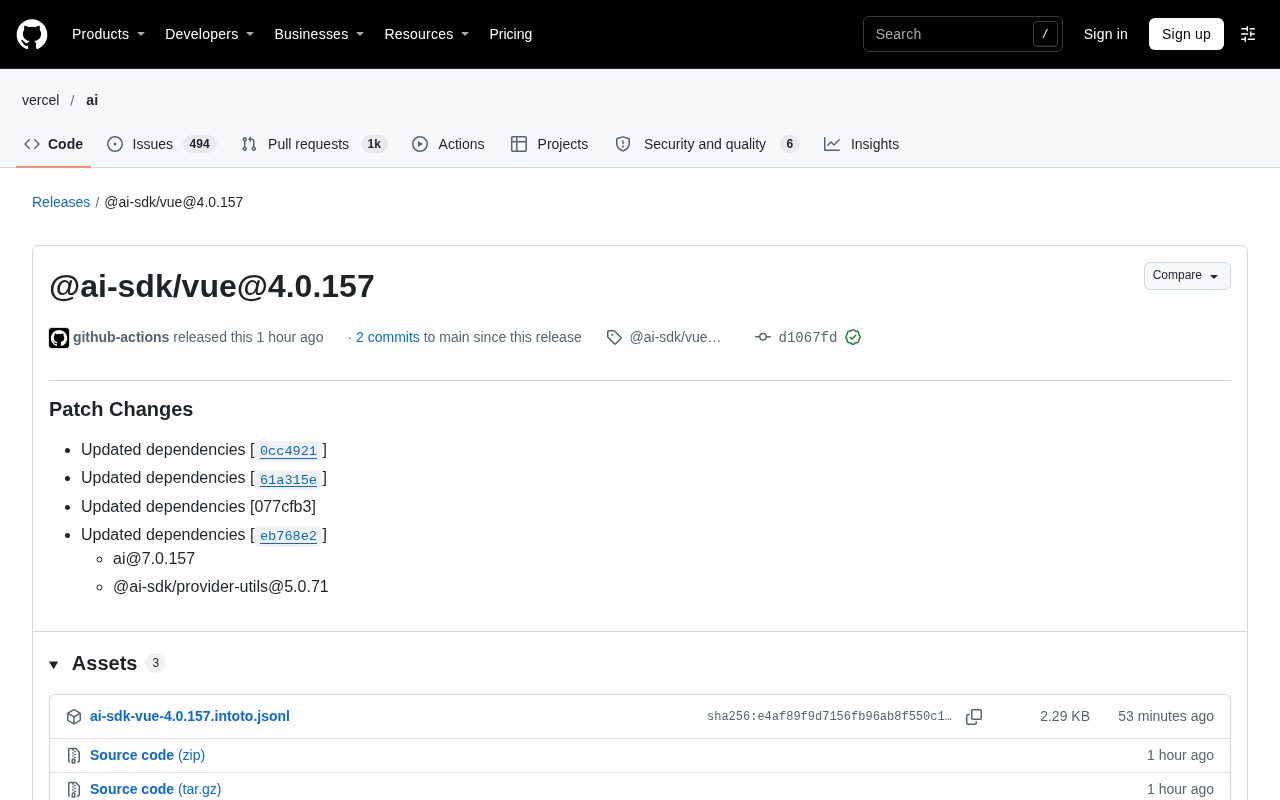
The Vue adapter layer for AI SDK, @ai-sdk/vue, has released patch version 4.0.157. According to the GitHub release records, this version does not introduce new APIs or breaking changes itself; instead, it focuses on dependency synchronization—involving four dependency update commits, with the core package ai upgraded to 7.0.157 and @ai-sdk/provider-utils upgraded to 5.0.71.
For developers heavily relying on AI SDK to build Vue applications, the significance of such patch versions often lies not in "new features" but in ensuring version alignment across the entire toolchain. The AI SDK package family adopts a coordinated release strategy, where the version number of @ai-sdk/vue stays in sync with the underlying ai package. This means the application-side dependency tree needs to be upgraded as a whole to avoid type or runtime issues caused by mismatched provider-utils versions.
Technical Implications of the Dependency Updates
The Role of provider-utils
@ai-sdk/provider-utils is the toolkit in AI SDK responsible for abstracting model providers, encapsulating low-level logic such as request construction, streaming response parsing, and error handling. It belongs to the infrastructure layer of the provider ecosystem, and any patch-level change typically indicates subtle fixes in areas like streaming transmission, token counting, or tool call parsing. Although this release does not include changelog details, including provider-utils in the synchronized update suggests there are upstream fixes that need to be aligned.
Provider Abstraction Layer and the Architecture of Vercel AI SDK
AI SDK is maintained by Vercel, with a core design that decouples "model providers" from "calling interfaces": the ai package provides unified high-level APIs such as generateText, streamText, and generateObject, while each provider package (e.g., @ai-sdk/openai, @ai-sdk/anthropic) is responsible for translating unified parameters into the corresponding vendor's HTTP request format. @ai-sdk/provider-utils sits between the two, providing interface contracts like LanguageModelV1, SSE parsing for streaming data, JSON Schema validation for tool calls, and retryable error encapsulation. Since all provider packages and framework adapter layers depend on it, once a patch-level fix occurs in provider-utils, it propagates down the dependency chain to every downstream package—this is the fundamental reason why @ai-sdk/vue needs to be upgraded in sync this time.
Why Patch Versions Still Warrant Attention
Under the semantic versioning system, patch versions are assumed to have "no breaking changes." However, for fast-iterating projects like AI SDK, with deep dependency chains and tight inter-package coupling, a patch version of the ai package may carry behavioral adjustments. For production environments, checking dependency tree integrity and confirming version consistency between the Vue adapter layer and the underlying ai package before upgrading remains a necessary step.
Limitations of Semantic Versioning in Coordinated Release Projects
SemVer stipulates that the patch position is only for backward-compatible bug fixes, but this convention is built on the premise of "individual packages evolving independently." AI SDK adopts monorepo coordinated releases, where all package version numbers increment in the same pipeline. The major version number of @ai-sdk/vue does not even align with the ai package (the former is 4.x, the latter 7.x), indicating that the adapter layer has its own version cadence. In this case, the patch number is more of a "build sequence number" than a strict compatibility contract. The actual risk point lies in peer dependency matching: if an application installs an old version of ai alongside a new version of provider-utils, TypeScript type definitions may become structurally incompatible, or fields may be missing in streaming chunk parsing. Therefore, when upgrading, use npm ls @ai-sdk/provider-utils or pnpm why to confirm there are no duplicate versions in the dependency tree.
Release Characteristics of This Update
Several details worth noting can be seen from the release records: the release was automatically completed by github-actions, includes 2 commits, and uses GitHub's verified signature (GPG key ID: B5690EEEBB952194). The automated release process indicates that AI SDK has established a relatively mature CI/CD pipeline, allowing patch versions to be produced frequently and with low friction. The four dependency update commits are identified by short hashes, corresponding to several upstream fixes—this "dependency-driven" release model is becoming increasingly common in SDK-type projects.
Changesets and Automated Release Pipelines
The four dependency update commits in the article are identified by short hashes, which are typically records generated after Dependabot or Renovate automatically submits PRs and they are merged; the release executed by the github-actions bot with GPG signature indicates the project uses Changesets or similar automated release tools. This type of pipeline works as follows: the bot detects a new version of an upstream package → automatically modifies package.json and commits → after CI passes tests, triggers npm publish and tags. Under this model, patch versions can be produced very frequently (multiple times a day), at the cost of often lacking manually written change descriptions in release records. If developers need to trace actual changes, they should check the monorepo's CHANGELOG or the corresponding upstream commits, rather than only looking at this package's release notes.
What It Means for Vue Developers
If you are using @ai-sdk/vue to build chat interfaces or AI features, the actual impact of this version depends on your dependency strategy. If you use a strategy of locking exact versions, you can evaluate whether to follow up as needed; if you use ^ range versions, you may automatically receive this patch on the next install. Either way, it is recommended to run integration tests related to streaming responses and tool calls after upgrading to confirm consistent behavior.
More broadly, the continuous releases of @ai-sdk/vue reflect AI SDK's emphasis on frontend framework adapter layers. The use of the Vue ecosystem in AI application development is expanding, and keeping the adapter layer in sync with the core package helps reduce maintenance costs for cross-framework usage.
Summary
@ai-sdk/vue@4.0.157 is a typical dependency-synchronization patch version, with no prominent new features, but it maintains version consistency across the AI SDK toolchain. For developers, understanding the dependency governance logic behind such versions is more valuable than chasing individual version numbers.
Related articles
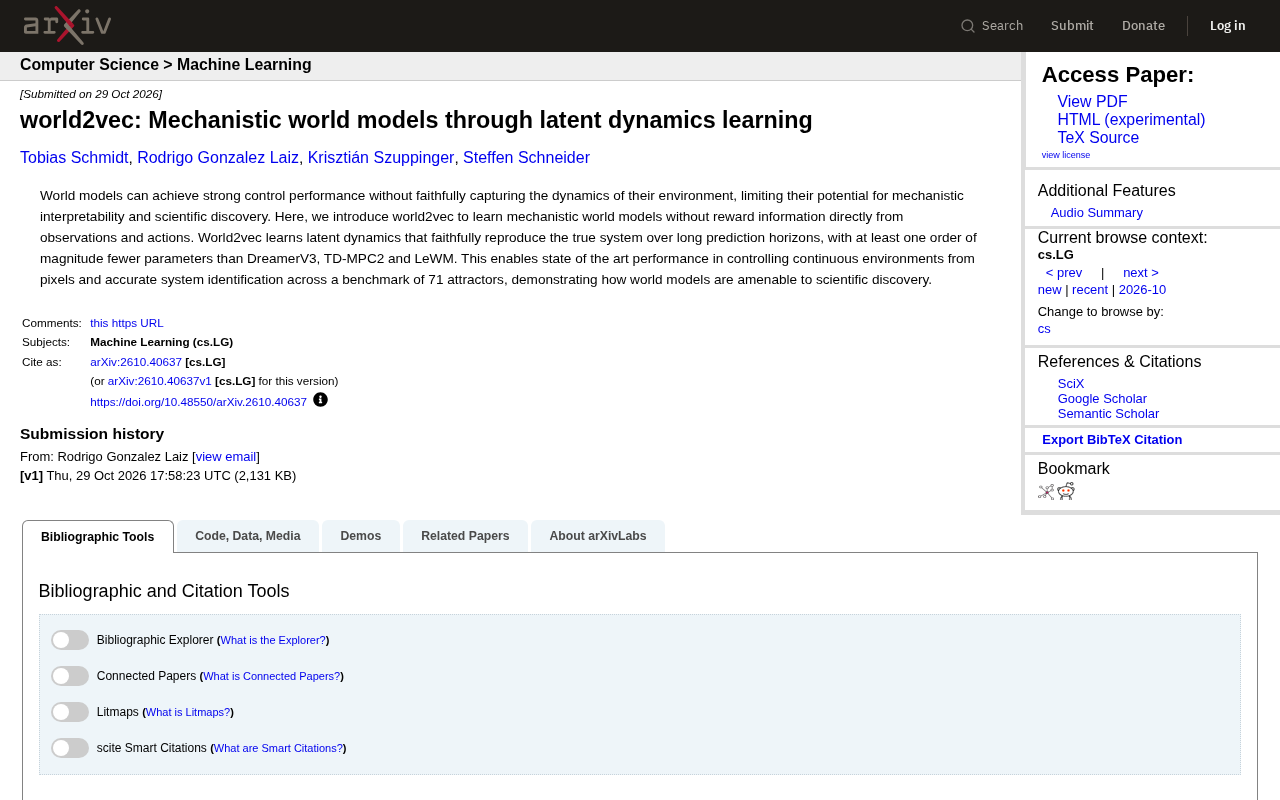
world2vec: Building Mechanistic World Models with Latent Dynamics Learning
world2vec proposes a reward-free method for learning mechanistic world models via latent dynamics, faithfully reproducing systems over long horizons with at least an order of magnitude fewer parameters than DreamerV3, TD-MPC2, and LeWM, and achieving accurate system identification on 71 attractor benchmarks.

A New KL-DRO Paradigm: Adaptive Scenario Generation Around a Learned Density Model
KL-DRO research proposes centering the KL ball on a learned density model instead of the empirical distribution, with adaptive scenario generation guiding sampling toward the worst case. Experiments show lower cost under distribution shift when records are scarce and the model can extrapolate, with comparable in-distribution cost.

ODE Samplers for Discrete Diffusion Models: Exponential Residual Flows Accelerate Generation
Discrete diffusion models lack deterministic ODE sampling? This article introduces Exponential Residual Flows (ERFs), which introduce continuous residual variables per token to construct piecewise ODEs for deterministic sampling and support consistency distillation acceleration. Superior to prior methods on code and text generation tasks.