AI SDK Vue 4.0.161 Patch Released: Dependencies Synchronized
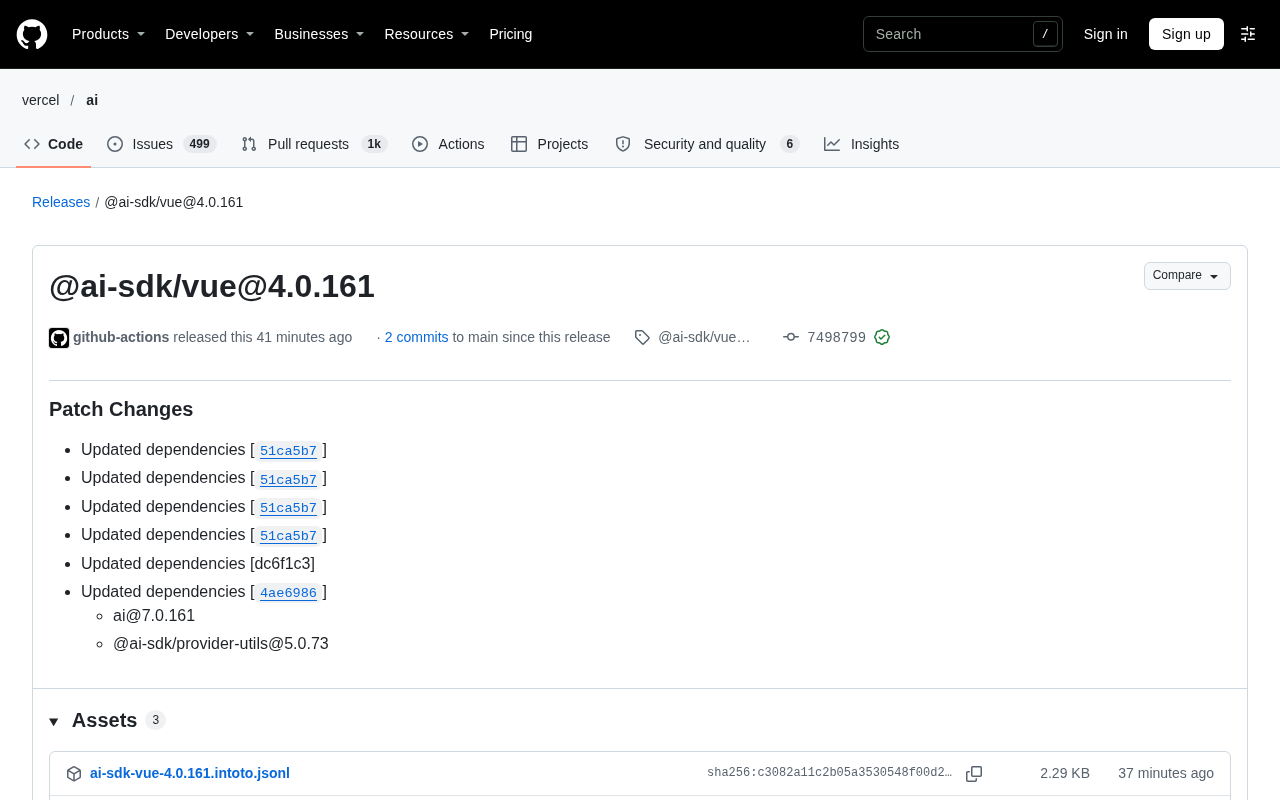
@ai-sdk/vue releases patch 4.0.161, only synchronizing upstream dependencies, a low-risk upgrade.
Vercel's @ai-sdk/vue releases version 4.0.161, a typical patch update whose changelog only shows synchronization of two upstream dependencies, ai@7.0.161 and @ai-sdk/provider-utils@5.0.73, without introducing new APIs or breaking changes. Since the Vue adapter layer itself does not implement model invocation logic, the fixes actually obtained mainly come from the core runtime and the provider utility layer. The article recommends treating it as a routine upgrade, verifying the build and type checks in the development environment before pushing to production, and emphasizes pinning versions via the lockfile to avoid patch-level drift. The release was completed automatically by github-actions with signature verification, reflecting a relatively mature release pipeline.
Vercel's AI SDK ecosystem has rolled out another routine iteration. @ai-sdk/vue has released version 4.0.161, a typical patch update (Patch Changes) whose core action centers on dependency synchronization rather than introducing new features or breaking changes.
Release Positioning: Patch, Not Feature
Judging from the release notes, the changelog for 4.0.161 only lists "Updated dependencies" along with several commit hashes. This means the version introduces no new APIs and changes no behavioral contracts; its main purpose is to propagate upstream dependency fixes and adjustments to the Vue adapter layer. For developers using @ai-sdk/vue to build AI chat interfaces, this is a low-risk upgrade.
In semantic versioning, patch versions are inherently meant to carry "backward-compatible bug fixes." When a framework adapter package frequently follows the core package's releases, such updates often indicate that the upstream ecosystem is rapidly converging on issues, and the adapter layer only needs to stay in sync.
Semantic Versioning (SemVer) is the most common versioning convention in the npm ecosystem, formatted as MAJOR.MINOR.PATCH. An increment of the major version indicates incompatible API changes; a minor version increment indicates new functionality added in a backward-compatible manner; and a patch number increment contains only backward-compatible bug fixes. @ai-sdk/vue 4.0.161 is an increment of the third segment, so at the specification level it promises that "upgrading will not break existing calls." It's worth distinguishing that SemVer is only a convention, not an enforcement; in real projects you should still combine the changelog and tests to judge. However, for repositories like AI SDK where the release process is automated and changelogs are tool-generated, the correspondence between version numbers and actual change types is usually fairly reliable.
Propagation of the Dependency Chain: ai and provider-utils
The release notes explicitly list two updated dependencies: ai@7.0.161 and @ai-sdk/provider-utils@5.0.73. These two packages play different roles—ai is the core runtime of AI SDK, while provider-utils is the shared utility layer for integrating various model providers. As a Vue-oriented wrapper, @ai-sdk/vue does not itself directly implement model invocation logic; instead, it exposes the core package's capabilities to Vue components in forms such as composables.
Therefore, when the core package and utility layer release patches, it is standard practice for the Vue package to follow suit. After developers upgrade @ai-sdk/vue, the fixes they actually obtain usually come from these two upstream packages rather than from code changes in the Vue layer itself.
Dependency hoisting and the lockfile mechanism are key background for understanding this update. Package managers such as npm, pnpm, and yarn resolve the actual installed version based on version ranges in package.json (such as ^5.0.0) and write the result into a lockfile (package-lock.json, pnpm-lock.yaml, etc.). @ai-sdk/vue typically declares range dependencies rather than exact versions for upstream packages, so when upstream releases patches, developers installing at different times may resolve to different patch numbers. The role of the lockfile is precisely to freeze a particular resolution result and ensure consistent installation within the team and in CI environments. This also explains why the original text emphasizes "the lockfile is authoritative": in a multi-package monorepo ecosystem, the lockfile is the only reliable basis for avoiding patch-level drift.
Practical Impact on Vue Developers
If you are using @ai-sdk/vue to build streaming chat, message lists, or tool-calling interfaces, this upgrade basically requires no changes to business code. Patch updates do not involve interface signature changes; after upgrading, it is recommended to run your existing tests once to confirm there are no dependency resolution conflicts.
What needs attention is alignment of dependency versions. The patch numbers of ai and provider-utils are not exactly the same as those of the Vue package, so when pinning versions, teams should preferably rely on the lockfile to avoid different subpackages referencing different patch levels and causing subtle behavioral differences.
Engineering Signals from the Release Process
This release was completed automatically by github-actions, and the commits carry GitHub verified signatures. The loading error prompt appearing on the release notes page is a front-end issue with the GitHub Releases interface and has nothing to do with the package's own quality. From an engineering perspective, automated releases plus signature verification indicate that the repository's release pipeline is already quite mature, and patches can be continuously produced at low labor cost.
For projects that depend on AI SDK, such minor version updates form the daily pulse of the ecosystem. They are not flashy, but they ensure that compatibility issues do not arise between the adapter layer and the core layer due to version drift.
GitHub Actions automated releases refer to repositories defining release steps through workflow files: usually triggered after code is merged into the main branch or a tag is created, with a bot account performing version number increments, generating changelogs, publishing to the npm registry, and creating a GitHub Release. Combined with commit signature verification (GPG or Sigstore signatures), it can confirm that release artifacts genuinely come from a trusted CI pipeline rather than local manual uploads. This combination has become standard for mature projects in the open-source ecosystem; its value lies in reducing human error, increasing release frequency, and enabling patch-level updates to be continuously produced at near-zero marginal cost.
Upgrade Recommendations
Overall, 4.0.161 is suitable for handling as a routine upgrade: install it first in the development environment, confirm that the build and type checks pass, and then push to production. If the project has a strict dependency version pinning strategy, this update can be included in the next batch upgrade window without scheduling separate regression testing.
One-line Summary
@ai-sdk/vue releases patch 4.0.161, only synchronizing upstream dependencies, a low-risk upgrade.
Paragraph Summary
Vercel's @ai-sdk/vue has released version 4.0.161, a typical patch update whose changelog only shows synchronization of two upstream dependencies, ai@7.0.161 and @ai-sdk/provider-utils@5.0.73, without introducing new APIs or breaking changes. Since the Vue adapter layer itself does not implement model invocation logic, the fixes actually obtained mainly come from the core runtime and the provider utility layer. The article recommends developers treat it as a routine upgrade, verify the build and type checks in the development environment before pushing to production, and emphasizes pinning versions via the lockfile to avoid patch-level drift. The release was completed automatically by github-actions with signature verification, reflecting that the repository's release pipeline is relatively mature.
Related articles

Skykea Showdown: A Hilarious Variety Show Experience of a Minecraft Airship Building Competition
Skykea Showdown is a Minecraft airship building racing variety show. This article analyzes its two-phase build + hole race format, airship mod lift physics, secret mission design, and team confrontation dynamics—ideal for game content creators.

Did the US Midterms Vote No to AI Data Centers? A Map Reveals the Truth
After the US midterms, media claimed voters rejected AI data centers, but a map shows restrictive votes are concentrated in a few Ohio townships, affecting less than 1% of US towns—the national anti-AI wave is exaggerated.

ApexW Optimizer Benchmark: Matches 8-bit AdamW in Unsloth with Lower Memory Usage
Developer shares benchmark of ApexW optimizer in Unsloth: ApexW 8bit has lower optimizer state memory (47.101 MB) and slightly better final loss than 8-bit AdamW, but similar speed. Needs independent reproduction.