@ai-sdk/vue 4.0.162 Patch Release: Vue SDK Dependency Chain Synced and Upgraded
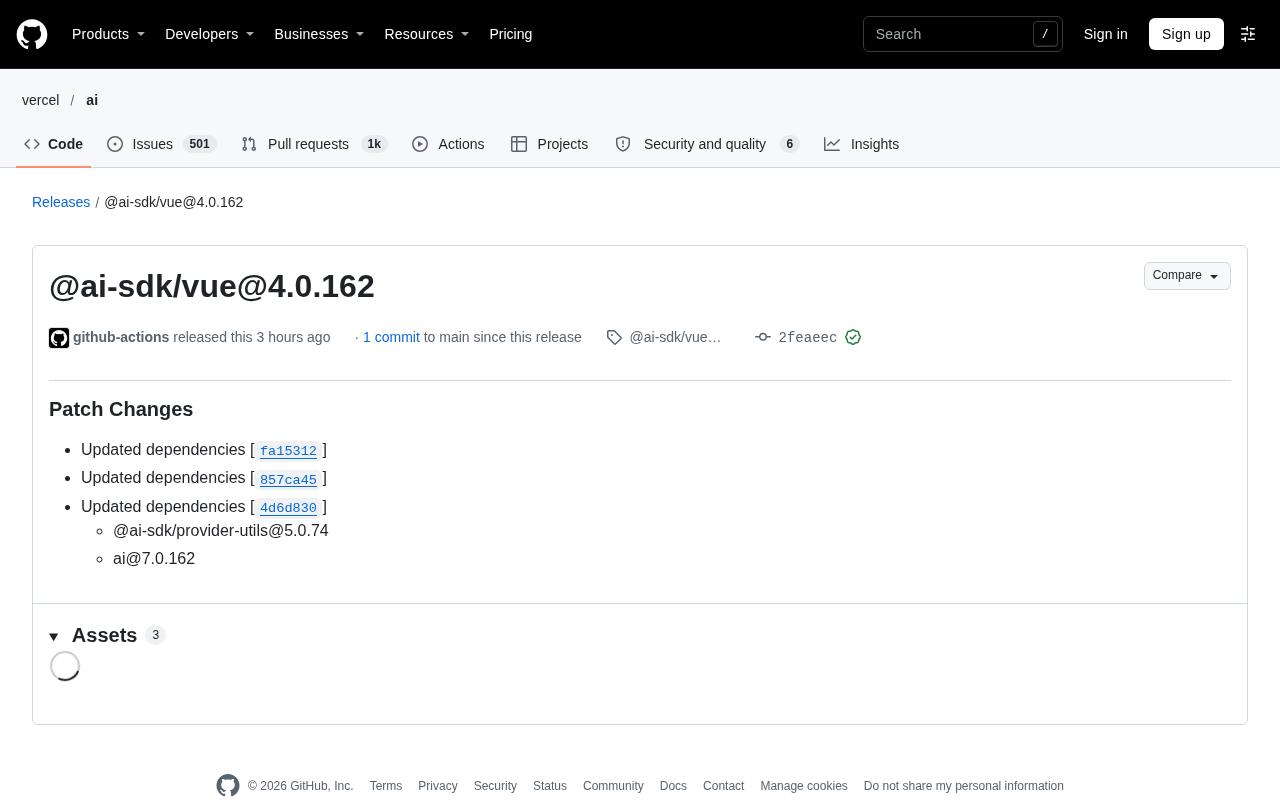
@ai-sdk/vue 4.0.162 only syncs underlying dependencies, illustrating monorepo version alignment.
This article explains the 4.0.162 patch release of Vercel AI SDK's Vue adapter layer. The version contains no business-code changes; it only upgrades @ai-sdk/provider-utils to 5.0.74 and the ai core package to 7.0.162, triggered by three dependency update commits. The article outlines the AI SDK's layered structure—the ai core layer, the provider-utils utility layer, and the @ai-sdk/vue framework adapter layer—and notes that the adapter layer's job is to map framework-agnostic capabilities onto Vue composables, so every core-layer change triggers a downstream sync release. The author sees this as reflecting the value of a monorepo's unified release strategy: the adapter layer always stays consistent with the core layer, and users don't need to align multiple package versions manually. It also warns that high-frequency small-step releases come with the added cost of scattered information—troubleshooting upgrade impact requires tracing the changelogs of underlying packages.
Vercel's AI SDK project recently released a patch version for its Vue adapter layer. On the surface it's just a routine dependency update, but it reflects how version synchronization actually works across the AI SDK's multi-framework ecosystem.
A Patch Release That's "Purely a Dependency Update"
According to the release record on GitHub, @ai-sdk/vue@4.0.162 is a Patch Changes release containing a single commit (commit 2feaeec), and that commit carries GitHub's verified signature (GPG key ID: B5690EEEBB952194). For developers familiar with semantic versioning, a patch number means this is neither a new feature nor a breaking change, but an adjustment at the level of fixes and alignment.
The substance of this version is a chain reaction triggered by three dependency update records. The release notes list three dependency update commits (fa15312, 857ca45, 4d6d830), corresponding to downstream package versions @ai-sdk/provider-utils@5.0.74 and ai@7.0.162. In other words, the Vue package itself has no business-code changes; the changes come entirely from the underlying utility package and core package it depends on.
How the Dependency Chain Propagates: The Roles of provider-utils and the ai Package
To understand the significance of this patch, you first need to see the layered structure of the AI SDK. The ai package is the core layer, carrying the main capabilities such as model invocation, streaming responses, and tool calling; @ai-sdk/provider-utils is the general-purpose utility layer for model providers, handling parameter validation, request construction, and other foundational work; and @ai-sdk/vue is the framework adapter layer, packaging the core capabilities into a form usable via Vue composables.
When both the core package and the utility package release new versions, the adapter layer must upgrade its dependencies in sync; otherwise, dependency resolution may result in multiple coexisting versions or type mismatches. This patch is precisely the product of that synchronization—provider-utils moves to 5.0.74, ai moves to 7.0.162, and the Vue package follows suit.
The practical impact for users: if you're calling models in a Vue project through @ai-sdk/vue, this patch brings the underlying fixes and changes along with it, without your needing to manually pin or align multiple package versions. This is exactly the value of a monorepo's unified release strategy—the framework adapter layer always stays in sync with the core layer.
Semantic Versioning (SemVer) and the Meaning of the Patch Number
SemVer defines a version number as three segments, MAJOR.MINOR.PATCH: the major version increments when there are incompatible API changes, the minor version increments when functionality is added in a backward-compatible way, and the patch number increments only for backward-compatible bug fixes. So the 162 in 4.0.162 indicates a purely fix-level release that introduces no new APIs and does not change existing behavioral contracts. In a monorepo, tooling (such as changesets) automatically calculates the appropriate version number for each package based on the type of change committed, and generates the corresponding changelog entries. When an underlying package releases a patch, an upstream package that depends on it will also automatically receive a patch number if it only bumps its dependency range—this is exactly the mechanism behind the Vue package "releasing without code changes" described in this article. Understanding this lets you distinguish between two fundamentally different release motivations: "the package's own logic changed" and "the package is merely passively following its dependencies."
Monorepo and Unified Release Strategy
A monorepo means managing multiple interrelated packages in a single code repository, sharing build configuration, test processes, and release pipelines. The AI SDK's packages such as ai, @ai-sdk/provider-utils, and @ai-sdk/vue follow this structure. The key benefit is version synchronization: when the core package changes, CI can automatically identify all downstream packages that depend on it, uniformly calculate version numbers, and release them in batches, avoiding multiple instances or type conflicts caused by the core package having been upgraded while the adapter layer still points to an old version. The cost is release noise—a single underlying fix may trigger dozens of downstream packages to each publish a patch version, flooding the changelog with entries that contain only dependency updates. When developers read this kind of release note, they need to develop the habit of "tracing back along the dependency chain to the real source of change" rather than mistaking a version number change in the adapter layer for a behavioral change.
Release Cadence in a Multi-Package Repository and Adapter Layer Maintenance
In terms of release cadence, the AI SDK adopts a high-frequency, small-step iteration approach. The dense appearance of patch versions shows that the team prefers to push fixes to users as quickly as possible rather than accumulating them for a single major release. This is good for production applications that depend on the SDK: risk is broken into small pieces, and upgrade costs remain manageable.
What's worth noting is the maintenance cost of the adapter layer. Each additional framework adapter package means that every change in the core layer triggers a round of downstream synchronization. The fact that the Vue package only updates dependencies without changing code this time precisely shows that the adapter layer's responsibility boundary is clear—it is only responsible for mapping framework-agnostic capabilities onto Vue's reactivity system and composables.
Upgrade Recommendations
For teams currently using @ai-sdk/vue, this kind of patch version can usually be safely followed. Before upgrading, it's advisable to confirm that the project hasn't pinned exact versions of other AI SDK packages, which could otherwise lead to inconsistent dependency versions. Patch-level releases don't involve API changes, so regression testing can focus on the connectivity of the model invocation path rather than business logic.
Another practical reminder: since the release notes contain only dependency update entries and no specific change descriptions, troubleshooting requires following the dependency chain to look at the release records for ai@7.0.162 and @ai-sdk/provider-utils@5.0.74 in order to locate the actual behavioral changes. This is the added cost of the small-step release model—information is scattered across the changelogs of multiple packages.
Conclusion
@ai-sdk/vue@4.0.162 itself has no new features; its value lies in maintaining version consistency across the ecosystem. For developers, this kind of release reminds us that in a multi-layered dependency system like the AI SDK, behavioral changes in a framework adapter package are often driven by underlying packages, and tracking the impact of an upgrade can't rely solely on the adapter layer's own changelog.
Related articles

Skykea Showdown: A Hilarious Variety Show Experience of a Minecraft Airship Building Competition
Skykea Showdown is a Minecraft airship building racing variety show. This article analyzes its two-phase build + hole race format, airship mod lift physics, secret mission design, and team confrontation dynamics—ideal for game content creators.

Did the US Midterms Vote No to AI Data Centers? A Map Reveals the Truth
After the US midterms, media claimed voters rejected AI data centers, but a map shows restrictive votes are concentrated in a few Ohio townships, affecting less than 1% of US towns—the national anti-AI wave is exaggerated.

ApexW Optimizer Benchmark: Matches 8-bit AdamW in Unsloth with Lower Memory Usage
Developer shares benchmark of ApexW optimizer in Unsloth: ApexW 8bit has lower optimizer state memory (47.101 MB) and slightly better final loss than 8-bit AdamW, but similar speed. Needs independent reproduction.