AI SDK Vue 4.0.163 Patch Released: Full Dependency Chain Update

@ai-sdk/vue 4.0.163 released as a dependency-only patch, keeping the SDK family version-aligned.
@ai-sdk/vue@4.0.163 is a patch version with no new features or API changes; its core action is synchronously upgrading ai@7.0.163 and @ai-sdk/provider-utils@5.0.75 to align version levels across the AI SDK ecosystem. Though small, such patches involve the core runtime and provider utility layer, potentially affecting streaming parsing and interface compatibility. The article recommends incorporating patch updates into a regular dependency maintenance cadence and verifying conversation flows in development after upgrading. For multi-package projects, keeping all @ai-sdk/* packages consistent with the ai core package is essential to avoid dependency conflicts.
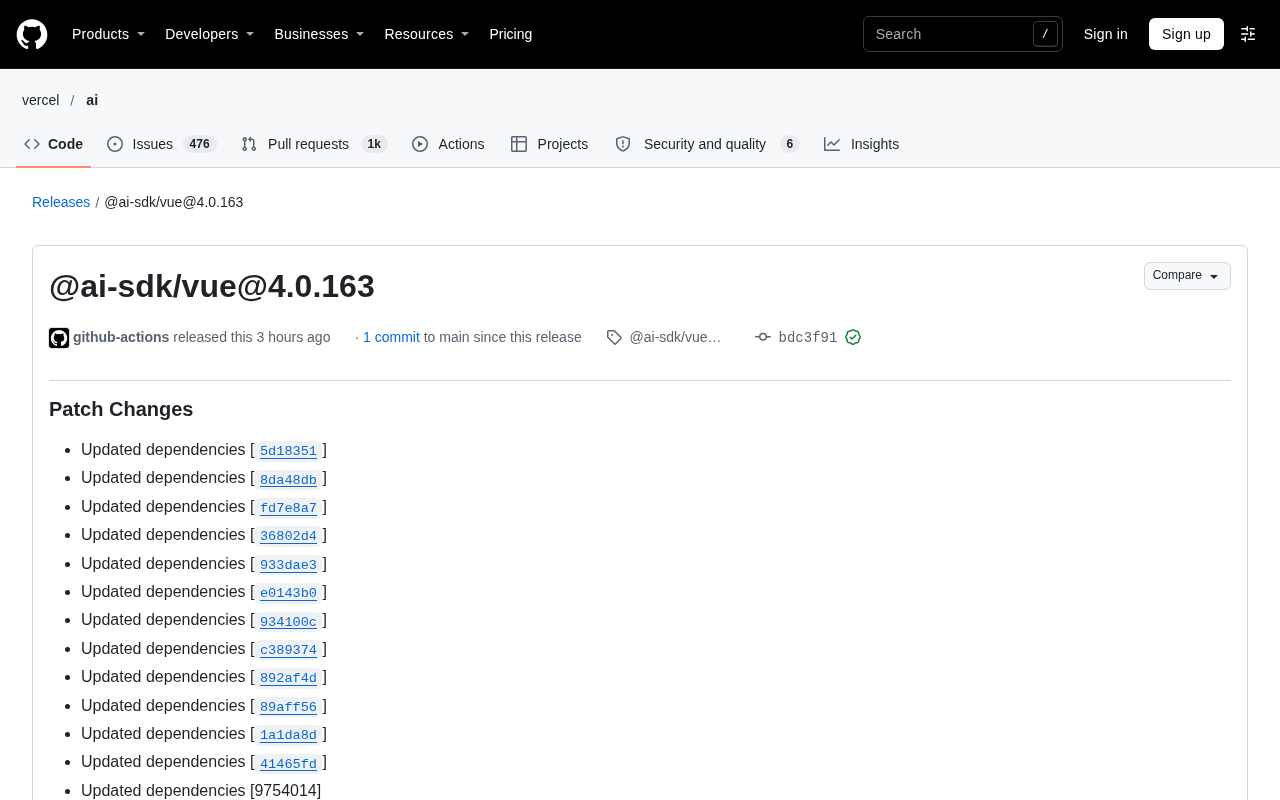
Vercel's AI SDK ecosystem is going through another round of rapid version iteration. @ai-sdk/vue@4.0.163 has been released as a patch version, and judging by the version number increment, this is not a major feature update but a systematic maintenance release centered on the dependency chain. For developers building AI chat interfaces with Vue, these releases are often easy to overlook, yet they directly affect whether a project runs stably.
What Actually Changed in This Update
According to the release notes on GitHub, the core changelog for @ai-sdk/vue@4.0.163 contains only one item: Patch Changes, followed by a long list of "Updated dependencies" entries. In other words, this version introduces no new Vue composables and no API signature changes—everything happens at the dependency level.
The dependencies updated in sync include ai@7.0.163 and @ai-sdk/provider-utils@5.0.75. The former is the core runtime of the AI SDK, responsible for streaming responses, tool calls, message management, and other low-level capabilities; the latter is the shared utility function collection used by model provider adapters. Both moving forward together indicates this release is about aligning the version level across the entire SDK family.
The release was carried out by the github-actions bot with a GitHub-verified commit signature—a typical artifact of an automated release pipeline.
Patch Version follows Semantic Versioning (SemVer), with the format major.minor.patch (e.g., 4.0.163). An increment in the patch number indicates only backward-compatible bug fixes, with no new features and no breaking changes to existing APIs. In the npm ecosystem, ^4.0.162 allows automatic upgrades to the latest version within the 4.x.x range (including patch updates), while ~4.0.162 only allows patch upgrades within 4.0.x. For high-frequency release projects like AI SDK, patch numbers often grow rapidly due to dependency cascades, and developers should understand the "fix-only, non-breaking" semantics to avoid unnecessary upgrade concerns caused by large version numbers.
Why Patch Versions Deserve Attention
Many developers habitually ignore patch versions: it's just 4.0.162 to 4.0.163, no breaking changes involved, so upgrade priority naturally falls to the bottom. But for toolchains in rapid evolution like the AI SDK, patch versions carry more weight than one might imagine.
Dependency updates usually mean upstream has fixed certain edge cases or adjusted compatibility logic with model provider interfaces. Every minor version change in provider-utils can affect details such as request parameter serialization and streaming data parsing. If a project pins an old version, no problems will surface in the short term, but as upstream APIs continue to change, a lagging dependency stack will eventually expose compatibility gaps in some scenario.
From an engineering practice perspective, these patch versions are better incorporated into a regular dependency update cadence rather than accumulated until a failure occurs and then handled all at once.
Dependency Chain refers to the transitive dependency relationships indirectly introduced into a project. Taking @ai-sdk/vue as an example, it depends on the ai core package, which in turn depends on @ai-sdk/provider-utils, forming a vertical chain. When an upstream package releases a patch, if downstream packages don't follow in time, multiple versions of the same dependency may coexist, leading to type definition conflicts (TypeScript errors) or inconsistent runtime behavior (such as differences in streaming parsing logic). pnpm's strict dependency isolation amplifies these issues, while npm's flattened installation may mask conflicts. Therefore, keeping all links in the dependency chain version-aligned is a key practice for avoiding "dependency hell."
Practical Impact in Vue Projects
The role of @ai-sdk/vue is to provide AI interaction capabilities for Vue applications, typically by exposing streaming text and tool call states to components through composables. It's not large in size but sits in the middle layer of the dependency chain: business components above, the ai core package and various provider adapters below.
This overall upward shift of dependencies brings version consistency as a direct benefit. When @ai-sdk/vue, ai, and provider-utils are version-aligned, cross-package type definition conflicts and runtime behavior discrepancies are correspondingly reduced. For multi-package projects using pnpm or npm workspaces, this alignment saves considerable manual override hassle.
It's worth noting that patch updates don't change the public API, so existing code can be upgraded without modification. However, if exact version pinning is used in package.json, the version numbers need to be adjusted manually; using ^ or ~ ranges will automatically pick up the update on the next install.
Composables are the core pattern of Vue 3's Composition API—functions starting with use that encapsulate reusable logic, such as useChat, useCompletion, etc. @ai-sdk/vue exposes AI SDK capabilities like streaming responses, message state, and tool calls to Vue components precisely through such composables. Composables internally depend on the runtime logic of the ai core package, so when ai or provider-utils is updated, composable behavior may be indirectly affected (such as streaming chunk parsing and error retry strategies). After upgrading a patch version, developers should focus on verifying how these composables behave in edge-case scenarios.
Signals Behind the Release Cadence
Zooming out a bit, a version number like 4.0.163 itself conveys information. The patch number has accumulated to three digits, indicating this package is in a high-frequency maintenance state with a highly automated release process. This aligns with the stage the AI SDK overall is in: model provider capabilities and interfaces are constantly changing, and the SDK must keep up frequently to remain usable.
For consumers, high-frequency patches mean two things. First, fixes are fast—problems encountered are usually addressed within a short time. Second, version noise is significant, requiring a reasonable upgrade strategy to avoid being led by every release. A pragmatic approach is to focus on change types: evaluate feature updates and breaking changes carefully, and batch-follow pure dependency maintenance patches on a fixed cadence.
Semantic Versioning (SemVer) patch numbers accumulating to three digits (163) typically indicate the project is in a high-frequency iteration phase with a highly automated release process. In the AI SDK ecosystem, model provider APIs adjust frequently (such as new parameters, changed streaming formats), and the SDK needs to align quickly through patch versions. This pattern contrasts with the "low-frequency major versions" of mature frameworks like React and Vue. For consumers, high-frequency patches require a more refined upgrade strategy: tools like Dependabot or Renovate can automatically create PRs, combined with CI test pipelines, to handle pure dependency updates separately from feature changes—neither missing critical fixes nor being disturbed by version noise.
Upgrade Recommendations
For projects currently using @ai-sdk/vue, this upgrade carries very low risk. It's recommended to update in the development environment first, run through existing conversation flows and tool call tests, confirm consistent behavior in streaming output and error handling, and then sync to production.
If a project depends on multiple @ai-sdk/* packages simultaneously, be careful to keep them version-matched with the ai core package during upgrades, avoiding situations where some packages are updated while others remain on old versions. Dependency tree consistency often affects stability more than whether an individual package is new or old.
One-line Summary
@ai-sdk/vue 4.0.163 patch released, dependency updates only, keeping the SDK family version-aligned.
Paragraph Summary
@ai-sdk/vue@4.0.163 is a patch version with no new features or API changes; the core action is synchronously upgrading ai@7.0.163 and @ai-sdk/provider-utils@5.0.75 to align version levels across the AI SDK ecosystem. Though small, such patches involve the core runtime and provider utility layer and may affect streaming parsing and interface compatibility. The article advises developers not to ignore patch updates, to incorporate them into a regular dependency maintenance cadence, and to verify conversation flows in the development environment after upgrading. For multi-package projects, special attention should be paid to keeping all @ai-sdk/* packages consistent with the ai core package to avoid dependency conflicts. The high-frequency patch releases reflect that the AI SDK is in a phase of rapidly following changes from model providers.
Related articles

World's First Humanoid Robot Company Agility Lists on Nasdaq: Buy or Not?
Agility becomes the world's first pure-play humanoid robot company to list on Nasdaq. This article analyzes what the landmark event means for the industry and investors, unpacking the commercialization test and investment framework for the pure humanoid robot sector.

Agent-Browser: A Browser Automation CLI for AI Agents
Vercel Labs open-sources agent-browser, a Rust-built browser automation CLI designed for AI agents, with over 45,000 GitHub stars and command-line-first browser control.

LZ4: The Open-Source Benchmark for Blazing-Fast Compression
Explore the LZ4 blazing-fast compression algorithm: its design philosophy, performance advantages, and wide use in the Linux kernel, databases, and more. How a 12k+ star open-source project became the speed benchmark.