AI SDK Vue 4.0.170 Release Update Analysis

@ai-sdk/vue 4.0.170 patch released, synchronizing the core ai package to 7.0.170.
The Vue adapter package @ai-sdk/vue from Vercel AI SDK released patch version 4.0.170, auto-published by the GitHub Actions bot with signature verification. This version includes two dependency updates, the core one bumping the underlying ai package to 7.0.170, keeping the Vue adapter layer aligned with the core SDK. As a patch-level update, it typically only contains minor tuning of fixes, type definitions, and runtime behavior, with low risk of breaking changes. The article recommends that developers who only depend on @ai-sdk/vue can upgrade directly, while projects that also directly depend on the ai package should use overrides or resolutions to ensure version consistency and avoid duplicate dependency conflicts. The article also notes that the package follows a high-frequency patch release cadence synchronized with core package iterations, and production environments should focus on the specific fixes in the changelog rather than blindly chasing the latest release.
Release Overview
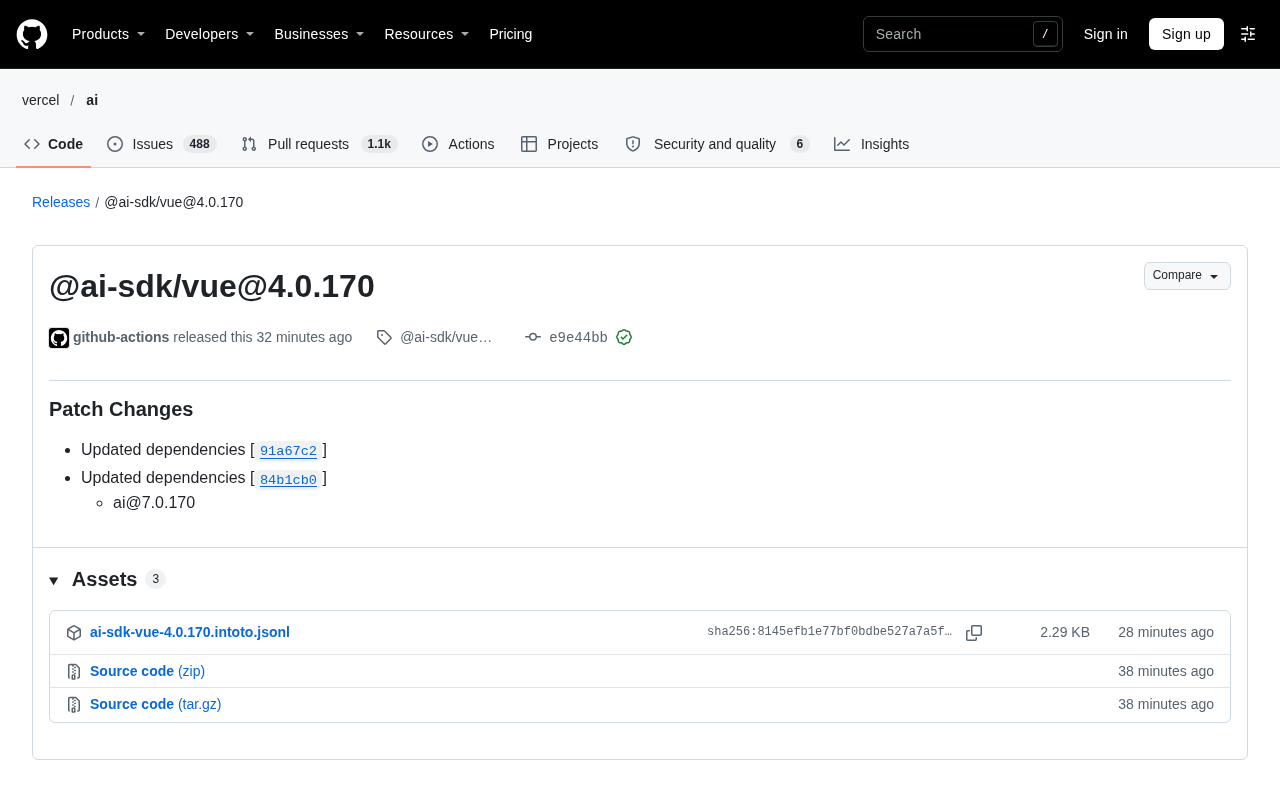
The Vercel AI SDK project recently released patch version 4.0.170 of @ai-sdk/vue. According to the release records on GitHub, this version was primarily auto-published by the github-actions bot, with commit hash e9e44bb and an attached GitHub verification signature. Although this is only a patch-level update, the dependency chain changes behind it are worth the attention of Vue developers.
Core Change: Dependency Upgrade
The release notes explicitly list two dependency updates, corresponding to commits 91a67c2 and 84b1cb0. These two updates bump the core dependency of @ai-sdk/vue, the ai package, to version 7.0.170. This means the Vue adapter layer is keeping pace with the evolution of the underlying AI SDK.
For developers building Vue applications with the AI SDK, such synchronized updates typically mean adjustments to underlying fixes, type definitions, or runtime behavior. Although the release notes do not itemize the specific changes in ai@7.0.170, dependency alignment itself is a key step in maintaining project stability.
Vercel AI SDK is a set of open-source TypeScript utility libraries for integrating large language model (LLM) capabilities into web applications. The core package is ai, and it provides framework adapter layers for React, Vue, Svelte, and more. @ai-sdk/vue is the Vue binding package within it, typically wrapping streaming responses, message state, and tool-calling logic through composables such as useChat. These adapter packages use the ai package as a peer/direct dependency, so every release of the underlying ai triggers a synchronized release of the adapter packages—which is why the version numbers are so closely aligned.
In the npm ecosystem, a three-part version number like 4.0.170 follows Semantic Versioning (SemVer) conventions: a major version change indicates incompatible API changes, a minor version indicates backward-compatible new features, and a patch number is used only for backward-compatible bug fixes. Therefore, a three-digit patch number does not mean instability; rather, it reflects a high-frequency, small-step release strategy.
Practical Impact on Developers
Upgrade Recommendations and Considerations
As a patch version, 4.0.170 is unlikely to introduce breaking changes. However, because it updates the version of the core ai package, if your project also directly depends on the ai package, it is recommended to check version compatibility to avoid duplicate dependencies or version conflicts.
In practice, you can use the package manager's overrides or resolutions fields to ensure a consistent version of the ai package. For most developers who only use @ai-sdk/vue, a direct upgrade is sufficient.
npm and Yarn allow multiple versions of the same package to exist in the dependency tree. When the ai@7.0.170 that @ai-sdk/vue depends on is inconsistent with the ai version declared directly by the project, two ai instances may appear, leading to type mismatches or shared runtime state (such as global configuration and provider registration) not being shared. The overrides (npm 8+) and resolutions (Yarn) fields are precisely for forcing the entire dependency tree to a specified version. pnpm uses pnpm.overrides instead. After upgrading, you can check for duplicate versions with npm ls ai or pnpm why ai.
Observations on the Version Iteration Cadence
From version numbers like 4.0.170, it is clear that the AI SDK's Vue adapter package adopts a relatively frequent patch release strategy. This cadence typically keeps pace with the rapid iteration of the underlying ai package, allowing developers to obtain fixes promptly. For production environments, it is recommended to focus on the specific fixes in the changelog rather than blindly chasing the latest release.
Summary
@ai-sdk/vue@4.0.170 is a routine dependency synchronization update, with the core change being bumping the ai package to 7.0.170. For teams using the AI SDK to build Vue applications, this is a low-risk upgrade option, but attention should be paid to dependency version consistency.
Related articles

RePlan-VLA: Progress-Aware Replanning Breakthrough for Long-Horizon Robotic Manipulation
The RePlan-VLA framework converts VLA models' short-horizon capabilities into reliable long-horizon execution through progress-aware adaptive replanning, improving success rates by 21.9% and 10.4% on RoboCasa365 and CALVIN, and validating real-world deployment on a Franka Research 3 robot.

Geometric Bridge Flow Matching: A New Breakthrough in Blind Rigid Motion Correction
Geometric bridge flow matching enables blind rigid motion correction in head CBCT, achieving 37.1 dB PSNR and 0.27 mm RPE on simulated data in ~9.1 minutes, outperforming existing methods.

Google Releases Gemini 4 Hydrogen: 2.5x Faster Without Sacrificing Intelligence
Google releases the lightweight Gemini 4 Hydrogen: 2.5x faster task completion, AA Intelligence Index of 54 beating its flagship sibling, 7.3s single-step on Agent Arena faster than Claude and GPT rivals, four thinking levels with pay-as-you-need pricing, now available across AI Studio and more.