@ai-sdk/vue 4.0.173 Patch Update: The Stability Signal Behind Dependency Sync

@ai-sdk/vue 4.0.173 is a patch release that only syncs dependencies to ai@7.0.173, with no API changes.
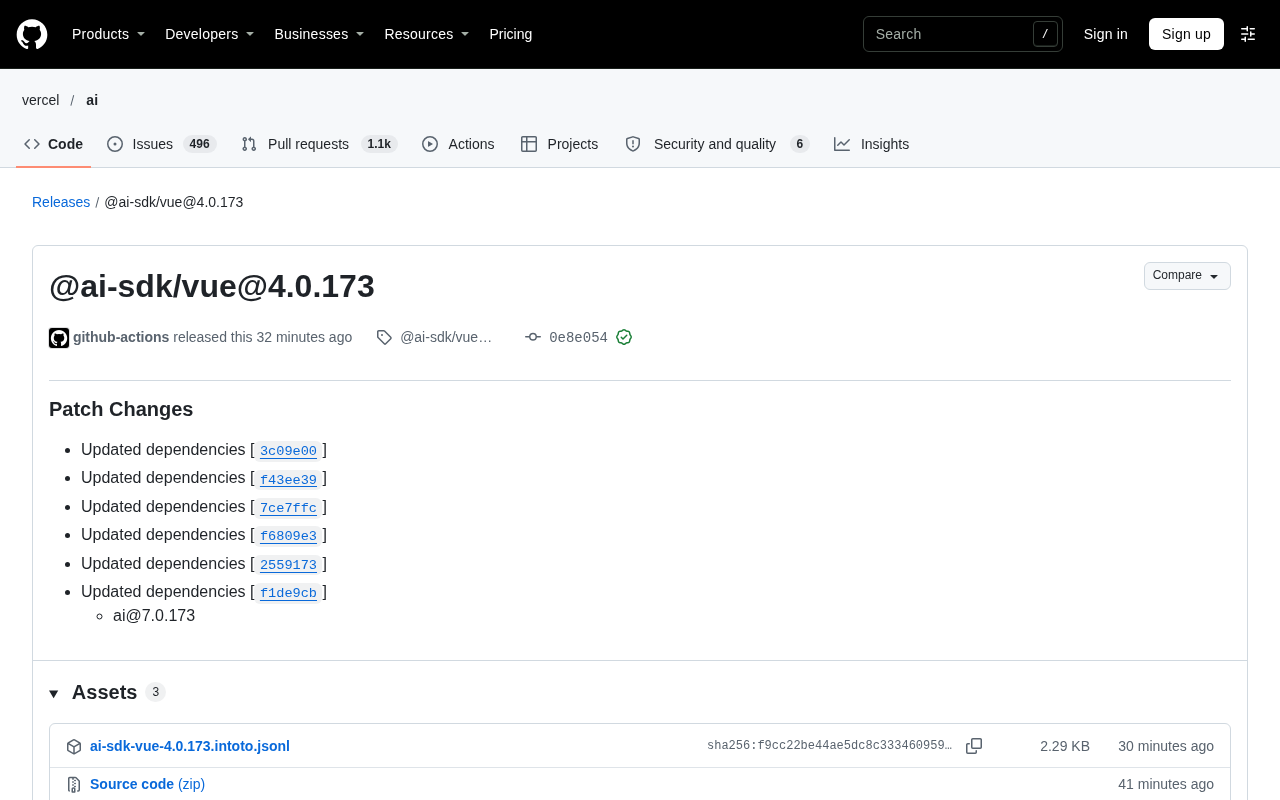
The article analyzes the release record of the @ai-sdk/vue 4.0.173 patch version. With commit hash 0e8e054 and a GitHub verified signature, the changelog contains only several dependency update entries, ultimately pointing to the core package ai@7.0.173. The author notes that as a Vue binding layer, @ai-sdk/vue's release cadence largely follows the patch rhythm of the core ai package; the binding code itself needs no changes, and the release ensures users install a consistent dependency combination. The signature information provides supply chain traceability. For developers, upgrading to this version carries extremely low risk, but if the project also directly depends on the ai package, version alignment should be ensured to avoid multiple versions coexisting in the dependency tree. The author also emphasizes that frequent patch releases reflect upstream's rapid iteration engineering practice rather than quality issues, and upgrade attention should focus on minor and major versions.
A Seemingly Unremarkable Patch Release
The GitHub Actions release record shows that @ai-sdk/vue@4.0.173 is a typical patch version, with commit hash 0e8e054 and a GitHub verified signature (GPG key ID: B5690EEEBB952194). According to the changelog, this version introduces no new APIs or features—the only content is a handful of "Updated dependencies" entries.
This kind of update increments the third digit of the version number, making it a maintenance release. For developers integrating the AI SDK into a Vue tech stack, it brings no behavioral changes, but it's worth understanding the engineering logic behind it.
What a Patch Update Really Means
Dependency Sync Is the Main Content
The changelog lists multiple dependency updates, each corresponding to a separate commit hash (such as 3c09e00, f43ee39, 7ce7ffc, etc.), and ultimately pointing to version ai@7.0.173 of the core package. This indicates that @ai-sdk/vue, as the Vue binding layer, largely follows the patch cadence of the core ai package in its release rhythm.
This dependency relationship means: the Vue binding itself may not need any code changes, but as long as the upstream core package has fixes, the binding package will publish a synchronized version to ensure users get a consistent dependency combination when installing.
Semantic Versioning (SemVer) specifies the version number format as MAJOR.MINOR.PATCH: a major version change indicates incompatible API modifications, a minor version change indicates backward-compatible feature additions, and a patch number change indicates backward-compatible bug fixes. In @ai-sdk/vue@4.0.173, the third digit increments from 172 to 173, which constitutes a patch release. The significance of SemVer lies in enabling dependency resolvers (such as npm, pnpm) to automatically select compatible versions based on version ranges—for example, ^4.0.0 allows installation of any 4.x version. Understanding this convention makes it clear why "just updating dependencies" warrants a separate release: it ensures the lock file stays in sync with upstream fixes while not triggering users' concerns about breaking changes.
Verified Signatures and Supply Chain Security
The release record mentions GitHub's verified signature and GPG key ID. For open source projects, signed release commits mean the publisher's identity can be traced, reducing the risk of supply chain poisoning. This information is easily overlooked in patch release records, but it's a valuable signal for production dependency management.
GPG (GNU Privacy Guard) signatures are a common means of verifying commit provenance in the open source supply chain. Developers sign commits or release tags with a private key, and GitHub verifies the signature via the public key, marking the commit as "Verified" while displaying the key ID (in this case, B5690EEEBB952194). The value of this mechanism is: even if an attacker gains write access to the repository, without the corresponding private key, they cannot forge a commit with a valid signature. For downstream users, signature traceability means they can confirm that a version was indeed published by a trusted maintainer—a low-cost line of defense against supply chain risks such as dependency confusion and poisoning attacks.
Practical Impact on Developers
Upgrade Strategy: Follow but Don't Be Aggressive
Since this version only syncs dependencies, the risk of upgrading to 4.0.173 is extremely low. If your project has already pinned a version range for @ai-sdk/vue, patch versions will typically be included automatically. One thing to note: the core ai package has been synced to 7.0.173, so if your project also directly depends on the ai package, make sure both versions are aligned to avoid multiple versions of the same package coexisting in the dependency tree.
"Multiple versions of the same package coexisting in the dependency tree" is usually caused by npm's nested installation mechanism: when different dependencies require incompatible version ranges of the same package, npm installs them separately under their respective node_modules, potentially leading to different instances being loaded at runtime. For packages like ai that may hold internal state or rely on instanceof checks, multiple instances can cause hard-to-troubleshoot behavioral anomalies. Use npm ls ai or pnpm why ai to check for duplicate versions; explicitly aligning the versions of @ai-sdk/vue and ai in package.json, or using the overrides/resolutions fields to force unification, are common mitigation approaches.
When to Pay Attention to the Changelog
For patch versions, developers don't need to read the changelog entry by entry, but it's advisable to keep dependency update checks in CI. When you see consecutive "Updated dependencies" releases, you can understand it as upstream making incremental fixes rather than API-level breaking changes.
A Rational View of Release Frequency
@ai-sdk/vue has a high patch release frequency, consistent with the rapid iteration pace of the AI SDK overall. Frequent patch releases don't necessarily indicate quality issues; they more reflect the engineering practice of the upstream core package continuously fixing issues while the binding layer syncs accordingly. For users, the key is to distinguish the semantic differences between patch, minor, and major versions, and focus upgrade attention on the latter two.
In the absence of additional release notes, this update itself does not constitute a technical event requiring special analysis—it's more like a routine record of version synchronization.
Related articles

RePlan-VLA: Progress-Aware Replanning Breakthrough for Long-Horizon Robotic Manipulation
The RePlan-VLA framework converts VLA models' short-horizon capabilities into reliable long-horizon execution through progress-aware adaptive replanning, improving success rates by 21.9% and 10.4% on RoboCasa365 and CALVIN, and validating real-world deployment on a Franka Research 3 robot.

Geometric Bridge Flow Matching: A New Breakthrough in Blind Rigid Motion Correction
Geometric bridge flow matching enables blind rigid motion correction in head CBCT, achieving 37.1 dB PSNR and 0.27 mm RPE on simulated data in ~9.1 minutes, outperforming existing methods.

Google Releases Gemini 4 Hydrogen: 2.5x Faster Without Sacrificing Intelligence
Google releases the lightweight Gemini 4 Hydrogen: 2.5x faster task completion, AA Intelligence Index of 54 beating its flagship sibling, 7.3s single-step on Agent Arena faster than Claude and GPT rivals, four thinking levels with pay-as-you-need pricing, now available across AI Studio and more.