AI SDK Vue 4.0.180 Patch Released: Underlying ai Package Upgraded in Sync
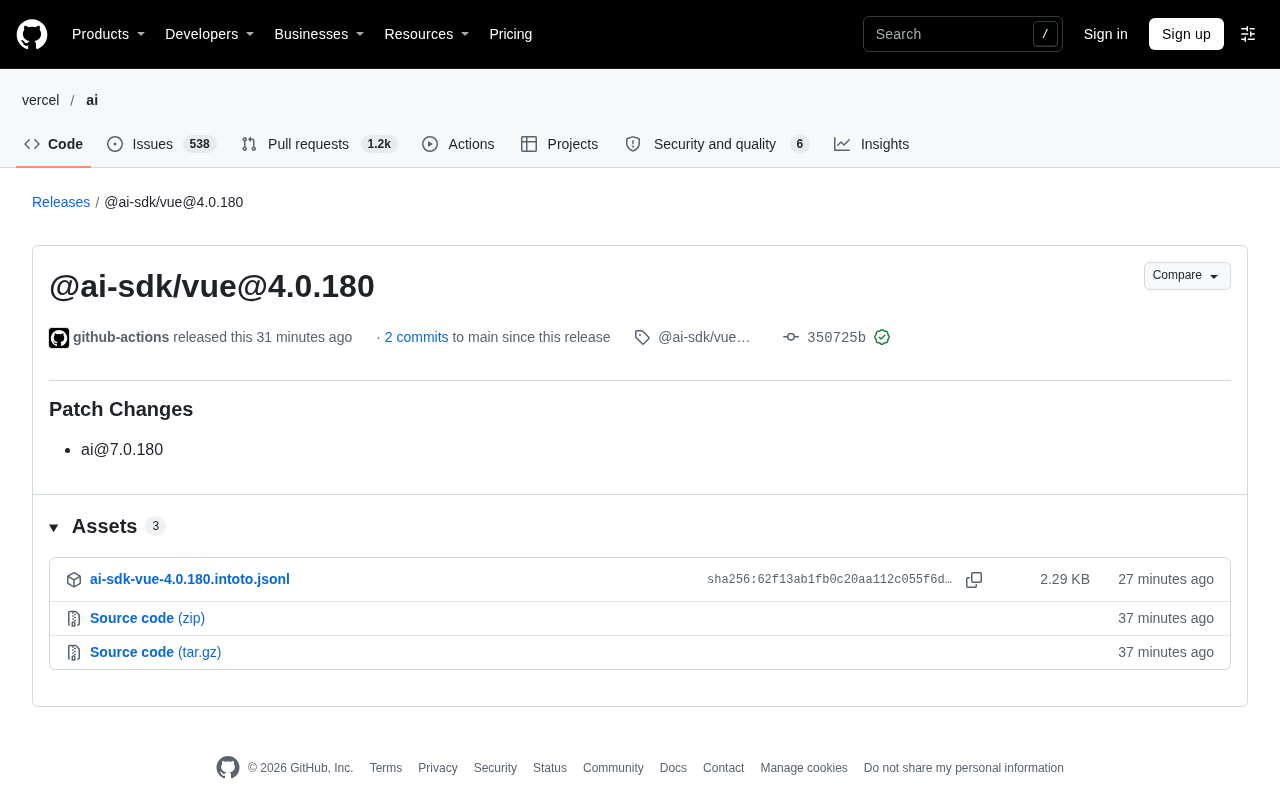
@ai-sdk/vue 4.0.180 patch released, only syncing the ai dependency to 7.0.180.
Vercel's AI SDK releases patch @ai-sdk/vue@4.0.180, automatically published to the main branch by a GitHub Actions bot with 2 commits and GPG signature verification. The only change is syncing the underlying ai dependency to 7.0.180, with no new APIs or behavioral changes in the adapter layer itself. The article explains AI SDK's "core package + framework adapter" architecture and notes that an adapter lagging behind the core package can cause multiple ai versions in the dependency tree, leading to type mismatches or runtime differences, so version alignment itself is a way to eliminate risk. For projects using the Vue integration, this kind of patch upgrade is low-cost and recommended to follow, with specific advice on checking version alignment, running regression tests, and evaluating whether to upgrade older ai versions. The article concludes by noting that this release has no developer-facing migration notes and that a single patch carries limited information; version alignment reflects project maintenance quality better than patch content.
Vercel's AI SDK has another routine maintenance release. @ai-sdk/vue@4.0.180 has been automatically published to the main branch via GitHub Actions. This is a pure patch release, with only one core change: syncing the underlying ai dependency to 7.0.180.
What Changed in This Update
From the GitHub Release page, this release contains 2 commits, completed by the github-actions bot and carrying a GitHub verified signature (GPG key ID: B5690EEEBB952194).
The Patch Changes section only lists ai@7.0.180, indicating that @ai-sdk/vue itself has no new APIs or behavioral changes. Releases like this are typically used to follow the fix cadence of the main ai package, keeping the Vue adapter layer aligned with the core package version.
Why This Kind of Sync Matters
AI SDK uses a "core package + framework adapter" architecture: ai carries general capabilities such as model invocation, streaming responses, and tool calling, while @ai-sdk/vue provides Vue-oriented composable APIs (such as interfaces like useChat; refer to the official documentation for specifics).
When the adapter lags behind the core package, it's easy for multiple ai versions to coexist in the dependency tree, which can lead to type mismatches or runtime behavioral differences. Locking @ai-sdk/vue's dependency to ai@7.0.180 is essentially about eliminating this kind of version drift risk.
Semantic Versioning (SemVer) and What Patch Numbers Mean: The SemVer specification splits version numbers into three parts, MAJOR.MINOR.PATCH. A MAJOR change indicates incompatible, breaking API changes, MINOR indicates backward-compatible feature additions, and PATCH indicates backward-compatible bug fixes. Therefore, a form like 4.0.180—with a stable major version and a high-frequency increasing patch number—usually indicates that the package is in a maintenance state of continuous fixes and upstream following, rather than a period of feature evolution. Note that AI SDK sub-packages follow independent version cadences; @ai-sdk/vue's 4.x and ai's 7.x do not correspond one-to-one. Compatibility should be judged based on the dependency range declared in package.json, not inferred intuitively from version number magnitude.
Dependency Drift and Duplicate Installs: In package managers such as npm/pnpm, if multiple packages declare non-overlapping version ranges for the same dependency, the package manager will nest multiple copies in node_modules. For TypeScript projects, two sets of ai type declarations will be treated as different module identities, leading to hard-to-diagnose errors such as "type mismatch"; at runtime, singleton state (such as global configuration or internal registries) may be split into two copies. Locking the adapter's dependency to the same version as the core package is the most direct way to eliminate this kind of risk.
Upgrade Recommendations
For projects using the Vue integration of AI SDK, this kind of patch upgrade has a very low cost, and it is recommended to follow it:
- Check whether the versions of
@ai-sdk/vueandaiinpackage.jsonare aligned - After upgrading, run your existing chat and streaming output test cases to confirm there are no regressions
- If your project also pins an older version of
ai, evaluate whether to upgrade it as well to avoid two versions coexisting
It is worth noting that this Release description does not list any developer-facing behavioral changes or migration notes. If you encounter issues after upgrading, you can troubleshoot by checking the update records for ai@7.0.180.
Common Ways to Pin Dependency Versions: The version prefix in package.json determines the allowed update range—^7.0.180 allows upgrading to any new version within 7.x, ~7.0.180 only allows patch updates within 7.0.x, and writing exactly 7.0.180 fully pins the version. If you want the entire dependency tree to keep only one version of ai, you can use npm's overrides, pnpm's pnpm.overrides, or yarn's resolutions field to force a unified version, and use npm ls ai / pnpm why ai to check for duplicate copies. In addition, committing the lockfile (package-lock.json, pnpm-lock.yaml) ensures that team members and the CI environment resolve exactly the same dependency graph, avoiding situations where "it works locally but fails online."
The Signal Behind the Version Numbers
@ai-sdk/vue has reached version 4.0.x, while the ai core package has reached 7.0.x; the two follow independent semantic versioning cadences. Frequent patch releases indicate that the project is actively maintained, but the information content of a single patch is limited—for the framework adapter layer, releases like this are more about "staying in sync" than feature evolution.
If you are choosing an AI integration solution for the Vue ecosystem, pay attention to the version alignment between the adapter and the core package. This often reflects the project's maintenance quality better than the content of a single patch.
Related articles

Satirical Viral Hit "Rich Girl's Christmas Haul": A Consumption Frenzy or an Isolated Case?
A Bilibili satirical rich-girl Christmas haul video sparks debate. This article breaks down the consumption symbols in its gift list, analyzes the blurred line between showing off and gratitude, and explores the narrative template of wealth-flaunting content on platforms and its impact on teenagers' wealth perception.

Before You Get Your Ears Pierced: A Professional Piercer Explains Placement, Pain, and Aftercare
A professional piercer explains the full ear piercing process: why a max of three per session, pain ratings and healing times by location, 18K gold vs. pure silver, hollow needles vs. piercing guns, and aftercare.

Follow the Light: How Light-Triggered ASMR Commands Your Attention
Analyzing Bilibili creator Veda's command-based ASMR video: how pen light and otoscope use visual tracking commands to command attention, upgrading sound relaxation into an interactive attention game, and what it means for immersive content creation.