AI SDK Workflow 2.0.108 Patch Released, Syncs ai Dependency Upgrade

@ai-sdk/workflow releases patch 2.0.108, syncing core package ai to 7.0.176.
The AI SDK ecosystem continues to iterate. @ai-sdk/workflow releases patch version 2.0.108, automatically built by GitHub Actions and published with verified signatures, with the core action being syncing the underlying ai package to 7.0.176. Since the AI SDK uses a split-package architecture, the core package and extension packages need to maintain version alignment, otherwise type mismatches or runtime behavior differences easily occur; this sync provides consumers with a clear compatibility baseline. The release notes do not list specific fix items, but patch-level updates typically involve fine-tuning of underlying logic such as task scheduling and state passing. The article recommends verifying the complete chain of multi-step workflows in a test environment before upgrading, and establishing a dependency update strategy of batch-merging patch versions weekly to balance stability and verification costs.
Title
AI SDK Workflow 2.0.108 Patch Released, Syncs ai Dependency Upgrade
Meta Description
AI SDK's @ai-sdk/workflow releases patch version 2.0.108, syncing the ai core package to 7.0.176. This article explains the significance of this dependency alignment, the risks of the patch update, and upgrade recommendations to help developers decide whether to follow up.
Article Content
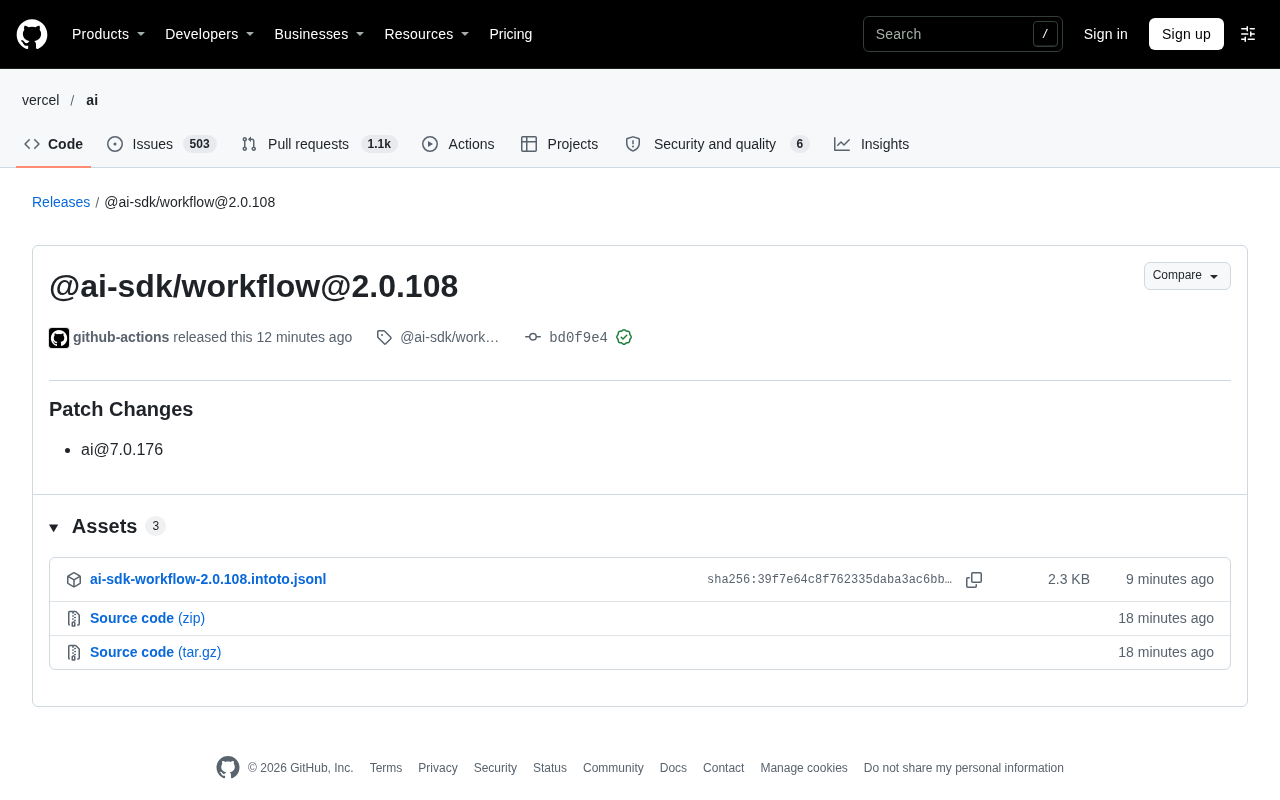
The AI SDK ecosystem continues to iterate. According to the GitHub Releases page, @ai-sdk/workflow has released version 2.0.108, labeled as Patch Changes, while syncing the underlying ai package to 7.0.176. For developers relying on AI SDK to build workflow applications, such minor version updates are often more noteworthy than major versions, as they typically carry stability fixes and dependency alignment.
What This Update Changed
From the release notes, 2.0.108 is a patch-level update (Patch Changes), with the core action being establishing a version correspondence with ai@7.0.176. The release was automatically completed by GitHub Actions, and the commit carries a GitHub verified signature, indicating this is a routine automated release process rather than temporary manual intervention.
Patch versions in the semantic versioning system represent backward-compatible bug fixes. Given the positioning of @ai-sdk/workflow—providing workflow orchestration capabilities for AI applications—such updates typically involve fine-tuning of underlying logic such as task scheduling, step chaining, and state passing. The release notes do not list specific fix items, but from the dependency linkage it can be inferred that this change is mainly to keep the workflow package behaviorally consistent with the latest ai core package.
Semantic Versioning (SemVer) is the common specification for software version number management, with the format MAJOR.MINOR.PATCH. An increment in the patch number represents backward-compatible bug fixes, an increment in the minor number represents backward-compatible feature additions, and an increment in the major number represents incompatible API changes. Understanding this system helps assess upgrade risk: this @ai-sdk/workflow change from 2.0.x to 2.0.108 is a patch-level change and theoretically will not break existing calling methods. However, SemVer is only a convention rather than mandatory, and given frequent automated releases, actual behavior still needs to be verified against the diff. Developers can use npm view or lockfile comparison of the dependency tree to confirm whether the underlying ai package has been indirectly bumped.
Why Dependency Alignment Deserves Attention
The AI SDK uses a split-package architecture, where ai as the core package provides fundamental capabilities such as model invocation, streaming responses, and tool calling, while extension packages like @ai-sdk/workflow layer orchestration capabilities on top. When the core package undergoes a version leap, extension packages that do not follow up in time are prone to type mismatches or runtime behavior differences.
This release pins ai at 7.0.176, effectively giving consumers a clear compatibility baseline. For producers already running workflows in production environments, locking dependency versions is a routine measure to avoid "it worked yesterday but suddenly errors today" situations.
Split-package architecture (monorepo sub-package publishing) refers to an SDK being split into multiple independent npm packages, with the core package and extension packages each releasing independently and declaring dependencies independently. The AI SDK follows exactly this pattern: ai provides fundamental capabilities such as model invocation and streaming responses, while extension packages like @ai-sdk/workflow reference the core package via peer dependency or direct dependency. The cost of this architecture is version drift risk—when the core package upgrades but extension packages are not synced, issues such as inconsistent type definitions and runtime interface misalignment may occur. Therefore, extension packages pinning the core package version with each release is essentially declaring "which core version this version has been jointly tested with," which is also why lockfile and peer dependency range management are particularly important in production environments.
Upgrade Recommendations and Practical Reminders
Patch updates typically carry lower risk, but it is still recommended to first verify the complete workflow chain in a test environment, especially the performance of multi-step tasks in state passing and error retry. Since the release page does not provide change details, before upgrading you can compare the actual diff between the two versions to confirm that no APIs you are using are affected.
Additionally, the high-frequency rhythm of such automated releases means version numbers roll quickly. Teams should establish a dependency update strategy internally, such as batch-merging patch versions weekly rather than immediately following up on every release, to reduce verification costs.
GitHub Actions automated publishing and commit signature verification is a common release pipeline in modern open-source projects: code merges trigger CI, which automatically executes builds, version number increments, tagging, and publishing to npm, while also GPG-signing the commit. Signature verification (the Verified badge on the page) proves that the commit was indeed signed by the repository maintainer's key, reducing supply chain poisoning risk. But automated publishing also means release notes are often tool-generated, with coarse granularity, sometimes only reflecting dependency changes. Therefore, when facing high-frequency patch releases, teams are better off obtaining real changes by comparing tarballs on npm or the GitHub compare view, rather than relying solely on release notes to judge the impact scope.
Summary
@ai-sdk/workflow 2.0.108 is a routine patch release, with the focus on dependency synchronization with ai@7.0.176. For teams deeply using AI SDK to build workflows, timely following up on patches helps gain stability improvements; for lightweight users, batch upgrading at a regular pace is sufficient, without needing to respond immediately to every patch version.
One-line Summary
@ai-sdk/workflow releases patch version 2.0.108, syncing the core package ai to 7.0.176.
Paragraph Summary
The AI SDK ecosystem continues to iterate. @ai-sdk/workflow releases patch version 2.0.108, automatically built by GitHub Actions and published with verified signatures. The core action is syncing the underlying ai package to 7.0.176. Since the AI SDK uses a split-package architecture, the core package and extension packages need to maintain version alignment, otherwise type mismatches or runtime behavior differences easily occur. This sync provides consumers with a clear compatibility baseline. The release notes do not list specific fix items, but patch-level updates typically involve fine-tuning of underlying logic such as task scheduling and state passing. The article recommends verifying the complete chain of multi-step workflows in a test environment before upgrading, and establishing a dependency update strategy of batch-merging patch versions weekly to balance stability and verification costs.
Related articles

Abnormal Error Rate Spike in Claude Mythos 5.2 and Fable 5.2
Claude Mythos 5.2 and Claude Fable 5.2 show an abnormal spike in request error rates, marked as investigating on the official status page. This article covers the incident overview, practical impact on developers, and recommended responses.

ReAct Runtime Context Trimming: Why Claude Code Acts at 70%
A deep dive into ReAct runtime context trimming: why Claude Code compresses at ~70% usage, why tool calls dominate, why messages must be dropped in pairs, and why codebases don't need RAG.

AI Agent vs LLM: How Cursor and Claude Code Actually Work
An in-depth analysis of the essential difference between AI Agents and LLMs: LLMs generate code suggestions, while Agents modify files and run tests via tool calls. Using a Spring Boot bug fix as an example, it breaks down the workflows, permission control, and verification mechanisms of Cursor and Claude Code.