AI SDK Workflow 2.0.111 Patch Released: Dependency Upgraded to ai@7.0.179
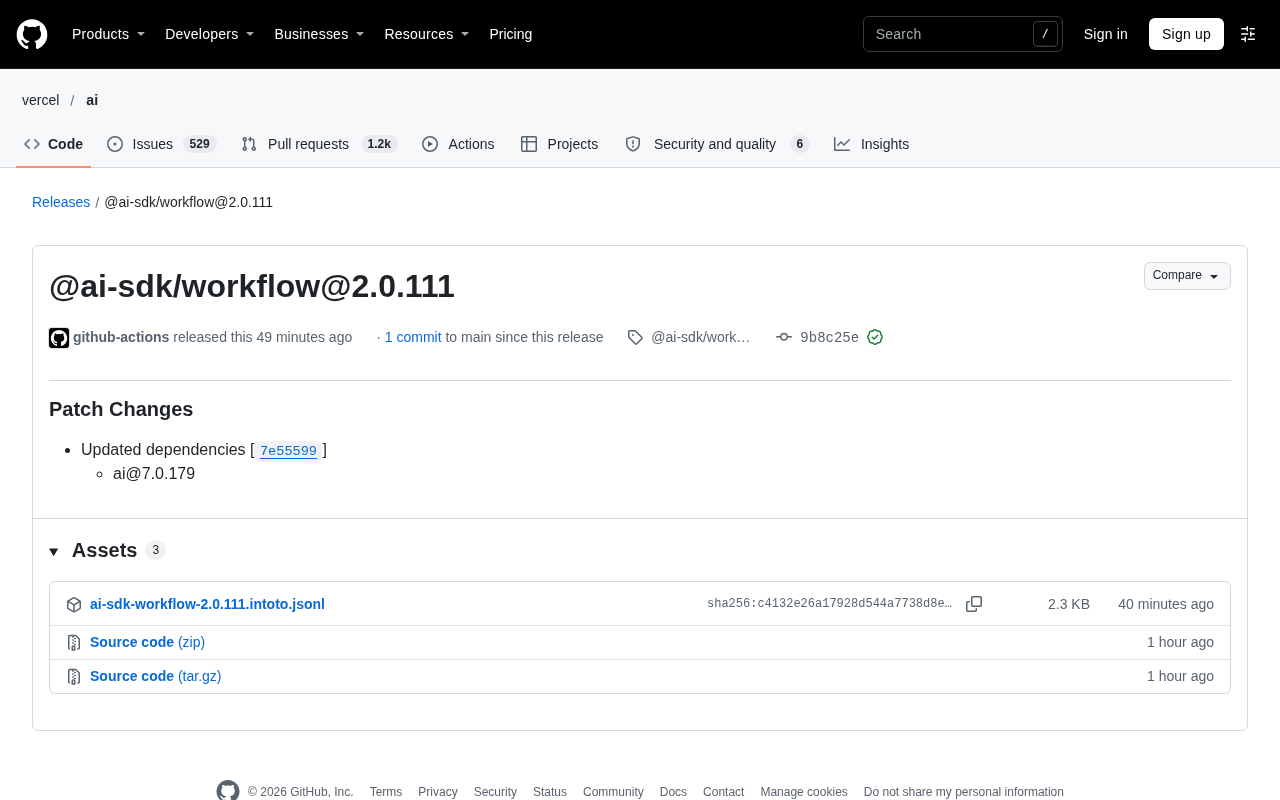
@ai-sdk/workflow 2.0.111 released, with the only core change being the peer dependency ai upgraded to 7.0.179.
The article covers the patch-level release of @ai-sdk/workflow 2.0.111. Published by an automated GitHub Actions pipeline with GPG signature, its only substantive change is upgrading the peer dependency ai to 7.0.179, with no API or behavioral changes in Workflow itself. The author notes that under AI SDK's modular layered architecture, such "follow-along" patches provide value through version alignment, preventing inconsistent type definitions and runtime divergence, and effectively serving as an official compatibility endorsement. For workflow developers, the upgrade benefit mainly comes from the ai core package; reviewing its changelog and running regression tests first is recommended, and whether to upgrade immediately depends on whether the project directly depends on ai and on the lockfile strategy.
The AI SDK ecosystem iterates quickly, and this @ai-sdk/workflow 2.0.111 release is a typical patch-level update. According to the release notes, there is only one core change: the dependency ai is bumped to 7.0.179. For developers who use Workflow daily to build agent pipelines, small releases like this are easy to overlook, but they reflect the consistent logic of dependency coordination under the AI SDK's layered architecture.
What this update changes
According to the GitHub release notes, @ai-sdk/workflow@2.0.111 is a Patch Changes release, commit 9b8c25e, automatically published by github-actions. The change is very focused — it updates the peer dependency ai to version 7.0.179, corresponding to commit 7e55599.
In other words, the Workflow package itself introduces no new APIs or behavioral changes. Its value lies in staying version-aligned with the upstream ai core package. This kind of "follow-along" release is common in SDK projects managed as monorepos: the core package fixes an underlying issue, and surrounding packages inherit the fix through version synchronization.
Peer dependency (peerDependency) is a type of npm dependency declaration indicating that the current package requires the host project to install a specified version of a dependency itself, rather than carrying its own copy. In modular ecosystems like AI SDK, @ai-sdk/workflow declares ai as a peer dependency, meaning Workflow does not bundle its own copy of ai but reuses the one in the project root. The benefit is avoiding type conflicts and state inconsistency caused by multiple SDK instances in the same process; the cost is that users must actively ensure version matching. Raising the peer dependency to ai@7.0.179 effectively tightens the compatibility range — projects below that version may receive warnings during installation, pushing the entire dependency graph toward the same baseline.
Patch Changes and semantic versioning: Under SemVer conventions, the third digit increment in version 2.0.111 represents a patch-level release, which by spec should only contain backward-compatible bug fixes and introduce no new features or breaking changes. However, for dependency-coordination packages, the patch number is sometimes used merely to express following the upstream version rather than actual code changes in the package itself. Understanding this helps assess upgrade risk: the real behavioral differences come from the ai core package, not Workflow itself.
Why patch versions still deserve attention
Many teams habitually treat patch updates as "risk-free, just upgrade", but in toolchains with multi-layered dependencies like AI SDK, version alignment itself is a stability signal. If the Workflow layer stays on an old ai dependency for long, issues such as inconsistent type definitions and runtime behavior diverging from documentation may arise.
From an engineering practice perspective, locking dependencies too loosely introduces unexpected breakage, while locking too tightly misses upstream fixes. Explicitly following ai@7.0.179 in 2.0.111 is effectively the official team providing a compatibility endorsement: this combination has been validated by the CI pipeline and can be safely used together.
Monorepo and automated release pipelines: The AI SDK ecosystem uses monorepo management, with multiple sub-packages sharing the same repository and CI pipeline, typically using tools like Changesets to record changes, compute version numbers, and automate releases. The commit was made by the github-actions bot, indicating that version bumps and release notes are generated by the pipeline rather than written manually. This is exactly why the change notes are brief — the automation faithfully reflects dependency differences only and does not explain the business implications of upstream fixes. GPG signature verification ensures that release artifacts genuinely come from the official CI environment, guarding against supply chain tampering. Understanding this pipeline explains why users need to trace upstream logs themselves to fill in the information for such releases.
Practical impact on workflow developers
If you are using @ai-sdk/workflow to orchestrate multi-step AI tasks, the direct benefit of upgrading to 2.0.111 comes from version 7.0.179 of the ai core package. Since the release notes do not list specific fixes, it is recommended to check the changelog for ai@7.0.179 before upgrading to confirm whether it involves interfaces you are using.
It is worth noting that this release was completed by an automated pipeline with GPG signature verification, indicating the release chain itself is trustworthy. However, automated releases also mean brief change notes, so teams should still run their own regression tests when merging dependencies, especially in scenarios with custom wrappers around workflow state management and step retry logic.
How to assess whether to upgrade immediately
The criteria can be reduced to two points: first, whether your project directly depends on the ai package — if so, Workflow and ai versions need to stay in sync to avoid two different SDK versions in the same process; second, whether your lockfile strategy allows automatic patch-level updates.
For production environments, a safe approach is to first validate end-to-end workflow execution in a staging environment before rolling out to production. For experimental projects, following the latest patch is usually low-cost. In either case, understanding the essence that "patch update = dependency alignment" is more meaningful than blindly chasing version numbers.
The AI SDK's modular split allows each sub-package to evolve independently, but it also requires users to stay sensitive to the dependency graph. 2.0.111 is not a version with a story, but it is one that demonstrates release discipline.
One-line Summary
@ai-sdk/workflow 2.0.111 released, with the only core change being the peer dependency ai upgraded to 7.0.179.
Paragraph Summary
The article introduces the patch-level release of @ai-sdk/workflow 2.0.111. This version was published by an automated GitHub Actions pipeline with GPG signature; the only substantive change is upgrading the peer dependency ai to 7.0.179, with no API or behavioral changes in the Workflow package itself. The author notes that under AI SDK's modular layered architecture, the value of such "follow-along" patches lies in version alignment, which avoids inconsistent type definitions and runtime behavior divergence, and effectively serves as an official compatibility endorsement for a specific combination. For workflow developers, the upgrade benefit mainly comes from the ai core package; it is recommended to review its changelog first and run regression tests. Whether to upgrade immediately depends on whether the project directly depends on the ai package and on the lockfile strategy.
Related articles

Hunter Rescues Educated Youth: The Mountain-Chasing System Launches a New Warm-Hearted Viral Drama Formula
Bilibili's early-access period short drama *Everyone Thinks I'm a Poor Hunter* opens with a snowy-night rescue of an educated youth. Hunter Chen Shan activates the mountain-chasing system, using realistic hypothermia first-aid details and mutual-probing character dynamics to deliver a warm-hearted period drama without the sleaze.

Riemann Hypothesis Proven by AI? The Truth Has Nothing to Do With Your Reality
34-year-old mathematician Levent Alpöge claims to have proven the Riemann Hypothesis and Generalized Riemann Hypothesis with Claude, releasing 17 million lines of formal verification code. This article sorts out the facts, debunks myths about RSA collapse and new material revolutions, and analyzes the true significance of mathematics-AI collaboration.

G3 Test Drive Gone Wrong: Why Is the "Dog Poop Gun" So Hard to Use?
Bilibili creator tests the G3 rifle, from skeleton barrel and 50-round drum to combat failure, calling it a "dog poop gun." Analyzing the gap between mods and real gameplay.