@ai-sdk/workflow 2.0.112 Patch Released: Bound to ai@7.0.180
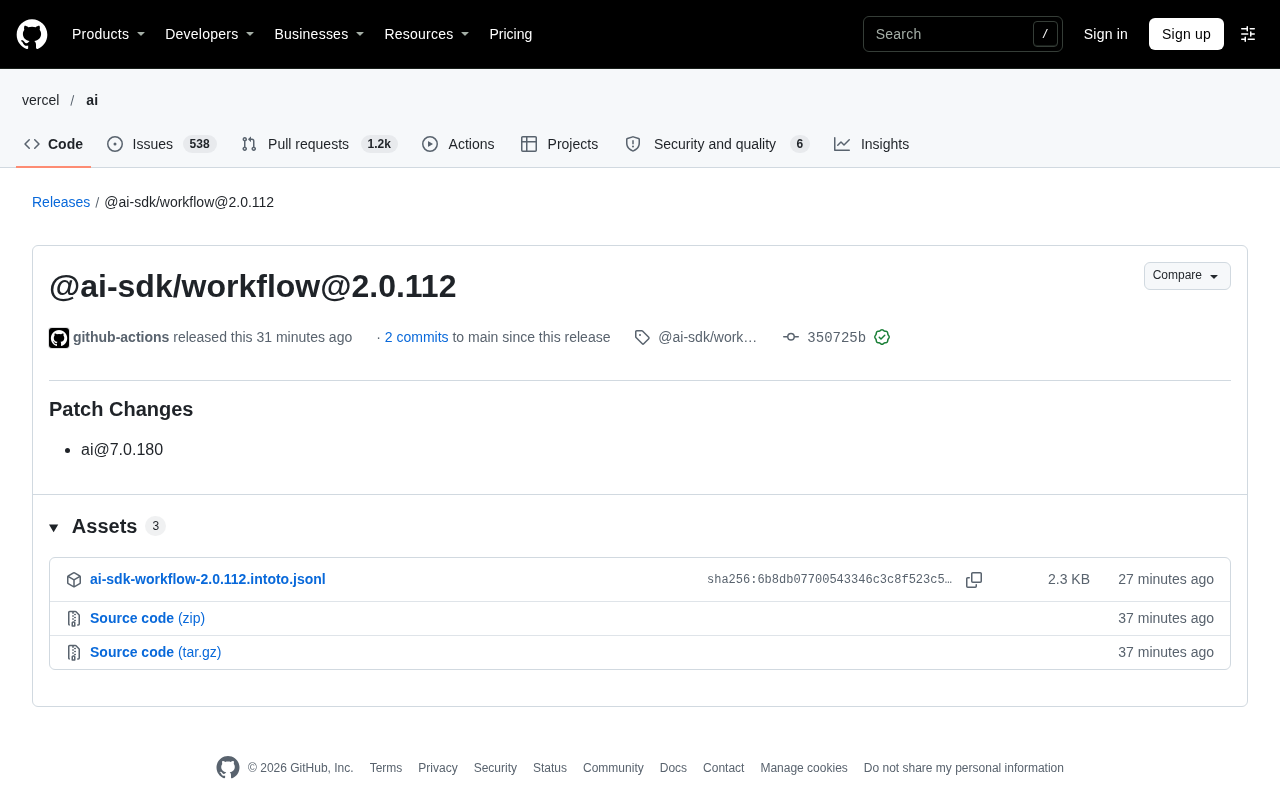
@ai-sdk/workflow releases patch 2.0.112, with the core change being syncing the ai@7.0.180 dependency.
The @ai-sdk/workflow repository has released patch version 2.0.112, containing only 2 commits and classified as Patch Changes, with the core action being syncing the dependent ai package to 7.0.180. The article notes that this type of maintenance update introduces no new APIs and doesn't change external interfaces, but version binding between the workflow layer and core SDK is becoming tighter—dependency synchronization is essentially about ensuring behavioral consistency between the orchestration layer and execution layer. The release was completed automatically by github-actions, and commits carry GitHub verified signature, indicating the release pipeline leans toward lightweight and high-frequency. For users, the main benefit of upgrading is getting underlying bug fixes and type adjustments, with no business code changes expected, but it's recommended to run existing tests after upgrading and establish a dependency update strategy that keeps pace with the release rhythm.
A Minor Version Update Hides the Cascading Rhythm of the SDK Ecosystem
The @ai-sdk/workflow repository on GitHub has just released a patch version: 2.0.112. Judging from the release notes, this change isn't flashy—only 2 commits, classified as Patch Changes, with the core action being syncing the dependent ai package to 7.0.180.
Release notes like this usually don't spark much discussion, but in the context of the AI SDK ecosystem, it reveals a signal worth paying attention to: version binding between the workflow layer and the core SDK is becoming tighter.
What This Patch Version Does
According to the GitHub Releases page, the changelog for this release is very concise:
- Version number:
@ai-sdk/workflow@2.0.112 - Change type: Patch Changes
- Associated dependency update:
ai@7.0.180 - Number of commits: 2, merged into the main branch
The release was completed automatically by github-actions, and the commits carry GitHub's verified signature (GPG key ID: B5690EEEBB952194), indicating the release process still follows the standard CI/CD channel.
In other words, this is a typical maintenance release: no new APIs introduced, no changes to external interfaces, just aligning the underlying dependency to the latest patch number.
Why Dependency Synchronization Is Worth Noticing
For developers using @ai-sdk/workflow, the version of the ai package is not an insignificant detail. The workflow module typically handles orchestrating multi-step model calls, tool execution, and state transitions, and these capabilities all depend on the underlying interfaces provided by the core SDK.
When the ai package releases a patch update, it often means there are bug fixes, type definition adjustments, or edge-case behavior corrections at the underlying level. Having the workflow package follow up with a bound release is essentially about ensuring behavioral consistency between the "orchestration layer" and the "execution layer."
If you're locking an older version in production, the main benefit of upgrading to 2.0.112 is getting these underlying fixes without having to handle compatibility issues from version mismatches yourself.
Semantic Versioning (SemVer) is the foundation for understanding this kind of patch update. SemVer divides version numbers into three segments: MAJOR.MINOR.PATCH. A major version change indicates incompatible API modifications, a minor version change indicates backward-compatible feature additions, and a patch number change indicates backward-compatible bug fixes. @ai-sdk/workflow going from 2.0.111 to 2.0.112, and the ai package to 7.0.180, are both patch-level changes, which by convention should not introduce breaking changes.
However, in real SDK ecosystems, patch numbers don't always mean "absolutely safe." When an upper-layer package binds a lower-layer package as a direct dependency, internal behavior corrections in the lower-layer package can still indirectly affect the runtime behavior of the upper-layer package—for example, error message formats, default retry counts, chunk boundaries in streaming responses, etc. Therefore, so-called "patch compatibility" is more of an interface-level promise; behavior-level verification still requires testing.
Engineering Details of the Release Process
There's another easily overlooked piece of information in the release notes: the commits are signed with GitHub verified signature. This is not uncommon in automated releases, but it shows that the repository has requirements for traceability of release sources.
Combined with the github-actions trigger and the rhythm of 2 commits going directly into the main branch, this project's release pipeline leans toward lightweight and high-frequency: small commits, automatic releases, rapid iteration. For teams that depend on it, this means they need a dependency update strategy that keeps pace, rather than waiting for major versions to take action.
GitHub verified signature refers to Git commits that are signed with GPG or S/MIME keys and display a "Verified" badge after GitHub validates them. Its purpose is not encryption, but to prove that the commit genuinely came from the party holding the corresponding private key, preventing others from impersonating identity to push code.
In automated release scenarios, signing is typically done by CI bots (such as github-actions) using keys configured by repository maintainers. For users of open-source dependencies, this badge provides a low-cost signal of source credibility: at minimum, you can confirm that the release commit was not tampered with in intermediate steps. Combined with the github-actions trigger and direct-to-main merge process, it's clear that this project adopts a "commit-to-release" lightweight model rather than a heavy process of manual approval followed by tagging.
Upgrade Recommendations
If you're using this workflow package, you can use the following approach to decide whether to follow up:
- Project already locks the
aipackage version: Confirm whether the two versions match to avoid runtime interface inconsistencies - Encountering underlying call exceptions: Prioritize upgrading to this patch to rule out known fixes
- Production environments prioritizing stability: You can observe for a period before upgrading, but don't stay on an overly old patch number for long
Overall, 2.0.112 is not an update that requires major effort, but it's a slice of the AI SDK ecosystem's continued evolution—the underlying layer is fixing, the upper layer is following, and users' dependency management needs to maintain the same rhythm.
FAQ
Does this update contain breaking changes?
Judging from the release notes, this is a Patch Changes type version with no breaking changes flagged; the main action is syncing the ai@7.0.180 dependency.
Do I need to manually modify code?
The release notes don't mention API changes, so no business code changes are expected. However, it's recommended to run your existing tests after upgrading to confirm that workflow orchestration behavior meets expectations.
Where can I view the full changelog?
You can visit the GitHub Releases page to see the comparison records and commit details for this version.
Related articles

Hunter Rescues Educated Youth: The Mountain-Chasing System Launches a New Warm-Hearted Viral Drama Formula
Bilibili's early-access period short drama *Everyone Thinks I'm a Poor Hunter* opens with a snowy-night rescue of an educated youth. Hunter Chen Shan activates the mountain-chasing system, using realistic hypothermia first-aid details and mutual-probing character dynamics to deliver a warm-hearted period drama without the sleaze.

Riemann Hypothesis Proven by AI? The Truth Has Nothing to Do With Your Reality
34-year-old mathematician Levent Alpöge claims to have proven the Riemann Hypothesis and Generalized Riemann Hypothesis with Claude, releasing 17 million lines of formal verification code. This article sorts out the facts, debunks myths about RSA collapse and new material revolutions, and analyzes the true significance of mathematics-AI collaboration.

G3 Test Drive Gone Wrong: Why Is the "Dog Poop Gun" So Hard to Use?
Bilibili creator tests the G3 rifle, from skeleton barrel and 50-round drum to combat failure, calling it a "dog poop gun." Analyzing the gap between mods and real gameplay.