AI SDK Workflow 2.0.116 Patch Released: Depends on ai@7.0.184
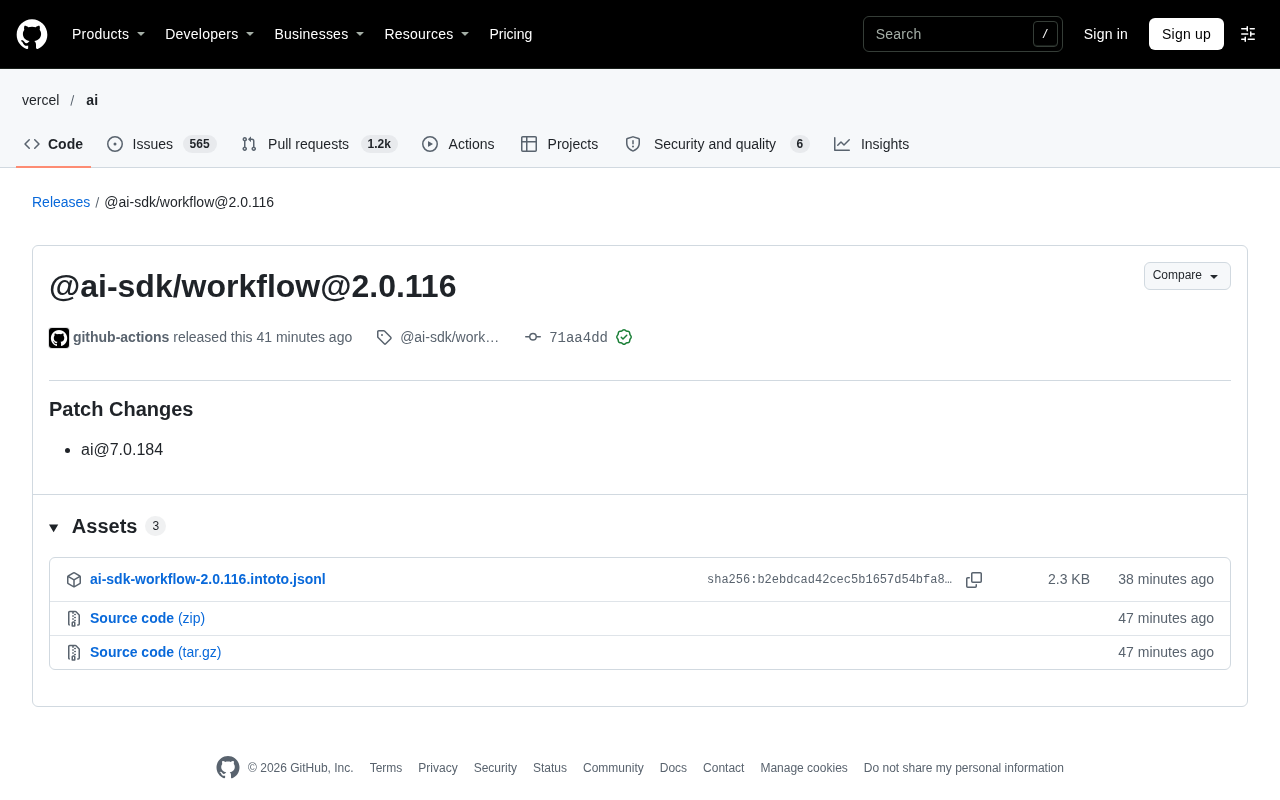
AI SDK workflow package releases patch 2.0.116, only aligning the ai@7.0.184 dependency.
`@ai-sdk/workflow` has released patch version 2.0.116, with the only change being alignment of the underlying `ai` core package to 7.0.184, with no new APIs or workflow syntax changes. The article notes that the workflow package is highly version-coupled with the `ai` package, and version mismatch can easily surface at runtime as type mismatches or streaming response and tool-calling exceptions, so explicitly listing the dependency version in the changelog serves as an alignment signal. The release was triggered by the github-actions bot and carries a GPG signature, reflecting traceable supply-chain practices. The upgrade advice is to include it in a routine dependency update batch, check the `ai` version at the same time, and regression-test streaming output and tool-call handoffs; teams not using this package do not need to migrate, but should establish a habit of regular dependency review.
Version iterations in the AI SDK ecosystem have always moved fast. @ai-sdk/workflow has released patch version 2.0.116, syncing its underlying ai package dependency to 7.0.184. On the surface this is just a routine patch, but for developers building multi-step workflows with the Vercel AI SDK, this kind of dependency alignment is precisely the detail that keeps builds stable.
Patch Contents: A Pure Dependency Alignment
According to the GitHub Releases page, 2.0.116 is marked as Patch Changes, and the only explicitly listed change is ai@7.0.184. This means the release introduces no new APIs and makes no changes to workflow definition syntax; the core action is syncing the ai core package version that the workflow package depends on to 7.0.184.
For utility libraries following semantic versioning, patch-level updates usually carry bug fixes and internal consistency maintenance. Explicitly writing the dependency version into the changelog also indicates that there is an interface contract between the two that needs to be aligned—workflow orchestration logic relies on underlying capabilities provided by the ai package, such as model invocation and streaming responses. Version mismatch can easily surface at runtime as hard-to-diagnose exceptions.
Semantic Versioning (SemVer) is the most mainstream versioning convention in the npm ecosystem, in the format major.minor.patch. A major version change means incompatible API modifications; a minor version increase indicates backward-compatible feature additions; a patch number increment corresponds to backward-compatible bug fixes and internal maintenance. 2.0.116 is a patch-level update, so both the publisher and consumers assume by default that it contains no breaking changes. However, SemVer is only a convention; cross-package interface alignment can still be affected in practice by peer or direct dependency version ranges. That is why explicitly listing ai@7.0.184 in the changelog has engineering significance—it makes an implicit dependency explicit and makes it easier for users to verify their own dependency trees.
Why Dependency Locking Deserves Serious Attention
In real projects, @ai-sdk/workflow is rarely installed in isolation. Developers also bring in ai, various provider packages, and their own utility functions, forming a dependency graph. If workflow declares a dependency on a certain ai version range while the project locks a lower version, type mismatches or runtime behavior differences may occur.
By writing the version number into the changelog, this release gives users a clear signal: when upgrading to 2.0.116, make sure your ai package is also around 7.0.184. Teams managing dependencies with a lockfile can complete alignment with a routine update; projects that maintain package.json manually need to watch for version conflict warnings.
lockfile (such as package-lock.json, yarn.lock, pnpm-lock.yaml) records the exact version and download URL that each package in the dependency graph resolves to, ensuring that different machines and different times produce exactly the same node_modules structure. When an extension package declares a dependency on a certain ai version range, the lockfile fixes the version that is actually resolved. If a project manually maintains package.json and does not update the lockfile in time, @ai-sdk/workflow and ai may end up out of sync. Running npm update once or deleting the lockfile and reinstalling usually aligns the dependency resolution result with the publisher's expectations; in team collaboration, the lockfile should be kept under version control to avoid introducing hard-to-reproduce runtime issues caused by environment differences.
Engineering Signals in the Release Process
This release was triggered by the github-actions bot, and the commit carries a GitHub-verified signature (GPG key ID: B5690EEEBB952194). Automated releases plus signature verification are a common supply-chain practice in mature open-source projects—they ensure that release artifacts can be traced back to a specific CI run and reduce the risk of tampering.
For users, the value of such signals lies in credibility: you can confirm that the 2.0.116 you have really comes from the project's official pipeline rather than a third-party mirror. Combined with npm's provenance mechanism, the transparency of the dependency chain is further improved.
GPG signature verification is a commit-origin verification mechanism provided by Git and GitHub. Developers or CI bots hold a private key and sign the commit object; GitHub verifies it with the corresponding public key, and upon success displays a Verified badge and notes the key ID. In the open-source supply chain, it can prove that a certain commit was indeed produced by the entity holding that key (here, the project's GitHub Actions pipeline) rather than being impersonated or forged. Combined with npm's provenance mechanism—which generates a verifiable build-origin statement at publish time and associates it with a specific CI run—users can trace the complete chain of a package from source commit to artifact release. Such practices reduce the risk of dependency confusion and package tampering, and are a plus when evaluating the trustworthiness of third-party libraries.
Upgrade Recommendations
If your project is using @ai-sdk/workflow to build multi-step agents or tool-calling chains, it is recommended to include 2.0.116 in your next dependency update batch and check the ai package version at the same time. After upgrading, run your existing workflow tests once, focusing on whether streaming output and tool-call handoffs work properly. Since this is a patch version, no breaking changes are expected, but it is still advisable to confirm at the lockfile level that the resolution result matches expectations.
For teams not yet using this package, this release itself is not a reason to migrate, but it highlights a practical point: in the AI SDK ecosystem, core packages and extension packages are highly version-coupled, and establishing a habit of regular dependency review is more valuable than chasing individual version numbers.
Related articles

Why Learn Python in the AI Era? A Deep Dive with the Author of 'Python Crash Course'
Eric Matthes, author of 'Python Crash Course', discusses why Python remains essential in the AI era, the democratization and risks of AI coding tools, and the value of human creators.

Convex Skill Allegedly Uploads User App Ideas to Remote Servers Without Consent
Convex backend skill allegedly sends user app ideas to remote servers without disclosure, sparking Hacker News debate. We analyze the privacy risks and transparency issues.

The Coding Data Market Booms: How Frontier Labs Buy Training Data
The coding data market is rapidly expanding, with frontier labs as major buyers. This article analyzes the types of data traded, labs' procurement logic, and concerns such as licensing compliance and data contamination.