AI SDK Workflow 2.0.61 Released: Tool Schema Compatibility and Streaming Performance Fixes

AI SDK workflow 2.0.61 patches tool schema compatibility and streaming performance reporting.
`@ai-sdk/workflow@2.0.61` is a low-risk patch update with two targeted fixes: broader compatibility for JSON Schema dialects and annotations (enabling smoother integration of tools from OpenAPI specs or third-party libraries), and corrected performance reporting for streamed agent steps (switching from estimates to real measurements for more trustworthy observability). The release also upgrades dependencies including `ai@7.0.129` and `@ai-sdk/provider@4.0.23`. Developers using non-standard schemas or relying on streaming step metrics for monitoring should upgrade promptly.
Vercel AI SDK's @ai-sdk/workflow module has released patch version 2.0.61, bringing two targeted fixes. While this is a routine patch update, the improvements to tool schema compatibility and streaming performance reporting are worth paying attention to for developers building agent workflows with AI SDK.
Core Changes in This Update
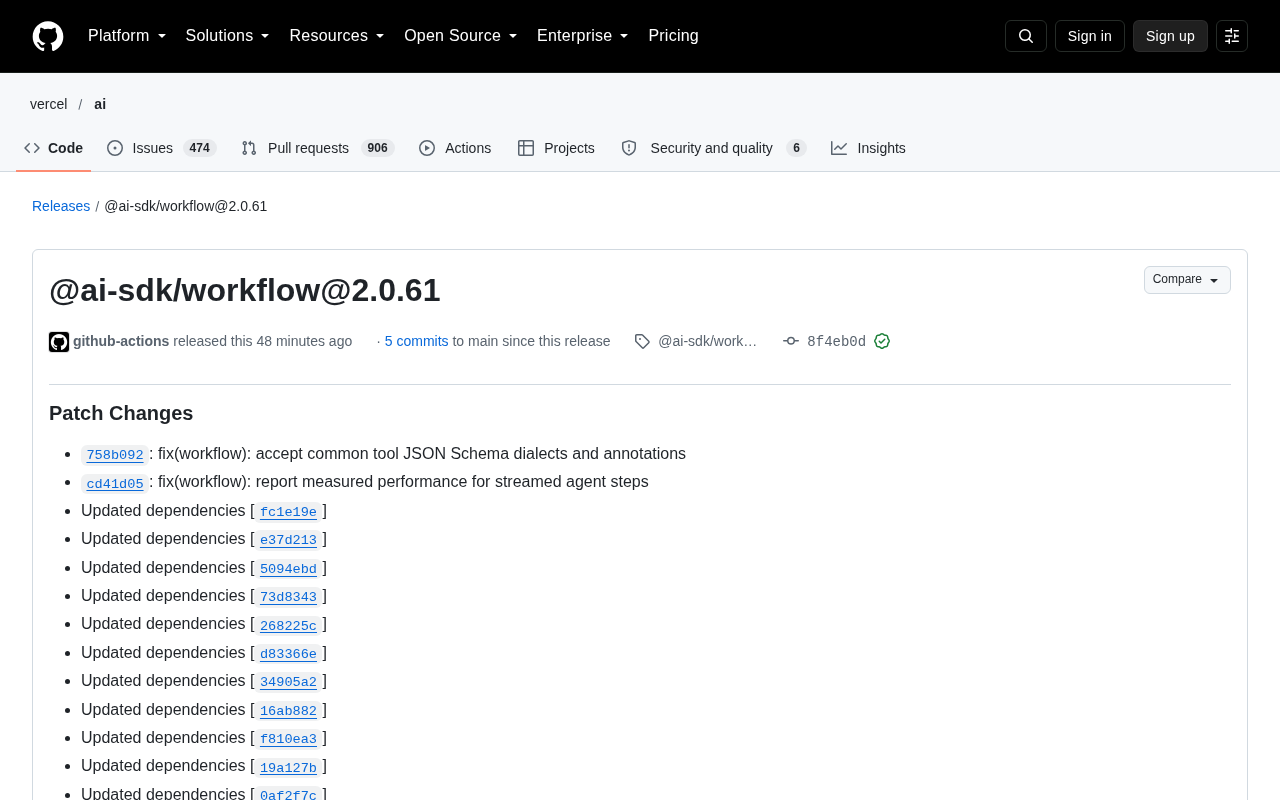
According to the GitHub Releases page, @ai-sdk/workflow@2.0.61 was published on October 6th and includes two straightforward patch changes:
- Accept common tool JSON Schema dialects and annotations (commit
758b092): Previously, the workflow had limited support for JSON Schema dialects and annotations when parsing tool definitions. This fix enables compatibility with a wider range of mainstream JSON Schema conventions, reducing errors developers encounter when tool schema formats aren't recognized during tool definition. - Fix performance reporting for streamed agent steps (commit
cd41d05): When executing agent steps in streaming mode, the previously reported performance data could be inaccurate. This update switches to reporting genuinely measured performance metrics, which is friendlier for teams relying on traces and metrics for observability analysis.
Why Tool Schema Compatibility Matters
When building AI Agents, tool calling is one of the core capabilities. Developers use JSON Schema to describe the input parameter structure of each tool, which models use to generate structured call arguments.
The challenge is that JSON Schema itself has multiple versions and dialects (such as Draft 7, 2020-12, etc.), and different toolchains or model providers may generate or expect slightly different schema formats. If the workflow module only accepts a narrow subset of formats, developers are forced to manually rewrite schemas or hit walls when integrating third-party tools.
This fix broadens the accepted range of schema dialects and annotations, meaning tool definitions migrated from other sources (such as OpenAPI specs or existing tool libraries) can integrate more smoothly, reducing friction.
JSON Schema "dialects" refer to syntax differences across specification versions. Draft 7 is the most widely used version, adopted by a large number of tool libraries and OpenAPI 2.x/3.x specs; Draft 2020-12 introduced new keywords like
$vocabularyandprefixItemswith semantically different behavior from older versions. "Annotations" refer to keywords in a schema that provide additional metadata, such astitle,description, andexamples— they don't affect validation logic, but in tool-calling scenarios, models often rely on these annotations to understand parameter meanings and generate more accurate call arguments. Previously, if the workflow module mishandled these keywords, it would at best silently ignore them (degrading model call quality) or at worst throw a parsing error.
The Real-World Impact of Streaming Performance Reporting
Streaming output is standard in modern AI applications — users expect to see model responses generated token by token rather than waiting for a complete result. In agent workflows, every step may involve a streaming LLM call.
Accurate performance reporting is especially critical in production environments. When teams use monitoring systems to track the duration of each agent step, reporting estimated values rather than actual measurements leads to distorted bottleneck identification. The cd41d05 fix switches reporting to real measured data, making observability data more trustworthy and helping teams optimize agent response latency.
In observability systems, AI Agent workflows typically use OpenTelemetry Traces or custom Spans to record metrics like step duration and token usage. Timing in streaming scenarios is particularly complex: Time to First Token (TTFT), total completion time (Total Duration), and intermediate chunk throughput are three dimensions that need to be measured separately. If the SDK only estimates duration as "time from request dispatch to stream object return" in streaming scenarios — rather than waiting for the stream to actually finish before reporting — it severely underestimates actual duration. This causes P95/P99 latency data in monitoring dashboards to be distorted, which in turn misleads capacity planning and performance optimization decisions.
Synchronized Dependency Upgrades
Beyond the two fixes in workflow itself, this release also synchronizes updates to a series of underlying dependencies, including:
@ai-sdk/provider-utils@5.0.55ai@7.0.129@ai-sdk/provider@4.0.23
These dependency updates span over a dozen commits, indicating the entire AI SDK ecosystem continues to iterate at a high frequency. For projects using monorepos or pinned versions, it's recommended to check the version compatibility of these core packages when upgrading workflow, to avoid cross-package type or behavior inconsistencies.
How Developers Should Respond
Since this is a patch version (following semantic versioning, only bug fixes with no breaking changes), the upgrade risk is low. Users in the following scenarios are encouraged to upgrade promptly:
- Those using newer or non-standard JSON Schema conventions in tool definitions who previously encountered parsing failures;
- Those relying on streaming agent step performance metrics for monitoring and tuning;
- Those who want to stay in sync with the latest core packages like
ai@7.0.129.
Upgrading is the same as any standard npm package — update the version number in package.json and reinstall. Given the minor version bump, regression testing costs are low, but it's still recommended to run a full validation pass on agent flows that integrate multiple tools.
Summary
@ai-sdk/workflow@2.0.61 is a quiet bug-fix release, but it reflects Vercel AI SDK's continued refinement of agent workflow details — from tool schema compatibility to streaming execution observability. These seemingly small improvements are exactly the kinds of things that are easiest to overlook when building stable, maintainable AI applications, yet genuinely impact the developer experience.
Related articles

Python 3.15 New Feature: Is the sentinel Type Better Than None?
Python 3.15 adds the sentinel type, using named unique sentinel objects to replace None and bare object(), resolving confusion among missing values, explicit emptiness, and invalid input while avoiding type hint failures.

Deep Learning's Three Architectures and the Universal Approximation Theorem: A Complete Guide to MLPs, CNNs, and Transformers
Explaining the inductive bias differences among MLP, CNN, and Transformer, the existence meaning of the Universal Approximation Theorem (UAT), and the role of Taylor expansion in approximation analysis, while clearing up common misconceptions.

GitLab Emergency Patch Release: Analysis of Critical Security Fixes
GitLab releases critical patch 19.5.1, sparking 355 points of discussion on Hacker News. This article analyzes the background, upgrade steps for self-hosted instances, and verification points to help DevOps teams respond quickly to security updates.