@ai-sdk/workflow 2.0.64 Released: Patch Update and Dependency Upgrade

@ai-sdk/workflow 2.0.64 is a backward-compatible patch that syncs the upstream ai package to version 7.0.132.
Vercel AI SDK sub-package `@ai-sdk/workflow` has released version 2.0.64, a patch update published via automated workflow and verified with a GPG signature. The release introduces no breaking API changes — the core change is bumping the underlying `ai` package to 7.0.132. Following SemVer conventions, patch updates are backward-compatible, making this a low-risk upgrade. The actual functional or bug-fix details reside in the upstream `ai@7.0.132` changelog, which developers should consult for specifics. This high-frequency, automated release pattern is typical of modern AI infrastructure open-source projects.
@ai-sdk/workflow 2.0.64 Release Notes
Vercel's AI SDK ecosystem continues to evolve rapidly. The @ai-sdk/workflow package recently shipped version 2.0.64 — a patch-level update focused primarily on dependency synchronization. For developers who have already integrated this workflow module into their projects, these incremental releases are worth keeping an eye on.
What's New in This Release
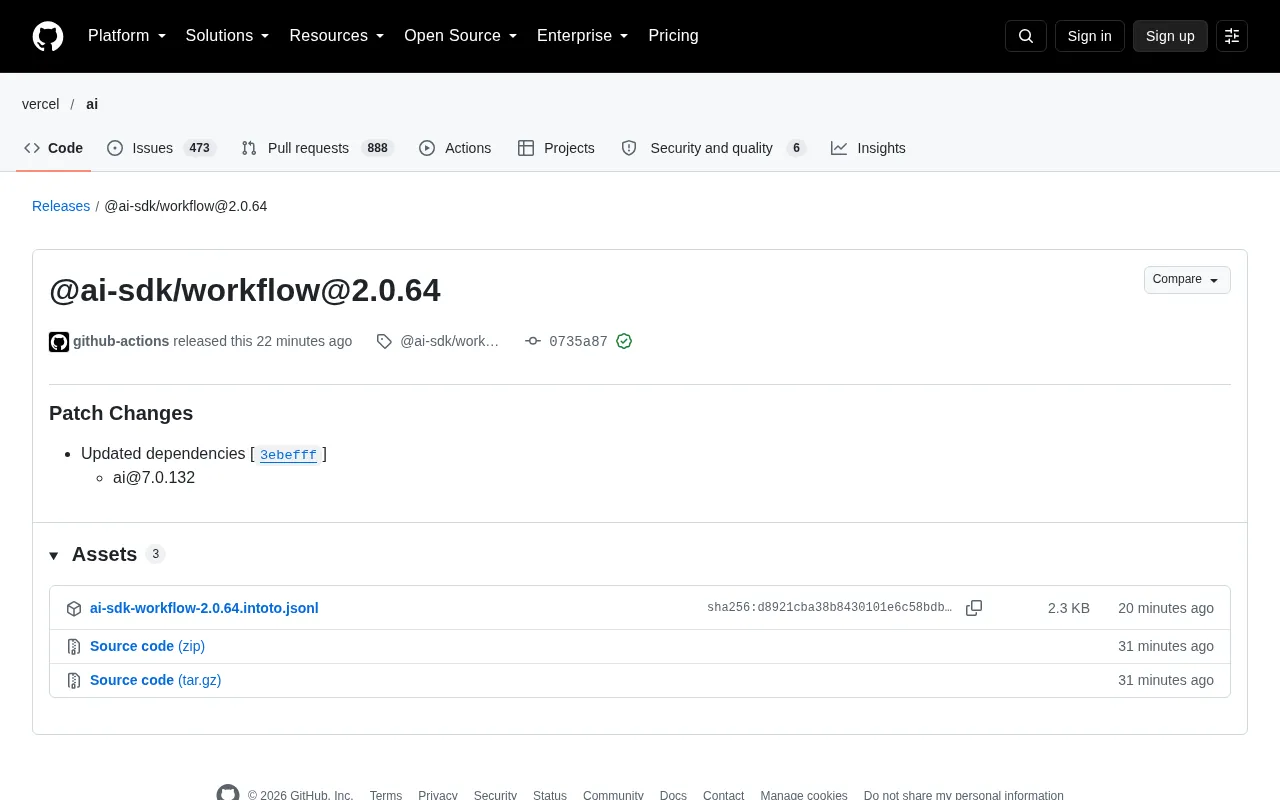
According to the GitHub Releases page, @ai-sdk/workflow@2.0.64 was published via an automated GitHub Actions workflow and verified with a GitHub GPG signature (key ID: B5690EEEBB952194), ensuring the authenticity of the release artifact.
This update is explicitly labeled as a Patch Change, with the core change being an upstream dependency bump: the underlying ai package has been upgraded to version 7.0.132 (corresponding to commit 3ebefff). This means 2.0.64 itself introduces no breaking API changes — it simply keeps in sync with the core runtime's ongoing development.
What a Patch Update Really Means
Following Semantic Versioning (SemVer) conventions, incrementing the patch number (from x.x.63 to x.x.64) typically indicates backward-compatible bug fixes or dependency maintenance. For consumers, this kind of upgrade is generally safe and can be applied directly without worrying about interface-level changes.
That said, since the real substance of this update is the ai@7.0.132 sync, the actual functional changes or bug fixes likely live in the upstream dependency's changelog. Developers looking for the specifics should consult the ai core package's Release Notes for version 7.0.132, rather than relying solely on the workflow package's brief description.
Recommended Upgrade Approach
For teams already running AI SDK Workflow in production, consider the following:
- In projects with pinned dependencies, evaluate whether you also need to bump the
aicore package to 7.0.132 - Validate your workflow orchestration logic in a staging environment before rolling out to production
- Keep an eye on version consistency across the entire
@ai-sdk/*ecosystem to avoid mismatches between sub-packages and the core package
Semantic Versioning (SemVer) is a versioning convention proposed by GitHub co-founder Tom Preston-Werner, using the format MAJOR.MINOR.PATCH. A MAJOR bump signals breaking API changes; a MINOR bump indicates backward-compatible new features; and a PATCH bump represents only backward-compatible bug fixes or maintenance updates (such as dependency syncs). In the npm ecosystem, range specifiers like ^2.0.63 automatically accept minor and patch upgrades within the same major version, so most projects using default lock strategies will automatically pick up 2.0.64 when running npm update or reinstalling. This is precisely why staying aware of what each patch update actually contains matters for production predictability — even when the risk is typically low.
About AI SDK Workflow
@ai-sdk/workflow is the orchestration module within the AI SDK toolchain, helping developers organize multi-step AI calls, tool usage, and state transitions into coherent workflows. It is tightly coupled with the core ai package, making version sync updates a common occurrence.
The release cadence reflects an actively maintained project that keeps dependencies current. This pattern of high-frequency, small version increments is characteristic of modern frontend and AI infrastructure open-source projects — leveraging continuous integration and automated publishing to rapidly propagate upstream fixes across all sub-packages.
The Vercel AI SDK, which @ai-sdk/workflow is part of, is a unified AI integration layer for TypeScript/JavaScript developers, designed to abstract away the API differences between various LLM providers (OpenAI, Anthropic, Google, etc.). The core ai package provides foundational capabilities like streaming text generation, structured output, and Tool Calling, while @ai-sdk/workflow builds on top of it to offer workflow orchestration abstractions — allowing developers to compose multiple AI call steps, conditional branches, external tool invocations, and state management into reusable flow graphs. The tight coupling between the two means any interface adjustments in the ai core package may require the workflow module to follow suit, which explains why the version number increments so frequently in patch form — it's essentially about maintaining API contract consistency between the two packages.
Summary
@ai-sdk/workflow@2.0.64 is a routine patch update centered on a dependency sync, with a low barrier to upgrade and minimal risk. The key thing for developers to focus on is the actual changes brought by the synchronized ai@7.0.132. Overall, this is a standard maintenance checkpoint in the AI SDK ecosystem's day-to-day upkeep.
Related articles

MCP Security Primer: OWASP Top 10 Risks and the Lethal Trifecta Defense
A systematic breakdown of MCP security risks: from the Postmark backdoor to the OWASP MCP Top 10, how the Lethal Trifecta reveals AI Agent fragility, plus shadow servers and missing audits.

DeepCell: One-Click AI Generation of Documents, Spreadsheets, and Slides
DeepCell tops Product Hunt with one-click generation of documents, spreadsheets, and slides, using the .deepcell format for linked updates, designed for System 2 tasks like modeling and sales reviews.

Doneas: 15-Minute Daily Accountability Calls That Keep Indie Developers From Procrastinating
Doneas is a daily accountability tool for indie developers: plan tasks on Monday, join a 15-minute call with five builders each day, and log deliveries on a public progress page. This article analyzes its core mechanics, effectiveness, and potential issues around retention and matching.