@ai-sdk/workflow 2.0.65 Released: A Patch Version with Dependency Sync Updates

@ai-sdk/workflow 2.0.65 syncs core dependencies with no feature changes — a safe, low-risk maintenance update.
@ai-sdk/workflow 2.0.65 is a routine maintenance release for the Vercel AI SDK's workflow module, with changes focused on syncing dependencies: ai@7.0.133, @ai-sdk/provider@4.0.25, and @ai-sdk/provider-utils@5.0.57. Published automatically via GitHub Actions with GPG signature verification for supply chain security. As a patch-level release under SemVer, it contains no breaking API changes, making it safe to upgrade. Note that release notes don't detail the specific changes in the underlying commit — check the core `ai` package changelog for more context.
Version Overview
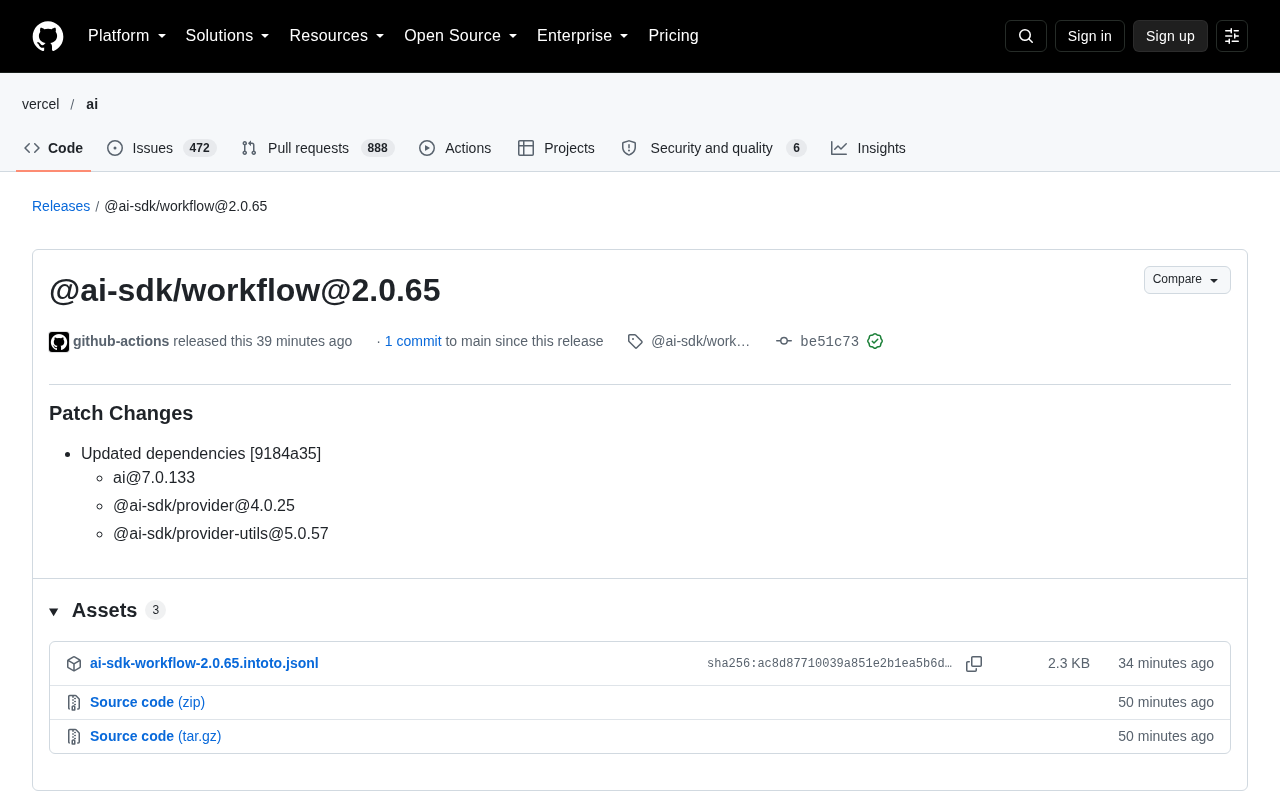
@ai-sdk/workflow has released version 2.0.65, a patch release focused primarily on dependency updates. This version was published automatically via GitHub Actions and carries a verified GPG signature (key ID: B5690EEEBB952194), ensuring the integrity of the release pipeline.
As the workflow module within the Vercel AI SDK ecosystem, @ai-sdk/workflow is responsible for orchestrating multi-step tasks in AI applications. This update introduces no new features or breaking changes — it simply syncs the versions of underlying dependencies, making it a typical maintenance release.
Dependency Update Details
According to the release notes, the core changes in this patch are centered on dependency synchronization. Triggered by the associated commit [9184a35], the following dependencies were updated to new versions:
- ai@7.0.133: The core AI SDK package
- @ai-sdk/provider@4.0.25: The provider abstraction layer, defining a unified interface for model providers
- @ai-sdk/provider-utils@5.0.57: A collection of utility functions for providers
The version numbers reflect that the entire AI SDK ecosystem is in a phase of rapid iteration. The core ai package has reached the 7.x major version, while each sub-module maintains its own independent semantic versioning cadence. The relatively high patch number of 65 in @ai-sdk/workflow 2.0.65 confirms its strategy of continuous, incremental maintenance.
Semantic Versioning (SemVer) is a widely adopted versioning convention in the Node.js ecosystem, following the format MAJOR.MINOR.PATCH. A major version bump indicates breaking API changes, a minor bump signals new backward-compatible features, and a patch bump covers only backward-compatible bug fixes or maintenance adjustments. The ai package being at major version 7.x means it has undergone multiple significant API redesigns, while @ai-sdk/workflow's patch number of 65 indicates 65 fine-grained maintenance iterations since the 2.0.0 release — quite common in active open-source projects. Each sub-package maintaining its own independent versioning cadence (rather than a unified monorepo version lock) allows modules to be released independently as needed, but also requires developers to pay closer attention to cross-package version compatibility matrices.
Practical Impact for Developers
For developers building applications with the Vercel AI SDK, patch releases like this are generally safe to upgrade to without hesitation. The primary goal of dependency sync updates is to maintain version compatibility and prevent potential issues caused by mismatched sub-package versions.
If your project relies on the workflow module for task orchestration, it's worth confirming before upgrading that related packages like ai and @ai-sdk/provider will work together harmoniously. Since this is a patch-level change, semantic versioning (SemVer) guarantees it should not contain any breaking API changes, making the upgrade risk low.
That said, it's worth noting that the release notes themselves are fairly sparse and do not disclose what the [9184a35] commit specifically fixed or improved. Developers who need more detail will need to consult the full changelog of the underlying ai package.
GPG (GNU Privacy Guard) signature verification is a critical mechanism for software supply chain security. During publishing, GitHub Actions signs the release artifacts with a private key, allowing developers or package managers to verify via the corresponding public key that the version was genuinely published by an authorized automated pipeline and not a tampered malicious package. With npm supply chain attacks becoming increasingly frequent in recent years, verifying release signatures has become a best practice for enterprise-grade projects. For AI application projects that depend on a large number of third-party packages, combining npm audit, lockfile pinning, and signature verification can significantly reduce the risk of dependency poisoning.
Summary
@ai-sdk/workflow 2.0.65 is a routine dependency maintenance update with no user-facing feature changes. It reflects the Vercel AI SDK team's ongoing commitment to maintaining version consistency across the ecosystem's modules. For teams tracking the AI application development toolchain, staying on top of these high-frequency releases helps ensure timely access to underlying improvements and compatibility fixes.
Related articles

Chain of Thought Isn't Just for AI: How Humans Can Use CoT to Improve Thinking Quality
Chain of Thought isn't just a prompt trick for large models. Starting from a Hacker News discussion, this article analyzes why CoT works for human thinking too, breaks down actionable ways to transfer it, and highlights the key differences between human CoT and machine CoT.
Cloudflare Teams Up with OpenAI: Closi…
Cloudflare Teams Up with OpenAI: Closing the Loop from Vulnerability Discovery to Defense with AI
Cloudflare uses OpenAI Daybreak to investigate security vulnerabilities and generate reviewable remediation plans, while developers use Codex to boost coding efficiency and quality.

Orca Multi-Agent Orchestration in Practice: A Guide to Parallel Collaboration with Claude and Codex
Orca is Stable AI's free open-source agent workbench supporting 34 agents like Claude Code and Codex in parallel. Learn its Git worktree isolation, multi-model orchestration, and mobile management.