AI SDK Workflow 2.0.66 Released: Upgrade to Stable Version 5.1.0

@ai-sdk/workflow@2.0.66 is a low-risk patch update that upgrades the underlying Workflow SDK to stable 5.1.0.
@ai-sdk/workflow@2.0.66 is a patch-level update, meaning the version increment theoretically introduces no breaking changes and is safe to adopt directly. The headline change is that the underlying Workflow SDK has officially reached stable 5.1.0, with a more settled API contract that better suits long-term production use. The AI core package has also been synced to `ai@7.0.134` to prevent type conflicts or runtime issues from version mismatches. Because the underlying dependency made a significant jump, developers are advised to run a regression test after upgrading, focusing on workflow orchestration logic, state transitions, and error handling behavior.
Version Overview
@ai-sdk/workflow@2.0.66 was recently published automatically via GitHub Actions as a patch-level update. The core change upgrades Workflow SDK support to the stable 5.1.0 release, along with synchronized dependency updates — the underlying AI package has been bumped to ai@7.0.134.
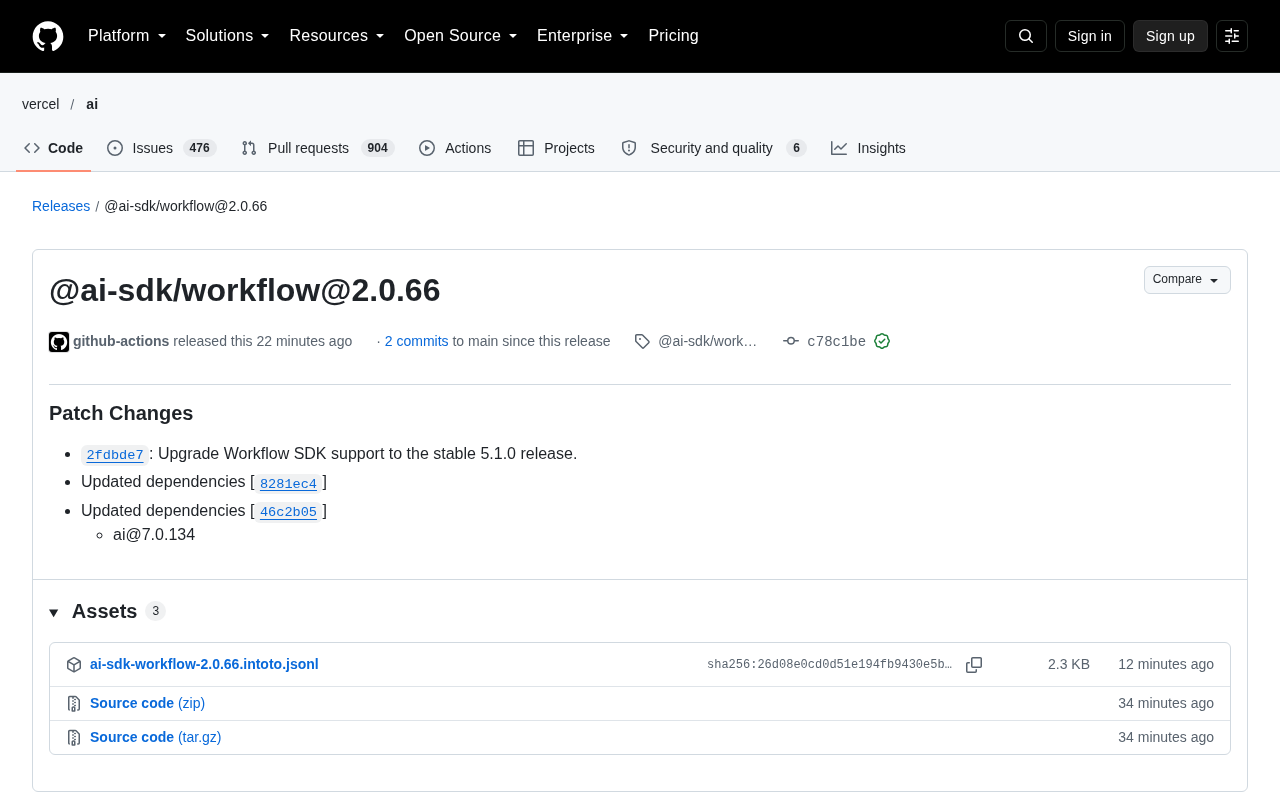
For developers building workflows with the AI SDK, patch updates like this typically signal improvements in stability and compatibility rather than sweeping feature changes. The most notable signal this time is the word "stable" — the Workflow SDK has graduated from preview/beta to the stable 5.1.0 release. This means its API contract is becoming more settled, making it a better fit for production adoption.
Core Changes in This Release
According to the release notes, version 2.0.66 focuses on two main areas:
Upgrade to Workflow SDK 5.1.0 Stable
The changelog (commit 2fdbde7) explicitly states: Upgrade Workflow SDK support to the stable 5.1.0 release. Locking a core dependency to a stable version is a classic sign of a maturing framework. Compared to pre-release versions, stable releases typically undergo more thorough testing with a lower risk of interface changes — especially important for projects with long maintenance horizons.
Synchronized Dependency Updates
This release also includes several dependency updates (commits 8281ec4 and 46c2b05), with the AI core package upgraded to ai@7.0.134. Keeping in sync with upstream core library versions helps avoid type conflicts or runtime issues caused by version mismatches.
What a Patch Update Means
From a Semantic Versioning (SemVer) perspective, 2.0.66 is a Patch-level increment, which theoretically contains no breaking changes. Developers can generally upgrade directly without worrying about large-scale rewrites to existing code.
That said, since this update involves a significant jump in the underlying Workflow SDK (migrating to the stable 5.1.0), it's still advisable to run a round of regression testing after upgrading. Verify that your workflow orchestration logic, state transitions, and error handling behave as expected — particularly for projects migrating from older preview branches, where default behavior differences between the stable release and the preview may be worth investigating.
Semantic Versioning (SemVer) defines version numbers as a three-part
MAJOR.MINOR.PATCHstructure: a Major increment signals breaking changes, a Minor increment adds backward-compatible new features, and a Patch increment covers backward-compatible bug fixes or internal optimizations. The core value of this convention is letting users quickly gauge upgrade risk from the version number alone — patch-level updates should theoretically be drop-in replacements requiring no changes to calling code. It's worth noting that while@ai-sdk/workflowitself is a Patch increment (2.0.66), its internal dependency has made a more significant jump to the stable 5.1.0 Workflow SDK. So while the outer package upholds SemVer's low-risk promise, it's still worth verifying behavior changes through testing.
Practical Impact for Developers
The Workflow module in the AI SDK is primarily used to orchestrate multi-step AI task pipelines — chaining together multiple model calls, tool calls, and conditional branching. With the underlying SDK now at a stable release, the reliability of these workflow capabilities is expected to improve further.
For teams evaluating whether to introduce AI workflow orchestration in production, the stable release is a positive signal. It reduces the maintenance overhead caused by frequent framework changes and provides a more solid foundation for future feature development.
Recommended upgrade path:
- Update
@ai-sdk/workflowin yourpackage.jsonto2.0.66; - Confirm that your
aidependency version is7.0.134or higher; - Run your existing test suite, with a focus on workflow-related logic;
- Monitor the official changelog for best practices around the 5.1.0 stable release.
Tool Calling in the AI SDK refers to the ability for language models to dynamically invoke pre-defined external functions or APIs during inference — extending beyond pure text generation to enable information retrieval, data computation, system operations, and more. In workflow orchestration, tool calls are typically embedded as nodes within multi-step pipelines: when the model determines that a particular capability is needed given the current context, it triggers the corresponding tool, feeds the result back, and downstream nodes continue processing. With the Workflow SDK now stabilized, the registration method for tool call nodes, execution context propagation, and error fallback logic are expected to have clearer contract guarantees — reducing the risk of silent behavioral changes in tool calls across version updates.
Summary
@ai-sdk/workflow@2.0.66 is itself a low-risk patch update, but the "upgrade to stable 5.1.0" change sends a clear signal of increased framework maturity. For developers relying on the AI SDK to build complex workflows, this is a version worth adopting promptly.
Related articles

Chain of Thought Isn't Just for AI: How Humans Can Use CoT to Improve Thinking Quality
Chain of Thought isn't just a prompt trick for large models. Starting from a Hacker News discussion, this article analyzes why CoT works for human thinking too, breaks down actionable ways to transfer it, and highlights the key differences between human CoT and machine CoT.
Cloudflare Teams Up with OpenAI: Closi…
Cloudflare Teams Up with OpenAI: Closing the Loop from Vulnerability Discovery to Defense with AI
Cloudflare uses OpenAI Daybreak to investigate security vulnerabilities and generate reviewable remediation plans, while developers use Codex to boost coding efficiency and quality.

Orca Multi-Agent Orchestration in Practice: A Guide to Parallel Collaboration with Claude and Codex
Orca is Stable AI's free open-source agent workbench supporting 34 agents like Claude Code and Codex in parallel. Learn its Git worktree isolation, multi-model orchestration, and mobile management.