@ai-sdk/workflow 2.0.68 Released: Dependency Updated to ai@7.0.136

@ai-sdk/workflow 2.0.68 is a patch release that syncs the core ai dependency to version 7.0.136.
Vercel's `@ai-sdk/workflow` has released version 2.0.68, a typical dependency-sync patch update with no changes to its own code logic — the sole change is upgrading the core `ai` dependency to `7.0.136`. Under SemVer, this patch-level bump is backward-compatible and safe to adopt. Since `@ai-sdk/workflow` is tightly coupled with the core `ai` package for multi-step AI task orchestration, keeping both versions aligned is critical to avoiding compatibility issues. Developers using the AI SDK are advised to update the `ai` package in tandem and review the `ai@7.0.136` Changelog for details on underlying fixes.
Version Overview
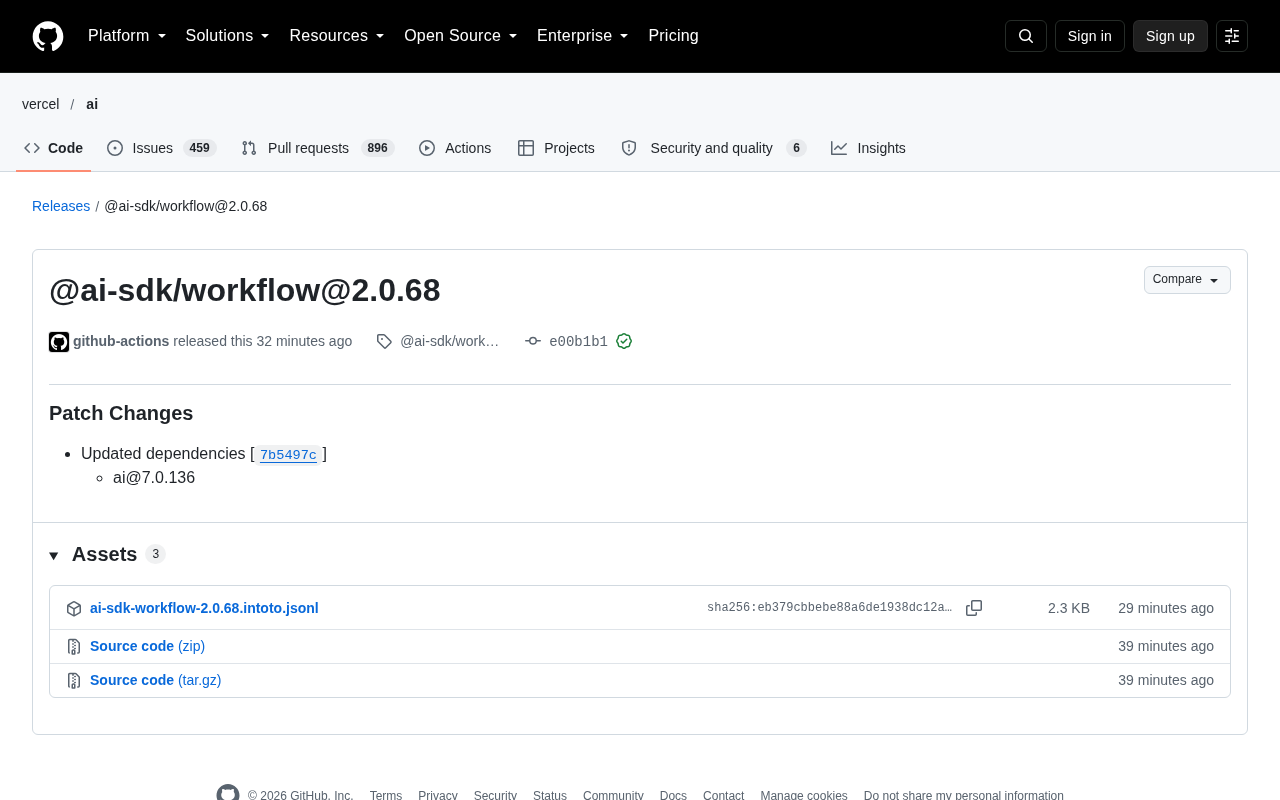
Vercel's @ai-sdk/workflow, part of the AI SDK ecosystem, has released version 2.0.68. This update was published through GitHub Actions automation with commit hash e00b1b1, verified via GitHub's GPG signature (key ID: B5690EEEBB952194). It is a standard patch-level release (Patch Changes).
Based on the release record, the core change in this update is a dependency upgrade — no significant new features or breaking changes were introduced. Updates like this are typically used to stay in sync with upstream core libraries, ensuring the workflow module continues to run stably on the latest SDK foundation.
What's Changed
According to the official Changelog, the only change in 2.0.68 is a dependency update:
- Updated dependencies
[7b5497c] - Core dependency
aiupgraded to7.0.136
In other words, the code logic of @ai-sdk/workflow itself was not directly modified — the version was bumped simply to align with the underlying ai package's iteration. For developers building AI workflows with this module, this means you can now pair it with the latest ai@7.0.136 to benefit from its underlying fixes and improvements.
What a Patch Version Means
Under Semantic Versioning (SemVer), an increment in the patch number (the third digit) typically represents a backward-compatible fix or dependency sync, with no new features or API changes. Therefore, upgrading from 2.0.67 to 2.0.68 carries minimal risk — developers can confidently update without worrying about breaking existing workflows.
Semantic Versioning (SemVer) is the most widely adopted versioning standard in the open-source ecosystem, formatted as
MAJOR.MINOR.PATCH. A major version bump indicates breaking, incompatible changes; a minor version bump adds backward-compatible new features; and a patch bump represents only backward-compatible bug fixes or internal dependency syncs. In large monorepo-based SDKs (like the Vercel AI SDK), sub-packages are often version-managed collectively through automation scripts. When a core package releases a new version, all dependent sub-packages will trigger a patch bump to declare the new dependency — even if their own code hasn't changed. This mechanism ensures package managers can correctly resolve the dependency tree and avoid incompatible core package versions across sub-packages.
Impact on Developers
@ai-sdk/workflow is the module in the AI SDK ecosystem used to orchestrate multi-step AI tasks — commonly used to chain together model calls, tool executions, and state management. It is tightly coupled with the core ai package, so keeping both versions aligned is especially important.
If you're already using the AI SDK in your project, it's recommended to update ai to 7.0.136 at the same time to avoid potential compatibility issues from version mismatches. With lock file management in pnpm, npm, or yarn, this kind of patch upgrade typically requires just a single dependency update command.
Upgrade Recommendations
- For production environments prioritizing stability, validate in a test environment before merging
- Review the
ai@7.0.136Changelog to understand what was specifically fixed at the underlying level - Use your CI pipeline to automatically verify builds and tests after the dependency upgrade
@ai-sdk/workflowis the sub-package within the Vercel AI SDK ecosystem specifically designed to handle complex AI workflow orchestration. Unlike directly invoking a single model inference, the workflow module allows developers to define multi-step task graphs with conditional branching, loops, parallel execution, and state persistence. Typical use cases include: first calling a language model to generate a plan, then sequentially triggering different tools (such as search, code execution, or database queries) based on that plan, and finally aggregating the results to return a final answer. Since the workflow engine depends heavily on the streaming output, tool-calling protocols, and middleware mechanisms provided by the coreaipackage, any underlying fix in the core package can affect the stability of workflow execution — which explains why this module needs to closely trackaipackage versions.
Summary
@ai-sdk/workflow@2.0.68 is a typical dependency-sync patch release, with its primary value being alignment with ai@7.0.136. While the update itself is minimal, for teams building production-grade workflows on the AI SDK, staying current with these releases helps maintain overall ecosystem stability and security.
Related articles

Chain of Thought Isn't Just for AI: How Humans Can Use CoT to Improve Thinking Quality
Chain of Thought isn't just a prompt trick for large models. Starting from a Hacker News discussion, this article analyzes why CoT works for human thinking too, breaks down actionable ways to transfer it, and highlights the key differences between human CoT and machine CoT.
Cloudflare Teams Up with OpenAI: Closi…
Cloudflare Teams Up with OpenAI: Closing the Loop from Vulnerability Discovery to Defense with AI
Cloudflare uses OpenAI Daybreak to investigate security vulnerabilities and generate reviewable remediation plans, while developers use Codex to boost coding efficiency and quality.

Orca Multi-Agent Orchestration in Practice: A Guide to Parallel Collaboration with Claude and Codex
Orca is Stable AI's free open-source agent workbench supporting 34 agents like Claude Code and Codex in parallel. Learn its Git worktree isolation, multi-model orchestration, and mobile management.