@ai-sdk/workflow 2.0.78 Released: Dependency Chain Synced and Upgraded

@ai-sdk/workflow 2.0.78 is a pure dependency sync patch with no feature changes, reflecting AI SDK ecosystem version alignment.
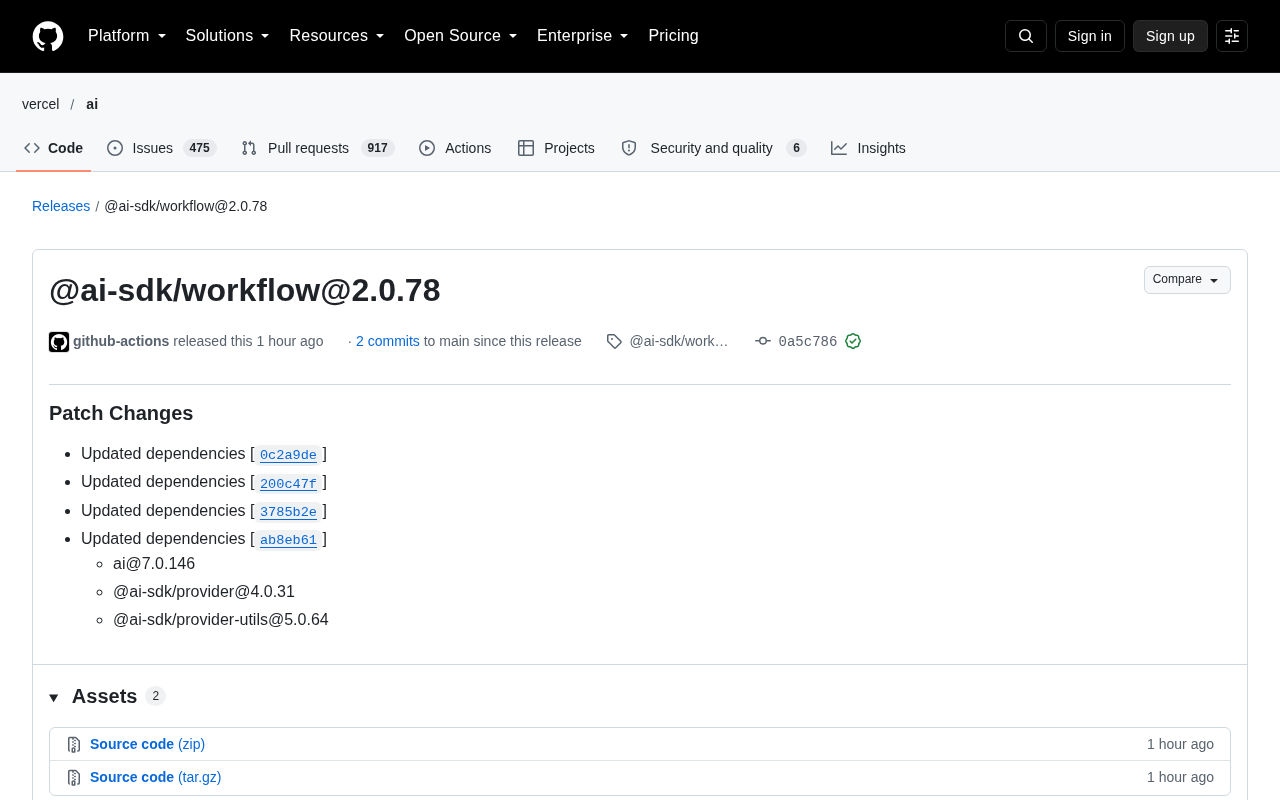
@ai-sdk/workflow released patch version 2.0.78. GitHub release notes mark it as Patch Changes, with all core changes focused on dependency upgrades involving ai@7.0.146, @ai-sdk/provider@4.0.31, and @ai-sdk/provider-utils@5.0.64, driven by four commits. This means the workflow package itself adds no new APIs or behavioral logic changes and instead follows upstream version alignment. The article analyzes how the layered design of provider and provider-utils propagates upstream changes downward, and the maintenance burden caused by independent semantic versioning of each AI SDK package. For developers, upgrading can directly eliminate peer dependency warnings and version conflicts and indirectly gain upstream bug fixes, but patch upgrades may still introduce subtle behavioral adjustments; running tests and checking bundle size and runtime logs is recommended.
The AI SDK ecosystem has another version sync. @ai-sdk/workflow has released patch version 2.0.78. On the surface, it looks like just a dependency update, but behind it lies the coordinated evolution rhythm of the entire AI SDK toolchain.
A Patch Release That Is a "Pure Dependency Update"
According to the release record on GitHub, @ai-sdk/workflow@2.0.78 is marked as Patch Changes, with all core changes focused on dependency updates. Specifically, dependency upgrades driven by four commits (0c2a9de, 200c47f, 3785b2e, ab8eb61) involve three packages: ai@7.0.146, @ai-sdk/provider@4.0.31, and @ai-sdk/provider-utils@5.0.64.
This means the workflow package itself adds no new APIs and does not change behavioral logic; instead, it keeps version alignment with the upstream core packages. For developers using AI SDK to build workflows, this type of patch can usually be upgraded directly with low risk, but it is still recommended to run existing tests in CI.
Technical Meaning of the Dependency Chain Upgrade
Layered Design of provider-utils and provider
@ai-sdk/provider and @ai-sdk/provider-utils are the two foundational package layers for abstracting model providers in AI SDK. The former defines the provider interface specification, and the latter provides utility functions and shared logic. The workflow package depends on both layers, indicating that in workflow orchestration it needs to call provider capabilities directly rather than relying only on the top-level ai package.
This layering lets workflow maintain consistency across different model providers, but it also means any adjustment in the upstream provider layer is propagated downward. The simultaneous upgrade of three dependency packages this time is exactly a manifestation of this propagation mechanism.
Semantic Versioning (SemVer) is the key background for understanding this upgrade. SemVer divides version numbers into three segments: major.minor.patch. A major version change indicates incompatible API modifications, a minor version indicates backward-compatible feature additions, and a patch number indicates only backward-compatible bug fixes. In this article, the patch numbers of ai@7.0.146, @ai-sdk/provider@4.0.31, and @ai-sdk/provider-utils@5.0.64 reach 146, 31, and 64 respectively, indicating that these packages have undergone a large number of small-step iterations within their respective major versions and follow a high-frequency release maintenance model. Independent releases for each package mean their major version numbers do not correspond to one another, and when upgrading you must check the actual changes in each package one by one rather than simply assuming that "a higher top-level package version means an overall update." This is also why workflow needs to release a dedicated patch to align dependencies: it must explicitly declare the combination of upstream versions it is compatible with.
Maintenance Strategy Behind Version Alignment
As the top-level package, ai@7.0.146 does not have a simple linear relationship with the version numbers of provider 4.0.31 and provider-utils 5.0.64. This suggests that AI SDK uses independent semantic version management for each package, and workflow maintainers need to follow up promptly after each upstream release to avoid dependency version drift. The patch number 2.0.78 indicates that such synchronization has already been performed many times and is a routine maintenance action.
Practical Impact on Developers
The direct benefit is dependency consistency: if your project uses both ai and @ai-sdk/workflow, upgrading to 2.0.78 can eliminate potential peer dependency warnings or version conflicts. The indirect benefit is that bug fixes and utility function improvements in upstream packages enter the workflow runtime through the dependency chain, even if the workflow's own code is unchanged.
It is worth noting that although patch versions are low risk, dependency upgrades can still introduce subtle behavioral adjustments. It is recommended to check bundle size and runtime logs after updating the lockfile to confirm there are no unexpected changes.
A peer dependency is a way of declaring dependencies in the npm ecosystem. It means that a package does not directly install a dependency but instead declares that "the host project using me must provide a certain version of this dependency." It is common in plugins and adapter libraries to ensure that the same dependency instance is shared at runtime and to avoid duplicate bundling or type conflicts. When multiple packages in a project require inconsistent peer version ranges for the same dependency, npm 7 and later will report peer dependency warnings or even fail installation. For a toolchain like AI SDK that consists of multiple interdependent packages, version alignment is a direct means of eliminating such warnings. A lockfile (such as package-lock.json or pnpm-lock.yaml) records the exact version tree actually installed; after upgrading, you should commit it and review its diff to confirm that only expected package versions have changed.
Conclusion
@ai-sdk/workflow 2.0.78 is a typical ecosystem synchronization release: no feature changes, focused on dependency alignment. It reminds us that in the rapidly iterating AI SDK ecosystem, keeping the toolchain versions consistent is itself a maintenance task. Paying attention to the evolution rhythm of the upstream provider layer is more valuable than chasing the version number of a single package.
Related articles

Chain of Thought Isn't Just for AI: How Humans Can Use CoT to Improve Thinking Quality
Chain of Thought isn't just a prompt trick for large models. Starting from a Hacker News discussion, this article analyzes why CoT works for human thinking too, breaks down actionable ways to transfer it, and highlights the key differences between human CoT and machine CoT.
Cloudflare Teams Up with OpenAI: Closi…
Cloudflare Teams Up with OpenAI: Closing the Loop from Vulnerability Discovery to Defense with AI
Cloudflare uses OpenAI Daybreak to investigate security vulnerabilities and generate reviewable remediation plans, while developers use Codex to boost coding efficiency and quality.

Orca Multi-Agent Orchestration in Practice: A Guide to Parallel Collaboration with Claude and Codex
Orca is Stable AI's free open-source agent workbench supporting 34 agents like Claude Code and Codex in parallel. Learn its Git worktree isolation, multi-model orchestration, and mobile management.