AI SDK Workflow 2.0.82 Patch Release Analysis

@ai-sdk/workflow releases 2.0.82 patch version, syncing three upstream dependencies—a low-risk upgrade.
`@ai-sdk/workflow` releases version 2.0.82 as Patch Changes, introducing no new APIs or features. The core change is synchronously updating three upstream dependencies: `@ai-sdk/provider-utils` to 5.0.67, `ai` to 7.0.150, and `@ai-sdk/provider` to 4.0.33, each corresponding to separate commits merged in batches. The release commit carries a GitHub GPG verified signature, making its origin verifiable. For teams already using the package, this is a low-risk upgrade—just run tests after the routine update, focusing on edge cases interacting with the provider layer. For those who haven't adopted it yet, this version is not a reason to try it out, but its dependency relationships can help gauge the ecosystem's stable version line. The article overall recommends a dependency pinning strategy of lockfile plus regular upgrade windows to cope with high-frequency iteration.
Version Overview: A Patch Release Centered on Dependency Upgrades
According to the official GitHub release records, @ai-sdk/workflow has shipped version 2.0.82. The release type is Patch Changes, with commit hash 594495a, automatically built and published by github-actions. Judging from the changes, this version introduces no new APIs or features; the core work is following the upstream package release cadence by synchronously updating three key dependencies.
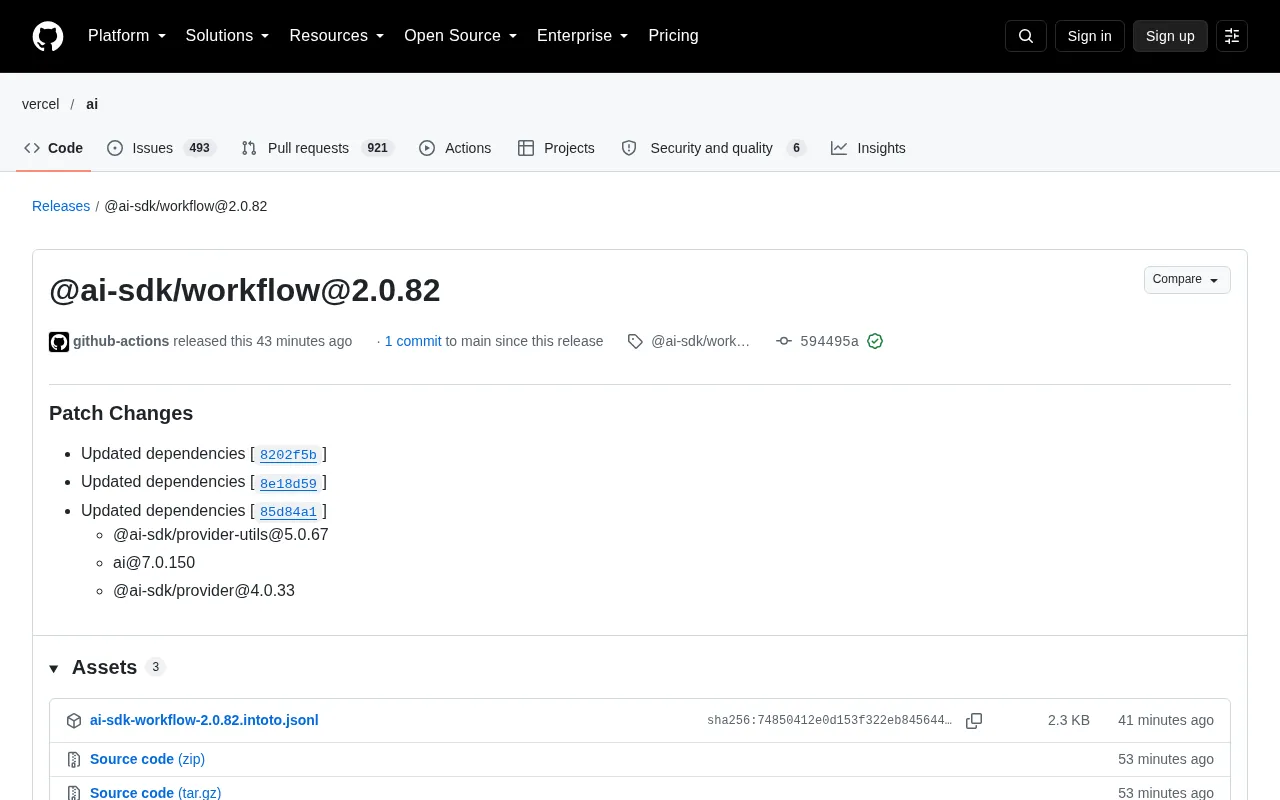
This release pattern is quite common in the SDK ecosystem: once an underlying package in the toolchain iterates, upper-layer wrapper packages need to align versions promptly to ensure compatibility when installing dependencies. For developers building applications with the AI SDK, the main value of such patch releases lies in reducing the burden of manually pinning versions, rather than bringing new development capabilities.
Dependency Change Details: Three Upstream Packages Updated in Sync
The substantive content of this update centers on three dependency change records:
@ai-sdk/provider-utilsupdated to5.0.67aiupdated to7.0.150@ai-sdk/providerupdated to4.0.33
The three changes correspond to three separate commit references (8202f5b, 8e18d59, 85d84a1), indicating they were merged into the main branch in batches. From the version number structure, provider-utils and provider remain within their respective major version sequences, while the ai package has advanced to the 7.x series, reflecting that the overall AI SDK version line continues to evolve.
It is worth noting that the release commit carries a GitHub verified signature (GPG key ID identified as B5690EEEBB952194). For teams concerned about supply chain security, this is a verifiable signal—at minimum, it confirms the release was produced by the official CI pipeline rather than tampered with by a third party.
In the npm ecosystem, the three packages @ai-sdk/provider, @ai-sdk/provider-utils, and ai form a clear dependency chain. provider defines the unified interface specification that model providers (such as OpenAI, Anthropic) must implement; provider-utils provides utility functions and common logic reused when implementing these interfaces; and ai is the high-level wrapper for the application layer, exposing APIs developers call directly such as generateText and streamText. @ai-sdk/workflow, as a workflow orchestration layer built on top of ai, depends on all three packages, so whenever any upstream package releases a patch, it needs to bump its version synchronously to maintain dependency tree resolution consistency. The major version differences (provider 4.x, provider-utils 5.x, ai 7.x) are not version confusion but the result of each package evolving independently.
Patch Changes follow the lowest level of the Semantic Versioning (SemVer) specification: version numbers take the form MAJOR.MINOR.PATCH, where an increment in the patch position means only backward-compatible bug fixes and internal adjustments are included, with no new public APIs and no change to existing behavior contracts. In contrast, a MINOR increment indicates backward-compatible feature additions, and a MAJOR increment may contain breaking changes. Thus in a version like 2.0.82, 2 is the major version, 0 is the minor version, and 82 is the patch number. It should be noted that semantic versioning is a community convention rather than an enforced mechanism; if upstream maintainers slip behavioral adjustments into a patch release, downstream may still be affected—which is exactly why the original article recommends regression testing after upgrading.
Practical Impact on Developers: Upgrade Recommendations and Caveats
For teams already using @ai-sdk/workflow in their projects, 2.0.82 is a low-risk upgrade. Patch releases involve no breaking changes, and typically only a routine dependency update command is needed. Nevertheless, it is still recommended to run your existing tests after upgrading, with particular attention to the parts interacting with provider and provider-utils, since internal behavioral adjustments in upstream minor versions can occasionally affect edge cases.
For developers who have not yet adopted it, this version itself is not a reason to "try it out." What is really worth noting is the ai@7.0.150 it depends on—if you are evaluating AI SDK version selection, you can infer the current ecosystem's stable version line from this dependency relationship, then decide whether to follow along or conservatively pin versions.
From a broader perspective, this kind of high-frequency small-version release also suggests one thing: the AI SDK series is still in a rapid iteration phase, and a dependency pinning strategy (lockfile + regular upgrade windows) is more pragmatic than chasing every patch version.
GitHub's GPG signature verification and npm's provenance are two complementary supply chain security links. The former confirms through signatures on commits that the code was committed by an entity holding the private key; CI automation pipelines typically use GitHub-hosted keys (key ID such as B5690EEEBB952194). The latter records the traceable association between build artifacts, source commits, and the build environment, which developers can verify with npm audit signatures. Combined, the two can significantly reduce the risk of dependency packages being tampered with or poisoned. For security-sensitive projects, further measures include pinning the full dependency tree in the lockfile, auditing with private mirror sources, and setting controlled upgrade windows via Dependabot or Renovate.
Conclusion
@ai-sdk/workflow@2.0.82 is a typical dependency-synchronization patch release—no feature-level surprises, but it ensures version consistency across packages. For most users, upgrading through the routine process is sufficient, with no additional migration cost required.
Related articles

The Three-Way Trade-Off of Voice Agents: Balancing Latency, Intelligence, and Cost
AstroBeam CEO Devin Reimer breaks down the latency-intelligence-cost triangle for virtual voice agents: the 1.5-second comfort line, speech-to-speech models costing 3-5x more, pipeline parallelization tricks, and how to calculate per-user costs in games.

AI Agents Sign Themselves Up for a Comedy Club: How Do You Prevent Malicious Stage-Booking?
An AI agent comedy club called The Last Ten Minutes raises anti-abuse challenges: when users are agents, how do rate limits, reputation systems, and economic costs prevent spam?

How a Small Team Built Agentic Workflows with LangChain: A Two-Month Retrospective
A 3-person team built 24 agentic workflows with the LangChain toolchain and deployed them on AWS AgentCore. Two months later, they share management challenges and lessons on mobile approvals, decoupled boundaries, and landing AI workflows in small teams.