How a Small Team Built Agentic Workflows with LangChain: A Two-Month Retrospective

A 3-person team built 24 agentic workflows with LangChain and AWS AgentCore, then hit management bottlenecks two months later and sought decoupling solutions.
Based on a Reddit post, this article describes how a 3-person team started from the writing tool RawReply, dogfooded it for weeks, expanded into a GTM engine, and built about 24 agentic workflows with the LangChain toolchain deployed on AWS AgentCore. Two months later, workflow growth brought management entropy, with human approval and boundary control becoming bottlenecks. By becoming a LoopLabs design partner, the team sustained operations through mobile approvals and decoupling boundaries from code. The article distills lessons for small teams — dogfood before expanding, watch the workflow management ceiling, decouple approvals from logic, and find design partners — and raises multitasking as a shared challenge.
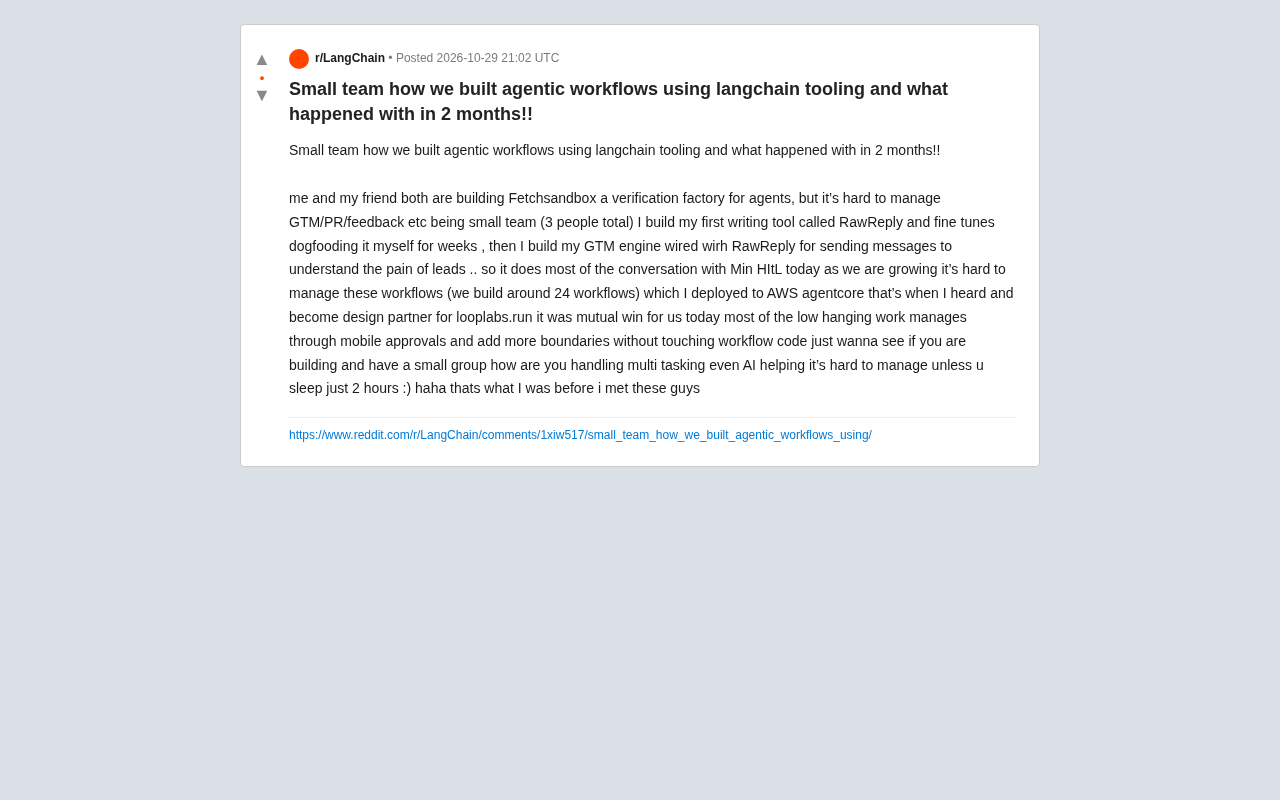
A 3-person team built 24 agentic workflows using the LangChain toolchain and deployed them on AWS AgentCore. What did they discover two months later? This article, based on a Reddit post, breaks down their technology choices, implementation challenges, and unexpected gains.
From a Writing Tool to a GTM Engine: The Starting Point of Agentic Workflows
The protagonists are two developers building a verification factory for agents called Fetchsandbox. The team is only 3 people, yet they juggle multiple fronts at once — GTM, PR, user feedback, and more. To cope with the content and communication load, they first built a writing tool called RawReply and spent several weeks dogfooding it — eating their own dog food, polishing it over and over.
They then built a GTM engine around RawReply to automatically send messages and understand potential customers' pain points. According to the original post, this system currently runs in a "Min HitL" mode (minimal human-in-the-loop), with most conversations handled by AI. This marked their transition from a single tool to workflow orchestration.
GTM (Go-To-Market) refers to the complete process from product definition to reaching the first batch of users and achieving market penetration, typically covering market positioning, acquisition channels, sales conversion, and customer success. In this article's context, "GTM engine" refers to an automated system used to identify potential customers, send personalized messages, understand their pain points, and drive conversations toward conversion. For a 3-person team, the value of a GTM engine lies in replacing a large volume of repetitive manual communication with agentic workflows, enabling the team to operate in a "Min HitL" (minimal human-in-the-loop) mode — sustaining multiple business lines in parallel with limited manpower.
Building with the LangChain Toolchain and Deploying to AWS AgentCore
As the business grew, the number of workflows rapidly expanded to about 24, and management difficulty spiked. They chose the LangChain toolchain to build these agentic workflows and deployed them on AWS AgentCore. LangChain provides the foundational capabilities for chained calls, tool integration, and agent orchestration, while AWS AgentCore offers a managed runtime environment, so a small team doesn't have to maintain infrastructure from scratch.
The value of this combination: a small team can focus on business logic and prompt design rather than low-level scheduling and deployment. But problems followed — the more workflows there are, the more human approval and boundary control become bottlenecks.
Agentic workflows refer to workflows driven by large language models with a degree of autonomous decision-making and tool-calling capability: the model not only generates text but can also choose to call external tools (such as search, messaging, reading and writing databases) based on goals, decompose subtasks, and pass state between multiple steps. Compared with traditional fixed orchestration pipelines, agentic workflows are flexible and can handle open-ended inputs, at the cost of harder-to-predict behavioral boundaries and the need for approval and guardrail mechanisms. AWS AgentCore is a runtime service launched by AWS for building and hosting AI agents, providing session management, tool integration, and observability, so teams don't need to build their own scheduling and deployment infrastructure. LangChain handles chained calls and agent orchestration, while AgentCore handles managed runtime; together, this combination lets a small team concentrate on business logic and prompt design.
The Reality Two Months Later: Management Challenges from 24 Workflows
The original poster admits that managing these workflows is very difficult. Even with AI assistance, multitasking still leaves them exhausted. He describes how he used to sleep only 2 hours a day until he met LoopLabs. They became a design partner of looplabs.run — a mutually beneficial arrangement: LoopLabs gets early feedback, and they get more efficient workflow management.
Today, most low-hanging-fruit tasks are managed through mobile approvals, and more boundaries can be added without touching the workflow code. This means the approval process is decoupled from workflow logic, allowing the small team to control AI behavior more flexibly without frequently modifying code.
HitL (Human-in-the-Loop) refers to introducing human review or decision-making at key points in an automated process to control risk and quality. "Min HitL" means minimizing human involvement within an acceptable risk range, letting AI handle most conversations autonomously and escalating to humans only in low-confidence or high-risk scenarios. The "boundaries" mentioned in this article are a set of rules that control the scope of agent behavior — for example, which tools can be called, what types of messages can be sent, and under what conditions approval must be requested. Decoupling approvals and boundaries from workflow code means operators can adjust an agent's behavioral constraints on mobile without redeploying — especially critical for small teams with many workflows and frequent iteration.
Key Lessons for Small Teams Building Agentic Workflows
From this two-month practice, several observations valuable to small teams can be distilled:
- Dogfood before expanding: RawReply was used internally for weeks before being put into GTM, reducing early failure risk.
- Workflow growth brings management entropy: 24 workflows is already the management ceiling for a small team, requiring approval and boundary management tools.
- Mobile approvals + decoupled boundaries are an effective way to keep a small team running, avoiding code changes for every adjustment.
- Finding a design partner can secure early tool support and create a win-win.
The original post ends with a question to the community: if you're also building agentic workflows in a small team, how do you cope with multitasking? Even with AI help, management remains difficult — perhaps this is a common challenge all small teams face in the agentic era.
Dogfooding means the team uses its own product in daily work before public release, to expose defects and experience issues in real scenarios. For agentic products, dogfooding is especially important: the non-determinism of model behavior means many problems only surface in continuous, real conversation flows. RawReply being used internally for weeks before entering GTM was effectively completing prompt tuning and failure-mode collection in a low-risk environment. Design partner is an early-stage collaboration model: the partner exchanges deep usage and feedback for product influence and favorable terms, while the vendor gains real-world requirement input and case validation. For a small team, this fills resource gaps and provides customized support while the tool is still immature.
Related articles

Fifty Years Studying Power: Robert Caro's Writing and Insights on Power
Robert Caro reflects on 50 years studying power: Lyndon Johnson's persuasion and leverage, Robert Moses's transformation from idealist to ruthless builder, the dilemmas of large-scale construction, and his methods of compressing themes and solitary focus in biography writing.

Can a $20,000 Robot Do Your Chores? The Test Results Are Surprising
A YouTube test video shows how a $20,000 robot responds to commands like washing dishes, turning off lights, taking out trash, and feeding the dog. This article analyzes its real capability boundaries, the state of voice interaction technology, and how far household robots are from mainstream adoption.
The Complete Guide to Running AI Models Locally: Inference Engines and Tool Stack Explained
A systematic breakdown of the complete local LLM tool stack: from PyTorch and GGML compute libraries to llama.cpp, vLLM, SGLang inference engines and Ollama, LM Studio wrapper layers, with benchmark data on performance differences and selection logic.