@ai-sdk/workflow-harness 1.0.140 Released: A Dependency Update Roundup

@ai-sdk/workflow-harness 1.0.140 ships as a routine patch with dependency sync updates and no source logic changes.
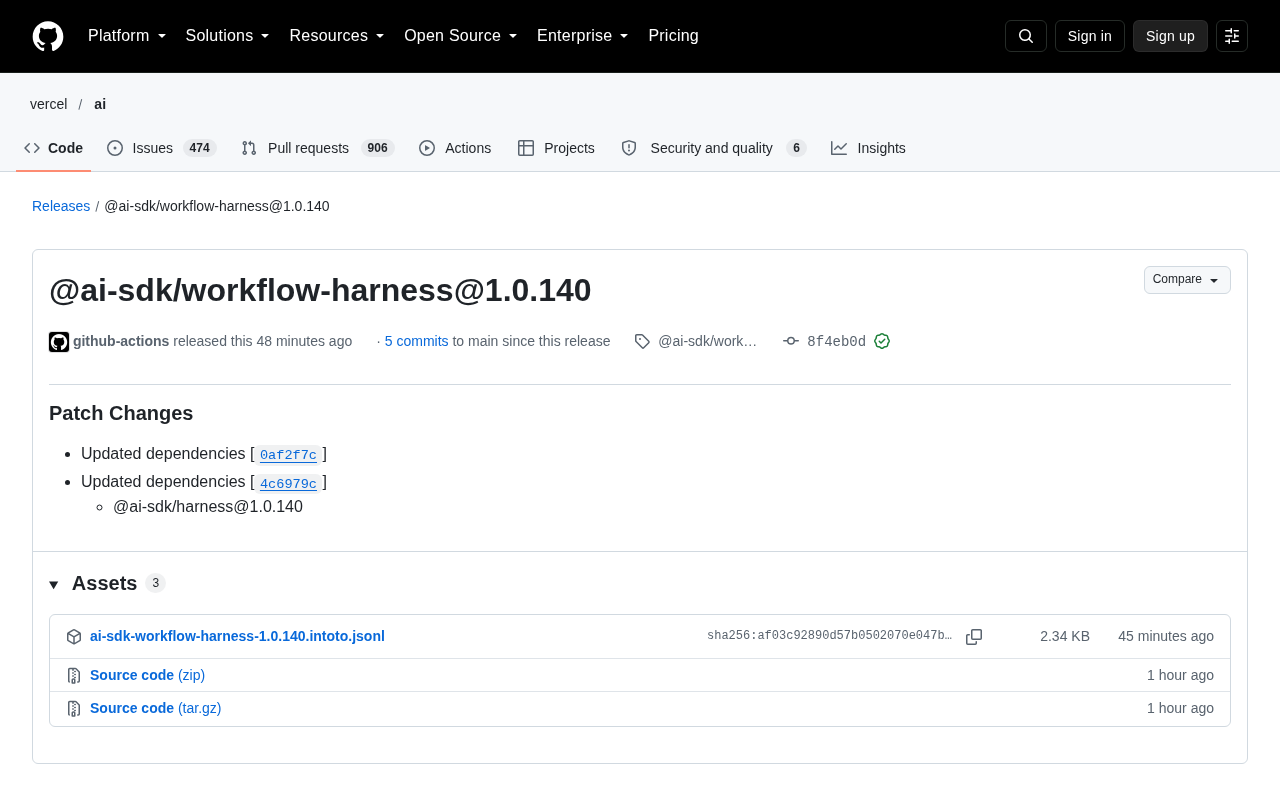
`@ai-sdk/workflow-harness@1.0.140` is a routine patch release with no source logic changes — the core updates are two dependency syncs (commits `0af2f7c` and `4c6979c`). It aligns with `@ai-sdk/harness@1.0.140`, reflecting the standard Changesets-driven cascading version bump pattern in monorepo projects. The package serves as an AI SDK workflow test harness — an internal infrastructure component for test pipelines rather than end-developer APIs. The release is GPG-verified via GitHub and carries low upgrade risk, making it suitable for routine dependency updates.
Version Overview
@ai-sdk/workflow-harness@1.0.140 is a patch release in the AI SDK toolchain, published recently via an automated GitHub Actions workflow. Based on the release record, this is a typical Patch-level update focused entirely on dependency synchronization rather than new feature additions.
This version was released alongside @ai-sdk/harness@1.0.140, aligning version numbers in a pattern commonly seen in monorepo projects where packages increment together. The release commit carries a GitHub Verified signature (GPG key ID: B5690EEEBB952194), ensuring the authenticity of the published artifact.
What Changed
According to the release notes, the core changes in 1.0.140 fall under Patch Changes, specifically two dependency updates:
- Updated dependencies (commit
0af2f7c) - Updated dependencies (commit
4c6979c)
This means the source logic of workflow-harness itself was most likely untouched. The version bump was passively triggered by upgrades to upstream packages it depends on (such as @ai-sdk/harness). This is standard behavior in projects using automated version management tools like Changesets: when a lower-level package is updated, packages that depend on it automatically receive a new patch version to stay consistent.
For end users, this kind of update is generally safe and worth tracking — it typically carries upstream bug fixes or compatibility adjustments without introducing any breaking changes.
Changesets is a popular monorepo versioning tool, open-sourced by Atlassian and adopted by many large JavaScript projects (such as Remix and Svelte). Its core mechanism works as follows: when developers submit code, they also write a "changeset file" describing the type of change (major/minor/patch) and its content. At release time, CI automatically reads these files, aggregates them into a changelog, and calculates the correct version bump for each package according to Semantic Versioning (SemVer) rules. When a lower-level package in the dependency chain receives a patch update, Changesets' "bump" mechanism cascades through all packages that directly or indirectly depend on it — even if those packages have no code changes of their own, they still receive a new patch version number. This mechanism ensures that the dependency ranges across all packages in a monorepo always correspond to real published versions, preventing situations where internal dependencies point to unreleased code.
What Is workflow-harness?
From its name, workflow-harness is an auxiliary module in the AI SDK ecosystem designed for workflow testing and scaffolding (harness). In software development, a "harness" typically refers to a framework built to run, test, or drive a piece of logic — providing the surrounding environment needed for execution. Combined with "workflow," this package is likely used to orchestrate and validate AI SDK-based workflows.
It is tightly coupled with @ai-sdk/harness, and the two are released in sync, indicating they are paired infrastructure components within the broader toolchain — not core APIs intended for direct use by end developers.
Test Harness is a classic concept in software engineering, referring to an auxiliary framework that provides a runtime environment, input simulation, and output capture capabilities for the code under test. In AI application contexts, a workflow harness typically handles: simulating LLM calls and responses, driving multi-step workflow execution in a predefined sequence, capturing intermediate state for assertion verification, and enabling integration testing without relying on real API keys or network connectivity. Unlike unit testing frameworks (such as Jest or Vitest), a harness is more focused on end-to-end process orchestration. It serves as a critical piece of infrastructure for ensuring the correctness of workflow logic in an AI SDK. Developers generally don't import such packages directly into business code — instead, they're used within CI test pipelines or the SDK's own internal test suites.
Upgrade Recommendations
For teams using AI SDK-related tooling, here's a practical approach to handling patch releases like this:
- Stay current: Patch versions typically contain only fixes and dependency syncs, making upgrades low-risk. It's worth incorporating them into your regular dependency update workflow.
- Trace upstream changes: The actual changes come from the dependency packages referenced by commits
0af2f7cand4c6979c. If you need to understand the specifics, trace back to the changelogs for those commits. - Validate your build: Even for patch updates, it's good practice to run your test suite in CI to confirm the dependency upgrade hasn't introduced any unexpected behavior.
Summary
Overall, @ai-sdk/workflow-harness@1.0.140 is a routine maintenance release that reflects the versioning discipline and automation maturity of a well-managed SDK project. There are no headline new features, but consistent and timely dependency synchronization is exactly the kind of steady work that keeps a healthy open-source toolchain moving forward.
Related articles

Python 3.15 New Feature: Is the sentinel Type Better Than None?
Python 3.15 adds the sentinel type, using named unique sentinel objects to replace None and bare object(), resolving confusion among missing values, explicit emptiness, and invalid input while avoiding type hint failures.

Deep Learning's Three Architectures and the Universal Approximation Theorem: A Complete Guide to MLPs, CNNs, and Transformers
Explaining the inductive bias differences among MLP, CNN, and Transformer, the existence meaning of the Universal Approximation Theorem (UAT), and the role of Taylor expansion in approximation analysis, while clearing up common misconceptions.

GitLab Emergency Patch Release: Analysis of Critical Security Fixes
GitLab releases critical patch 19.5.1, sparking 355 points of discussion on Hacker News. This article analyzes the background, upgrade steps for self-hosted instances, and verification points to help DevOps teams respond quickly to security updates.