@ai-sdk/workflow-harness 1.0.150 Patch Release: Batch Dependency Chain Update

@ai-sdk/workflow-harness releases 1.0.150, a pure dependency sync patch best followed automatically.
@ai-sdk/workflow-harness released patch version 1.0.150, automatically pushed by the GitHub Actions bot and containing only one GPG-signed commit. It adds no features or breaking changes, focusing on refreshing five dependency commits and syncing @ai-sdk/harness@1.0.150. Such pure dependency updates matter in the modular AI SDK toolchain, since dependency versions determine the actual underlying implementation. Use Dependabot or Renovate to follow updates and keep E2E tests in CI.
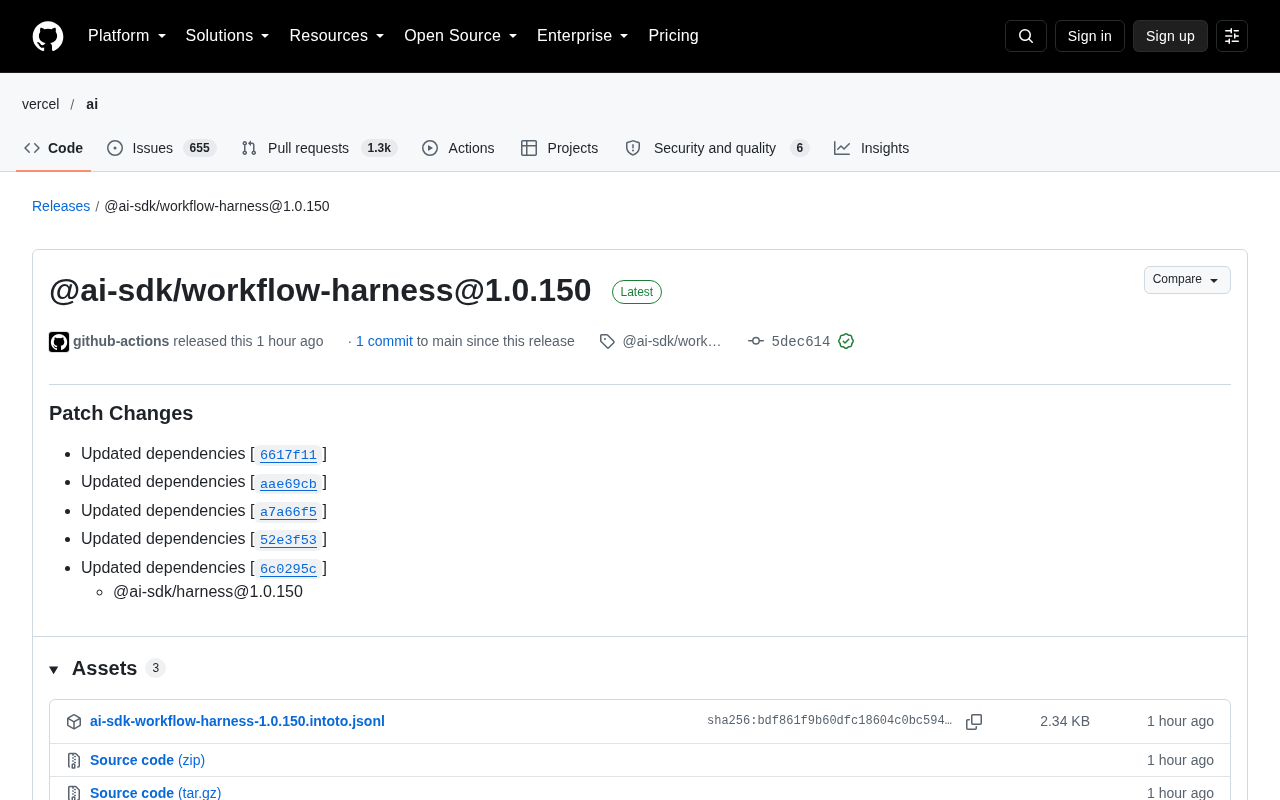
@ai-sdk/workflow-harness, an automated workflow component package in the AI SDK ecosystem, has released version 1.0.150. This update was completed and pushed automatically by GitHub Actions and is a typical patch-level change, focused on cascading updates across multiple upstream dependencies rather than introducing new features or breaking changes.
What This Update Changed
Looking at the released commit record, 1.0.150 contains only a single commit (commit 5dec614), pushed by the github-actions bot to the main branch on October 13 at 16:12, and carries a GitHub verified signature (GPG key ID B5690EEEBB952194), indicating the source is trusted and the process is traceable.
The changelog lists five consecutive Updated dependencies entries, corresponding to dependency commits 6617f11, aae69cb, a7a66f5, 52e3f53, and 6c0295c, and finally brings in @ai-sdk/harness@1.0.150 at the same version number. This pattern of "refreshing dependencies in a single batch of commits" usually means multiple upstream packages released new versions within the same time window, and the downstream harness unified them through a machine-driven process.
Why This Kind of "Pure Dependency Update" Deserves Attention
For ordinary developers, a patch release containing only dependency changes may seem trivial, but in a highly modular toolchain like the AI SDK, it is often more worth noting than new features.
workflow-harness, as the name suggests, is a build layer responsible for "workflow orchestration/testing." It barely encapsulates any specific model capabilities; instead, it combines the capabilities of underlying packages such as @ai-sdk/harness into runnable workflows. Therefore, its dependency versions directly determine which version of the underlying implementation you actually hit when running workflows locally.
A patch version absorbing five dependency commits in a row indicates that the underlying layer is being rapidly iterated. If your project locks an older version of workflow-harness, you might mistakenly attribute differences in workflow behavior to your own configuration, when the real cause is that upstream and downstream protocols have drifted slightly.
What Is Semantic Versioning (SemVer)
Semantic versioning stipulates that version numbers take the form MAJOR.MINOR.PATCH: a major version change means incompatible API changes, a minor version corresponds to backward-compatible new features, and a patch number is used for backward-compatible bug fixes. Under this convention, the patch position should theoretically not introduce any behavior changes. But in dependency-driven packages, the patch number is often used as a vehicle for "syncing upstream" — the package's own source code is untouched, and only its internal dependency pointers are pointed to newer versions. At this point, the patch number no longer strictly corresponds to a "fix" but to "following." Understanding this is the only way to explain why a pure dependency patch can still indirectly change runtime behavior: the code that actually changes is hidden in the dependency tree, not in the package itself.
Signals from Automated Releases
This release was triggered by github-actions and comes with a verified signature, which is the standard practice in mainstream open-source repositories today. It conveys two messages:
First, the project's dependency upgrades have been proceduralized, no longer relying on manual merge-by-merge work, allowing faster responses to upstream changes. Second, the release cadence is machine-driven, meaning version numbers will increment relatively frequently, and the patch position in semantic versioning corresponds more to "sync" than to "fix."
For consumers, such packages are better followed with automated tools (such as Dependabot or Renovate) rather than manually comparing changelogs one by one. The returns from manual auditing are limited — most changes occur deep in the dependency tree, and the changelog only lists commit numbers.
GPG Verified Signatures and a Trusted Release Chain
The verified mark on the commit comes from a GPG signature (here the key ID is B5690EEEBB952194). It uses a private key to generate a signature for the commit contents, and GitHub uses the public key to verify its integrity and origin. For automated releases, the signature turns "some CI machine produced this commit at some point in time" into a verifiable cryptographic fact, rather than an ordinary entry in platform logs. This makes the dependency refresh process auditable: anyone can confirm that this version was indeed generated by a trusted process and that the contents were not tampered with in transit. Against the backdrop of frequent supply chain attacks, signature mechanisms are the precondition for trusting automated releases and the foundation that enables downstream tools (such as Dependabot) to merge such updates without human intervention.
Upgrade Recommendations
If your project directly depends on @ai-sdk/workflow-harness, it is recommended to include it in automated updates and retain end-to-end workflow tests in CI so that behavioral differences can be discovered immediately after a dependency refresh. If the project has high stability requirements and tends to lock versions, then before upgrading you should compare the same-version notes for @ai-sdk/harness to confirm there are no behavioral changes in the underlying layer.
Overall, 1.0.150 is a routine dependency sync patch with no API-level signals. Its value lies not in itself, but in reminding us that iteration of AI SDK tooling is advancing in a pipeline fashion, and subscribing to updates is less effort than tracking them manually.
One-line Summary
@ai-sdk/workflow-harness released 1.0.150, a pure dependency sync patch, recommended to follow automatically.
Paragraph Summary
@ai-sdk/workflow-harness released patch version 1.0.150, automatically pushed by the GitHub Actions bot and containing only one commit with a GPG verified signature. This update adds no new features or breaking changes; its core is a concentrated refresh of five dependency commits, along with the same-version @ai-sdk/harness@1.0.150. The article notes that such pure dependency updates are actually worth attention in a highly modular AI SDK toolchain: workflow-harness handles workflow orchestration, and its dependency versions directly determine the underlying implementation actually hit locally, while rapid underlying iteration causes slight protocol drift. Automated releases mean version numbers will increment frequently, and the patch position corresponds more to "sync" than to "fix." Users are advised to follow updates automatically with tools such as Dependabot and Renovate, and to retain end-to-end tests in CI to detect behavioral differences early.
Related articles

Chain of Thought Isn't Just for AI: How Humans Can Use CoT to Improve Thinking Quality
Chain of Thought isn't just a prompt trick for large models. Starting from a Hacker News discussion, this article analyzes why CoT works for human thinking too, breaks down actionable ways to transfer it, and highlights the key differences between human CoT and machine CoT.
Cloudflare Teams Up with OpenAI: Closi…
Cloudflare Teams Up with OpenAI: Closing the Loop from Vulnerability Discovery to Defense with AI
Cloudflare uses OpenAI Daybreak to investigate security vulnerabilities and generate reviewable remediation plans, while developers use Codex to boost coding efficiency and quality.

Orca Multi-Agent Orchestration in Practice: A Guide to Parallel Collaboration with Claude and Codex
Orca is Stable AI's free open-source agent workbench supporting 34 agents like Claude Code and Codex in parallel. Learn its Git worktree isolation, multi-model orchestration, and mobile management.