AI SDK workflow-harness 1.0.151 Release Update Explained
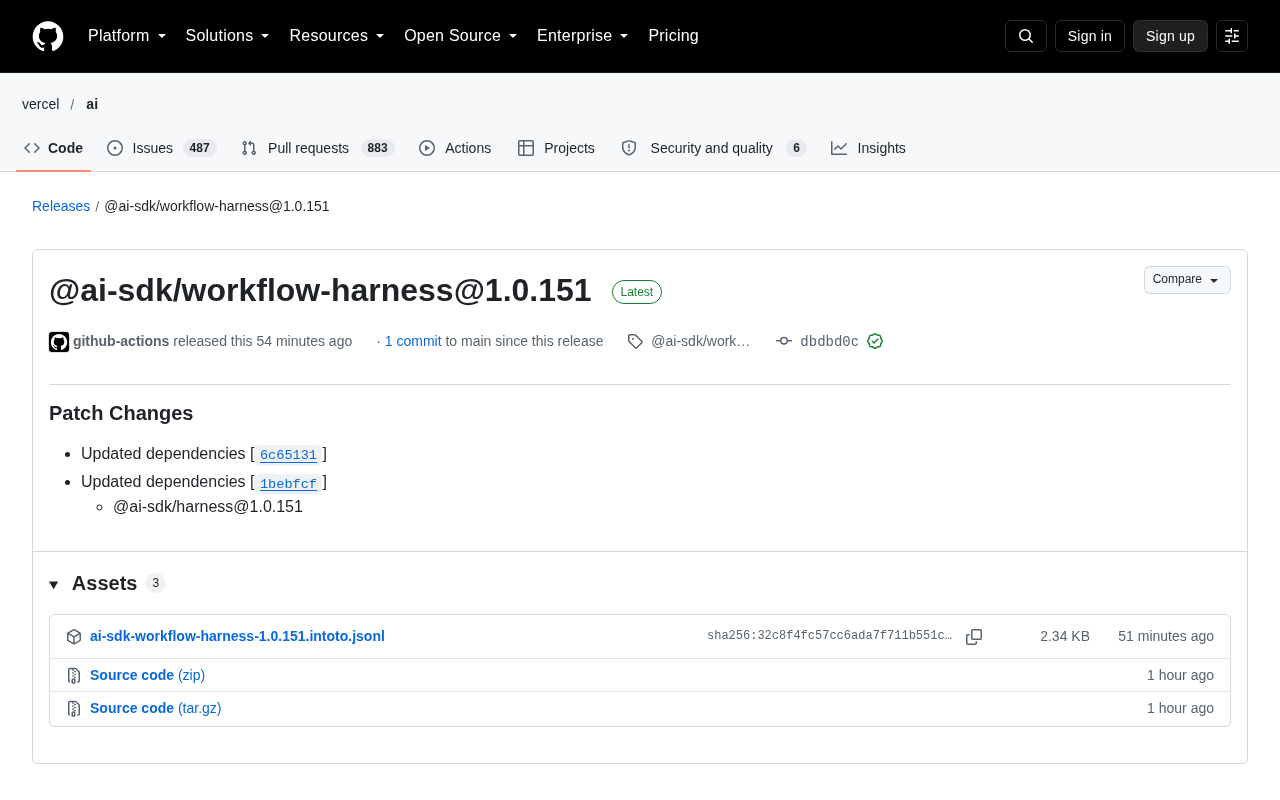
@ai-sdk/workflow-harness 1.0.151 is a patch release containing only dependency changes and version alignment.
The article explains the release of @ai-sdk/workflow-harness 1.0.151. This version is a patch-level update in semantic versioning, with just one commit, changes focused on dependency updates (commits 6c65131 and 1bebfcf), and no new features. Meanwhile, @ai-sdk/harness is upgraded in sync to 1.0.151, keeping the two packages version-aligned, indicating no breaking changes to the public API. The article notes: dependency-level updates can still introduce subtle behavioral differences through the underlying model adaptation layer, retry, and streaming parsing logic; whether to upgrade also depends on lockfile and auto-update strategies. Production environments are advised to validate workflow orchestration and tool-call chains in a small canary first, prioritize specific dependency commits when troubleshooting, and use tools like Dependabot and Renovate for more reliable alerts than the Release page.
A Seemingly "Boring" Patch Release
The @ai-sdk/workflow-harness package in the AI SDK ecosystem has quietly shipped version 1.0.151. From the GitHub Release page, this looks like a typical patch update: just one commit (dbdbd0c), tagged as the latest version, with changes focused entirely on dependency updates.
For developers used to chasing "major version features," this kind of release is easy to overlook. But if you're using workflow-harness to build agents or automation pipelines, understanding the cadence behind version numbers can help you decide whether to upgrade in production.
What Actually Changed in This Update
According to the release notes, 1.0.151 is straightforward, falling into two categories:
- Patch Changes: Patch-level changes in semantic versioning, typically without breaking changes.
- Updated dependencies: Two dependency updates, corresponding to commits
6c65131and1bebfcf.
Meanwhile, @ai-sdk/harness@1.0.151 was updated in sync, indicating that both packages maintain version alignment at this release. This "main package + harness base package" synchronized release strategy is common in the AI SDK family of libraries.
You might not have noticed: the Release page itself uses screenshots for display, and some resources (Assets, Filter, etc.) failed to load. This doesn't affect the accuracy of the version information itself, but it does remind us that GitHub Releases pages can render incompletely when scripts are blocked or network access is restricted. It's best to cross-verify key information from commit records and CHANGELOGs.
Semantic Versioning (SemVer) is the MAJOR.MINOR.PATCH three-part numbering convention: MAJOR indicates incompatible breaking changes, MINOR indicates backward-compatible new features, and PATCH indicates backward-compatible bug fixes. So in 1.0.151, going from 1.0.150 to 1.0.151 is a patch-level change and by convention should not introduce new public interfaces or breaking changes. However, note that SemVer only constrains the "public API," while dependency updates can indirectly change runtime behavior—if an updated transitive dependency fixes a bug or adjusts a default value, the effect perceived by the consumer can amount to a feature change. This is why judging upgrade risk by version number alone is unreliable; you still need to cross-check with the CHANGELOG and specific commits.
Dependency alignment refers to multiple interdependent packages in a monorepo being released synchronously at the same version number. Organizations like AI SDK typically use tools like changesets or lerna to manage versions uniformly. When both @ai-sdk/workflow-harness and @ai-sdk/harness are tagged as 1.0.151, it means the two have been jointly tested at this version and their mutually referenced API contracts are consistent. The benefit of this strategy is avoiding version drift like "package A uses the new interface while package B still uses the old one"; the cost is that if any single package changes, the entire group gets bumped, so version numbers grow quickly and the number itself doesn't directly reflect the magnitude of functionality.
Transitive dependency is a package you didn't declare directly but that is depended upon by your direct dependency. For example, your project depends on workflow-harness, and workflow-harness depends on some underlying HTTP or streaming parsing library—that latter one is a transitive dependency. Behavioral changes in such dependencies won't appear in your package.json, yet they can manifest at runtime. The lockfile pins the resolution of the entire dependency tree, so whether transitive dependencies auto-upgrade depends on your package manager and upgrade strategy.
Why "Just a Dependency Update" Still Matters
Many teams treat patch versions as "no-brainer upgrades," but dependency-level updates are precisely where behavior changes can creep in—especially for AI-related SDKs:
- The underlying model adaptation layer may have been adjusted: If the updated dependencies involve request parameters, retry logic, or streaming parsing, actual runtime results will differ subtly.
- Version alignment means the API surface is stable:
workflow-harnessandharnessshare the same version number, indicating no new public interfaces were introduced in this version, and upgrade risk mainly comes from transitive dependencies. - Lockfile strategy determines the scope of impact: If you use a pnpm/npm lockfile without automatic updates enabled, this patch won't enter your project unless you manually run an upgrade command.
In other words, 1.0.151 is more of an "ecosystem sync" than a "feature delivery." It ensures consistency of the dependency tree and prevents version drift for projects using the latest harness base package.
Lockfile refers to pnpm's pnpm-lock.yaml, npm's package-lock.json, or Yarn's yarn.lock, which records the exact version and resolution address (integrity hash) of every package in the dependency tree. Its purpose is to solidify range declarations like "^1.0.0" into deterministic outcomes like "actually install 1.0.151," ensuring the same dependency tree across different machines and times. Therefore, unless you explicitly run an upgrade command (like pnpm update) or use Dependabot/Renovate to auto-create PRs, new patches published upstream won't automatically enter your project. Conversely, if your CI/CD uses --no-frozen-lockfile or ignores the lockfile, you might inadvertently pull in new versions—which is exactly why "a tiny dependency change" still deserves attention.
Dependabot and Renovate are common automated dependency update tools. They monitor release events in upstream repositories, automatically create upgrade PRs, and attach changelogs, release notes, and potentially affected dependency chains. Compared to manually browsing GitHub Release pages, these tools have the advantage of identifying which updates relate to your project's direct dependencies, flagging whether they are security updates, and running tests in CI before merging. For patch versions that only update dependencies, treating tool alerts as your first-hand signal is more reliable than relying on Release page screenshots.
Practical Advice for Users
If your project depends on @ai-sdk/workflow-harness, here's how to approach it:
- Production: Validate in a small-scale or canary environment first, focusing on whether workflow orchestration and tool-call chains show anomalies.
- Development: You can upgrade directly to 1.0.151 to stay aligned with the upstream ecosystem and make issues easier to reproduce.
- When troubleshooting: Prioritize examining the specifics of the two dependency commits
6c65131and1bebfcf—they are the real source of behavioral differences.
Also, since this update doesn't include detailed change descriptions, automated dependency tools (like Dependabot, Renovate) provide more informative alerts than the Release page.
Summary: Patch Versions Are Signals, Not Noise
@ai-sdk/workflow-harness@1.0.151 doesn't bring new features by itself, but it reflects one aspect of the AI SDK team's maintenance rhythm—frequent, small-step, dependency-driven. For applications built on AI SDK, tracking these versions isn't about "what you can do after upgrading" but about "whether not upgrading means stepping into bugs that have already been fixed." Staying version-aligned matters more than chasing version numbers.
Related articles

MCP Security Primer: OWASP Top 10 Risks and the Lethal Trifecta Defense
A systematic breakdown of MCP security risks: from the Postmark backdoor to the OWASP MCP Top 10, how the Lethal Trifecta reveals AI Agent fragility, plus shadow servers and missing audits.

DeepCell: One-Click AI Generation of Documents, Spreadsheets, and Slides
DeepCell tops Product Hunt with one-click generation of documents, spreadsheets, and slides, using the .deepcell format for linked updates, designed for System 2 tasks like modeling and sales reviews.

Doneas: 15-Minute Daily Accountability Calls That Keep Indie Developers From Procrastinating
Doneas is a daily accountability tool for indie developers: plan tasks on Monday, join a 15-minute call with five builders each day, and log deliveries on a public progress page. This article analyzes its core mechanics, effectiveness, and potential issues around retention and matching.