@ai-sdk/workflow-harness 1.0.153 Patch Released, AI SDK Workflow Orchestration Toolchain Iterates Again

@ai-sdk/workflow-harness releases patch 1.0.153, reflecting continuous maintenance and supply chain security practices for AI workflow testing tools.
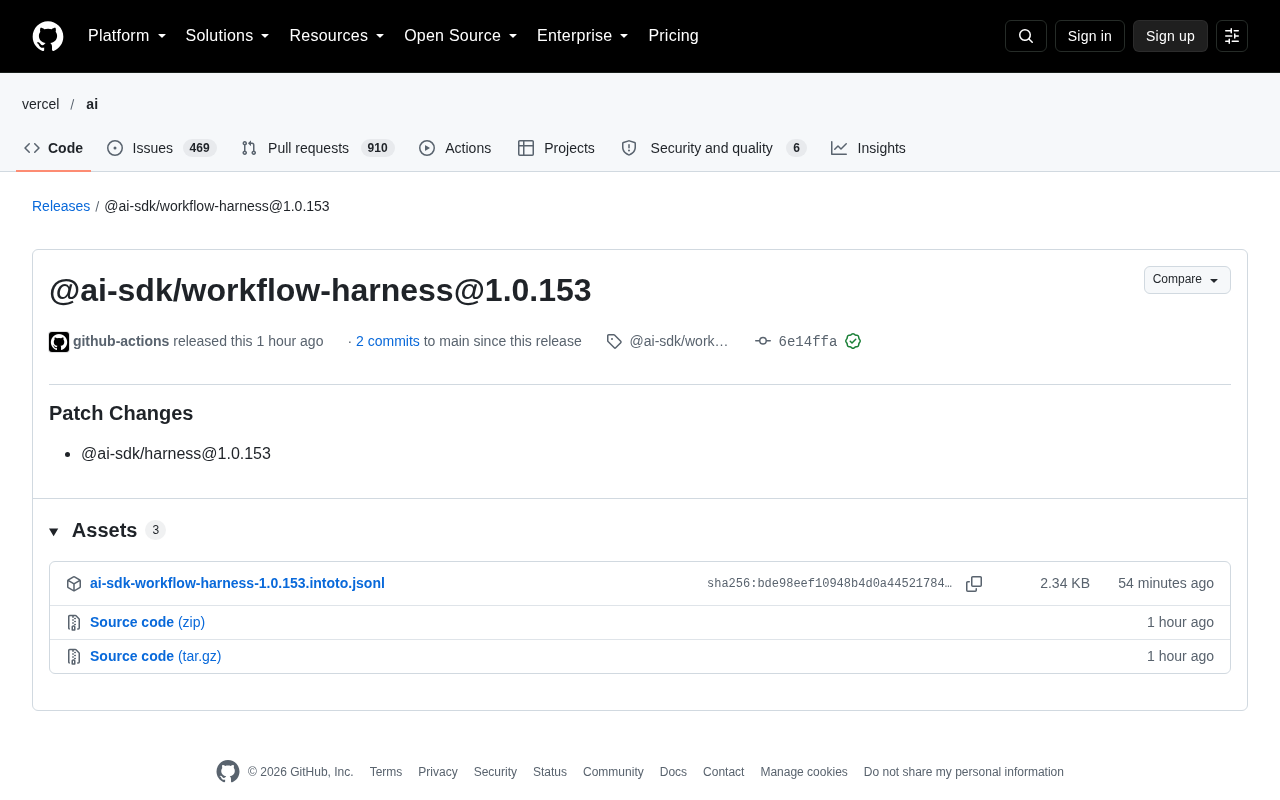
@ai-sdk/workflow-harness released patch version 1.0.153 on GitHub, automatically published by github-actions with a GPG verified signature and containing 2 commits. Based on the package name and AI SDK ecosystem conventions, the article infers that this package may be a harness tool for AI workflow orchestration and testing, used to mock model responses and verify control flow locally or in CI. The 1.0.x series has accumulated 153 patches, reflecting a high-frequency, continuous maintenance rhythm and short bug-fix cycles; under SemVer rules, patch upgrades do not introduce breaking changes, so downstream upgrade costs are low. Because the release page's Assets and comparison view failed to load, the specific diff could not be viewed, and the official repository commit records should be taken as authoritative.
A Seemingly Routine Version Bump
On GitHub, @ai-sdk/workflow-harness released version 1.0.153. The release page shows this is a Patch Changes update, automatically published by the github-actions bot, with the commit carrying a verified GPG signature and containing 2 commits in total.
For developers who have long tracked the AI SDK ecosystem, this kind of patch release is business as usual. But behind the version number, there are often important signals about the maturity of the toolchain.
About the Positioning of @ai-sdk/workflow-harness
Breaking down the package name, @ai-sdk is the scope and workflow-harness is the package name. Given the consistent naming conventions in the AI SDK ecosystem, this package is most likely an auxiliary tool centered on AI workflow orchestration and testing, used to simulate, drive, or verify workflows defined in the AI SDK during development.
The term Harness (test fixture) in software engineering typically refers to an encapsulation layer that provides a stable runtime environment for the object under test. In the AI SDK context, workflow-harness may serve one or more of the following roles:
- Provide local execution or replay capabilities for AI workflows
- Inject mock model responses in CI to avoid real API calls
- Standardize workflow inputs and outputs for easier assertions and snapshot testing
It should be noted that the above is reasonable inference based on the package name and ecosystem conventions. Since the original release page only contains version change information, the public documentation details of @ai-sdk/workflow-harness are still awaiting further official disclosure.
Harness (test fixture) is a mature testing pattern in software engineering, with its core idea originating from the fixture concept in the xUnit testing framework family. A harness typically handles three things: establishing the runtime environment required by the component under test (such as a temporary database or mock service), injecting controlled inputs into the object under test, and collecting and exposing assertable outputs. In traditional backend testing, harnesses are commonly found in integration testing and contract testing scenarios; in AI application development, however, because model calls are non-deterministic, costly, and high-latency, the value of harnesses is further amplified — they need to replace real models locally or in CI, providing repeatable, replayable deterministic responses so that developers can test LLM-driven control flow just like testing ordinary functions.
SemVer (Semantic Versioning) is the key premise that appears repeatedly in this release. Its rules are MAJOR.MINOR.PATCH: a major version change represents incompatible API modifications, a minor version represents backward-compatible feature additions, and a patch number contains only backward-compatible bug fixes. Therefore, seeing a change like 1.0.152 → 1.0.153 allows one to directly infer that upgrading will not bring breaking changes. The significance of SemVer lies in turning "can this version be safely upgraded" from a subjective judgment into a mechanically reasoned rule, and it is also the cornerstone of automatic upgrade strategies for dependency management tools in the npm ecosystem (such as Dependabot and Renovate).
Why Patch Releases Are Worth Watching
A package iterating from 1.0.0 to 1.0.153 means 153 accumulated patches. This density itself conveys information.
High-frequency patch releases usually indicate several things: active project maintenance, continuous absorption of user feedback, and short response cycles for bug fixes. For downstream projects that depend on this package, sticky maintenance is more valuable than major version jumps — it reduces the decision cost of upgrading, so you don't have to deal with breaking changes every time.
This release carries a GPG verified signature, which also shows that the release process has been integrated with supply chain security verification. For AI infrastructure packages, this is becoming increasingly important, because they may involve sensitive areas such as API key management and model routing.
GPG verified signatures are marks displayed by GitHub after cryptographically verifying a commit or tag. Developers sign locally with a private key when committing, and GitHub uses their public key to verify the signature's validity, thereby confirming that the commit indeed comes from the claimed author and that the contents have not been tampered with. In the npm publishing context, in addition to commit signatures, there is also the npm provenance mechanism, which can bind the published package to its source repository and build pipeline. For AI infrastructure packages, the consequences of supply chain attacks may include theft of API keys and injection of malicious model routing, so signature verification is becoming one of the mandatory checks for enterprise-level dependency admission.
Iteration Rhythm Seen from 2 Commits
The 2 commits in this release come from the github-actions automated publishing process. This suggests that the project's CI/CD has already automated everything from code merge to npm publish.
The benefit of automated publishing is that once a fix is merged into the main branch, the version number can advance, and downstream consumers can get the fix faster. For teams that rely on workflow-harness for integration testing in CI, getting patches quickly also means build stability can be restored sooner.
However, the Assets section and comparison view on the original page showed loading errors and failed to display the specific diff contents. This is a common rendering issue on GitHub release pages and does not mean there is a problem with the release itself.
CI/CD automated publishing means that after code is merged into the main branch, the pipeline automatically completes version number advancement (usually with tools such as changesets or semantic-release), generates a changelog, tags the release, and publishes it to npm. The publisher shown on this page, github-actions, is a typical hallmark of this model. The difference between automated and manual publishing is not just efficiency: it turns "releasing a version" from a one-off manual operation into an auditable, reproducible event, reduces the risk of missing or mislabeling version numbers, and also allows downstream dependency update bots to track new versions more promptly.
What This Means for AI SDK Users
If you are using the AI SDK to build applications and your workflow involves multi-step calls, conditional branches, or tool calls, then a stable and testable workflow harness is a companion tool worth watching. It allows you to verify the correctness of control flow locally and in CI without relying on real models.
Although this patch update is small, according to SemVer rules, patch versions do not introduce breaking changes, so you can upgrade with confidence. It is recommended to pay attention to the specific fixes in the release notes. If they are relevant to your current use case, update promptly; if not, you can upgrade opportunistically following the strategy of your dependency management tool.
Key Takeaways
@ai-sdk/workflow-harnessreleased patch version 1.0.153, automatically published by GitHub Actions, containing 2 commits- The release carries a GPG verified signature, reflecting supply chain security practices
- The package name points to an AI workflow test fixture scenario, used for workflow verification locally or in CI
- 153 patch iterations reflect a continuous maintenance rhythm, and patch upgrades carry no breaking change risk
- Specific change details could not be viewed due to a page loading error; refer to the official repository commit records for accuracy
Related articles

Chain of Thought Isn't Just for AI: How Humans Can Use CoT to Improve Thinking Quality
Chain of Thought isn't just a prompt trick for large models. Starting from a Hacker News discussion, this article analyzes why CoT works for human thinking too, breaks down actionable ways to transfer it, and highlights the key differences between human CoT and machine CoT.
Cloudflare Teams Up with OpenAI: Closi…
Cloudflare Teams Up with OpenAI: Closing the Loop from Vulnerability Discovery to Defense with AI
Cloudflare uses OpenAI Daybreak to investigate security vulnerabilities and generate reviewable remediation plans, while developers use Codex to boost coding efficiency and quality.

Orca Multi-Agent Orchestration in Practice: A Guide to Parallel Collaboration with Claude and Codex
Orca is Stable AI's free open-source agent workbench supporting 34 agents like Claude Code and Codex in parallel. Learn its Git worktree isolation, multi-model orchestration, and mobile management.