AI SDK workflow-harness 1.0.157 Patch Release Explained

@ai-sdk/workflow-harness releases patch 1.0.157, syncing the upstream harness dependency version.
This article covers the release of @ai-sdk/workflow-harness 1.0.157, a typical patch update whose only change is syncing the upstream dependency @ai-sdk/harness to 1.0.157, published automatically by github-actions with a GPG signature. It explains how version alignment reduces the risk of dependency drift, API behavior differences, type mismatches, and runtime errors, and notes that upgrading is low-risk for existing users while not being a migration reason for newcomers. It also analyzes the release cadence as a sign of normalized dependency governance and mature release engineering.
The @ai-sdk/workflow-harness package in the AI SDK ecosystem has released version 1.0.157. Judging from the GitHub Release page, this is a typical patch update whose core change is synchronizing the version of the upstream dependency @ai-sdk/harness. For developers building workflow applications with the Vercel AI SDK, small releases like this are often easy to overlook, but they reflect the ongoing convergence of the toolchain and the maintenance rhythm around dependency consistency.
What the Release Actually Contains
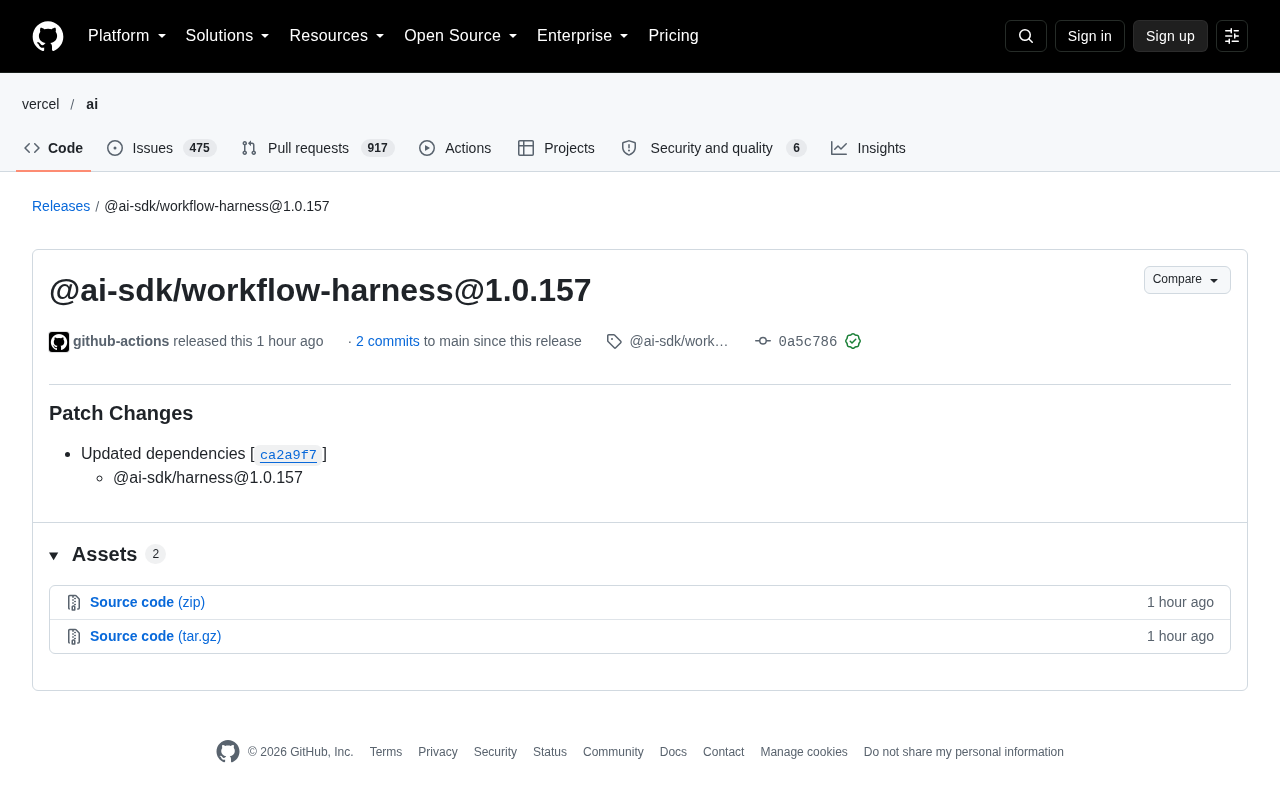
According to the Release notes, version 1.0.157 contains only one Patch Changes entry: updating the dependency @ai-sdk/harness to 1.0.157. The commit history shows this iteration involves 2 commits, published automatically by github-actions and carrying a GitHub-verified signature (GPG key ID: B5690EEEBB952194).
This release pattern indicates that the package uses an automated pipeline for version management: dependency changes trigger builds, and CI handles publishing and signing. For downstream users, the most direct effect is that the version numbers of the workflow-harness and harness packages stay aligned, reducing the risk of runtime inconsistencies caused by dependency version drift.
Why Dependency Alignment Matters
In a fast-evolving toolchain like the AI SDK, harness typically provides foundational capabilities such as workflow execution, task orchestration, or test mounting, while workflow-harness is the workflow layer built on top of it. When the two versions fall out of sync, you can run into API behavior differences, mismatched type definitions, or runtime errors. Locking the dependency to the same version number is a simple but effective engineering constraint.
Semantic Versioning (SemVer) is the key convention implicitly at play in this update. SemVer splits a version number into three parts: MAJOR.MINOR.PATCH. A major version change indicates incompatible API modifications, a minor version indicates backward-compatible feature additions, and a patch version indicates backward-compatible bug fixes. Under this specification, 1.0.157 is a patch release and should not, in theory, introduce breaking changes. In practice, though, whether a dependency truly follows SemVer depends on how strictly maintainers enforce it—especially in fast-iterating AI toolchains, where "patch versions" can occasionally carry behavioral adjustments. So when upgrading, don't rely on the version number alone; combine the Release notes with regression testing to judge compatibility.
Dependency drift refers to the situation where, because of missing lockfiles, overly broad version ranges, or transitive dependency updates, the package versions actually resolved during installation differ from what was expected. In monorepos or multi-package setups, if harness and workflow-harness fall out of step, you can get mismatches between type declarations and actual implementations, differences in runtime entry points, and similar problems. Locking both to the same version number essentially makes the implicit version relationship explicit, reducing these risks.
GitHub Actions is GitHub's CI/CD automation platform, where workflow files define tasks like building, testing, and publishing. The github-actions publisher mentioned here indicates that releases are triggered by an automated pipeline rather than performed manually. This pattern is often used together with changeset tooling: developers submit change descriptions, and after merging, CI automatically calculates the version number, generates the CHANGELOG, and publishes to npm. Automated releases reduce human error and make frequent patch iterations a sustainable engineering practice.
GPG signing is a cryptographic means of verifying software origin and integrity. Publishers sign artifacts with a private key, and users can verify with the corresponding public key whether the signature comes from a trusted source and whether the content has been tampered with. The provenance and signing mechanisms in the npm ecosystem became widespread precisely to counter supply-chain attacks. The GPG key ID noted on the Release page indicates that this version has been signature-verified, so downstream users can confirm at install time that the package was indeed published by the maintainers rather than swapped out by a man-in-the-middle.
Practical Impact on Developers
For teams already using @ai-sdk/workflow-harness in their projects, upgrading to 1.0.157 is a low-risk operation. Patch versions should not contain breaking changes under semantic versioning, but it's still advisable to run your existing workflow tests after upgrading to confirm that dependency resolution behaves as expected.
For developers who haven't adopted the package yet, this update alone is not a reason to migrate. What's more worth noting is the package's role in AI SDK workflow orchestration: it wraps the capabilities of the harness layer into reusable workflow components, suited to AI application scenarios that require multi-step task orchestration.
The lockfile is an easily overlooked part of upgrade decisions. package-lock.json, pnpm-lock.yaml, or yarn.lock records the exact resolved dependency tree and determines which versions are actually installed. Even if package.json declares a range like ^1.0.157, the lockfile pins the installation result. So after upgrading workflow-harness, check whether @ai-sdk/harness in the lockfile has also been updated to 1.0.157, to avoid a situation where the top-level package is upgraded but the transitive dependency remains on an old version. In a monorepo, you can also use overrides or resolutions fields to force version unification, further tightening dependency consistency.
Toolchain Maturity as Seen Through Release Cadence
The Release page shows the package is published frequently as patch versions, paired with automated signing and a CI publishing flow—indicating that the maintainers have already engineered the release process. While each iteration carries limited information on its own, cumulatively they reflect the normalization of dependency governance: the toolchain keeps converging at the detail level rather than advancing through big version jumps.
For technology selection, a package that is actively maintained, has clear dependency relationships, and offers a verifiable release process is usually a better candidate for production dependencies than one that goes long stretches without updates. The value of 1.0.157 isn't in new features—it's in maintaining the continuity of that maintenance curve.
One-line Summary
@ai-sdk/workflow-harness releases patch 1.0.157, syncing the upstream harness dependency version.
Paragraph Summary
This article covers the release of @ai-sdk/workflow-harness 1.0.157. It's a typical patch update whose only change is syncing the upstream dependency @ai-sdk/harness to 1.0.157, published automatically by github-actions with a GPG signature. The article notes that this version alignment reduces the risk of API behavior differences, type mismatches, and runtime errors caused by dependency drift. For teams already using the package, upgrading is low-risk, though running existing workflow tests is still recommended; for developers who haven't adopted it yet, this update is not a reason to migrate. The article closes by analyzing the release cadence, arguing that frequent patch releases combined with automated signing and CI flows reflect the normalization of dependency governance and the maturity of release engineering in the toolchain.
Related articles

Chain of Thought Isn't Just for AI: How Humans Can Use CoT to Improve Thinking Quality
Chain of Thought isn't just a prompt trick for large models. Starting from a Hacker News discussion, this article analyzes why CoT works for human thinking too, breaks down actionable ways to transfer it, and highlights the key differences between human CoT and machine CoT.
Cloudflare Teams Up with OpenAI: Closi…
Cloudflare Teams Up with OpenAI: Closing the Loop from Vulnerability Discovery to Defense with AI
Cloudflare uses OpenAI Daybreak to investigate security vulnerabilities and generate reviewable remediation plans, while developers use Codex to boost coding efficiency and quality.

Orca Multi-Agent Orchestration in Practice: A Guide to Parallel Collaboration with Claude and Codex
Orca is Stable AI's free open-source agent workbench supporting 34 agents like Claude Code and Codex in parallel. Learn its Git worktree isolation, multi-model orchestration, and mobile management.